
MODEL CASTINGS • BOOKINGS • PROFESSIONALISM
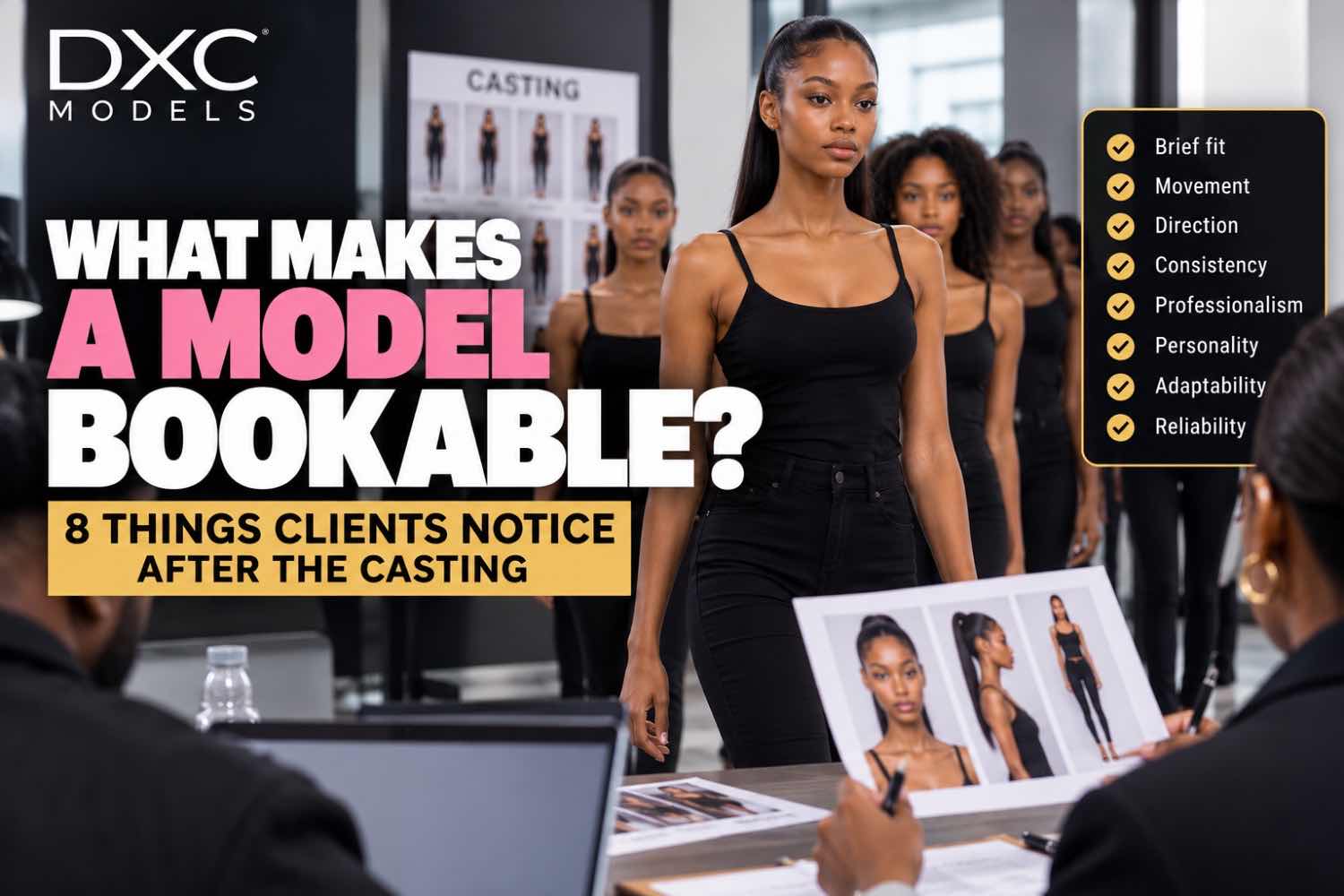
What Makes a Model Bookable? 8 Things Clients Notice After the Casting
You can be beautiful, tall, photogenic and still leave a casting without the job.
That can be difficult for new models to understand because from the outside, modelling looks heavily dependent on appearance.
Appearance matters. Nobody serious is pretending otherwise.
But once several suitable models are standing in the same casting room, the decision becomes more complicated.
The client is no longer asking only, “Who looks good?”
They are asking:
Who can actually deliver what we need?
That difference is where bookability starts.
Being Attractive and Being Bookable Are Not the Same Thing
A model can photograph beautifully but struggle with movement.
Another can have an unusual face but understand direction immediately.
One model may look perfect for the brief but arrive late, communicate poorly and become difficult to manage.
Another may not be the most obvious person in the room, but everything about working with them feels easy.
Clients remember that.
Bookability is the combination of fit, performance and professionalism that makes a client comfortable choosing you for the job.
1. Do You Actually Fit the Brief?
This comes before almost everything else.
A casting is not simply a competition to find the most attractive person in the room.
There is usually a specific requirement behind it.
The client may be looking for a particular age range, body profile, energy, height, look, personality, movement style or audience.
A skincare campaign may need something completely different from an Agbada campaign.
A commercial banking advert may need something different from a high-fashion editorial.
A runway designer may be casting for a very specific silhouette.
This is why a rejection does not always mean you performed badly.
Sometimes you were simply not the person the brief needed.
Professional models learn not to turn every casting decision into a judgement on their entire modelling potential.
2. How Well Do You Take Direction?
This is one of the fastest ways to separate somebody who simply looks like a model from somebody who can work like one.
A photographer may say:
“Relax the shoulder.”
“Give me less smile.”
“Turn your chin slightly.”
“Make it stronger.”
“Now give me something softer.”
The question is not whether you understand English.
The question is whether the adjustment can actually be seen in what you do next.
A client does not want to repeat the same instruction seventeen times while everybody waits.
Models who listen, process direction and adjust quickly make production easier.
That makes them valuable.
3. What Happens When You Start Moving?
Still photographs can hide a lot.
Movement reveals more.
That is why castings may involve walking, turning, introducing yourself, posing, acting naturally or performing a simple action.
How do you enter a space?
What happens to your posture when you walk?
Can you move without looking painfully aware of every part of your body?
Can you transition between poses naturally?
Can you maintain expression while moving?
For runway models, obviously the walk becomes particularly important.
For commercial models, natural body language can matter even more.
The client is imagining the final campaign while watching you.
4. Are You Consistent?
One excellent photograph is not a modelling career.
Neither is one brilliant runway walk.
Clients want to know whether the person they cast can reproduce the quality they saw during selection.
If your digitals look completely different from you in person, that creates a problem.
If your casting video looks strong but your physical audition is completely different, that creates another problem.
If your first two poses are excellent and everything after that collapses, the client notices.
Consistency creates confidence.
That is one reason DXC constantly tells developing models not to rely heavily on filters and excessive editing.
You want the person who arrives on set to resemble the person the client selected.
5. Can You Be Professional Without Being Robotic?
Professionalism does not mean walking into every casting with a serious face and behaving as if smiling will destroy your career.
It means understanding how to conduct yourself around work.
Arrive when you are expected.
Read the brief.
Bring what was requested.
Keep communication clear.
Be respectful to the people working around you.
Know when to ask a question.
Know when to listen.
Production teams remember people who make the process unnecessarily difficult.
They also remember models who make the day easier.
6. Does Your Personality Help the Job?
Personality is not about being the loudest person in the casting room.
Some of the strongest model presence is actually quiet.
What matters is whether there is something memorable about how you carry yourself.
Confidence.
Warmth.
Composure.
Energy.
Character.
For commercial campaigns especially, clients are often looking for people audiences can connect with.
A technically perfect model who feels completely disconnected may lose a job to somebody whose presence feels believable.
You do not need to manufacture a personality.
You need enough confidence for your actual personality to show.
7. Can You Adapt?
Models rarely get to work only in the exact conditions they imagined.
The outfit may change.
The photographer may change the concept.
The client may suddenly want a different energy.
The runway choreography may be adjusted.
A fitting may reveal that something has to be altered.
A shoot that was supposed to take three hours may become six.
You still have to work.
That does not mean accepting unsafe conditions or disrespect.
It means being able to respond professionally to the normal changes that happen during creative production.
Rigid models are harder to use.
8. Can the Client Trust You After They Book You?
This is where many models underestimate the business.
Getting selected is not the end of the assessment.
Once you are booked, people are still learning what working with you is like.
Do you confirm your availability and then disappear?
Do you arrive on time?
Do you suddenly change your hair the night before a campaign without telling anybody?
Do you follow wardrobe and grooming instructions?
Do you remain professional when the shoot becomes tiring?
Do you respect confidentiality where required?
Do you communicate if there is genuinely a problem?
The model who does these things well becomes easier to recommend again.
And repeat work matters.
The Model Who Gets Booked Is Not Always the Model Everyone Expected
We see this confusion often.
Someone attends a casting, sees another model and thinks:
“There is no way they will choose that person over me.”
Then that person gets the job.
What the disappointed model may not have seen is everything else the client was assessing.
Maybe that person understood the brief better.
Maybe their movement was stronger.
Maybe the garment sat better on them.
Maybe they took direction immediately.
Maybe their energy matched the campaign.
Maybe they simply fit the client’s customer better.
Modelling becomes easier to understand once you stop treating every casting like a beauty contest.
What Can Make a Good Model Difficult to Book?
Sometimes the issue is not appearance at all.
- Constant lateness
- Poor communication
- Not reading casting instructions
- Showing up looking significantly different from current digitals
- Weak movement despite strong photographs
- Difficulty taking direction
- Unprofessional behaviour around clients or crew
- Repeatedly cancelling after confirming availability
- Not understanding basic casting etiquette
- Assuming every rejection is personal
These things can quietly damage opportunities.
And unfortunately, nobody may sit you down and explain exactly why the phone stopped ringing.
Can Model Training Make You More Bookable?
Training cannot manufacture the right person for every brief.
Neither can an agency guarantee that training will produce bookings.
What proper development can do is improve the parts of modelling that can actually be learned.
Movement.
Runway technique.
Posing.
Camera awareness.
Casting etiquette.
Taking direction.
Professional conduct.
Understanding how the business works.
That gives a model more tools to work with when the right opportunity eventually appears.
Bookability Is Built Before the Client Sees You
The work starts long before casting day.
Your current photographs matter.
Your measurements matter.
Your walk matters.
Your ability to pose matters.
Your reputation matters.
How you communicate matters.
And your understanding of where you realistically fit in the market matters.
The goal is not to become suitable for every job.
No model is.
The goal is to become prepared enough that when the right brief comes, you are capable of delivering it.
DXC REMINDER
Being invited to a casting does not guarantee a booking.
Being represented by an agency does not guarantee a booking.
Completing model training does not guarantee a booking.
Clients make final selections according to their individual briefs, creative direction and production requirements.
How DXC Develops Models for Real Work
At DXC Models Management, model development is not only about teaching somebody how to walk beautifully in heels.
We work on the wider professional behaviour that models need around castings, shoots, runway jobs and clients.
Because eventually the question is not:
“Do you look like a model?”
It is:
“Can we confidently send you to represent yourself, DXC and the client’s project professionally?”
That is a much higher standard.
Frequently Asked Questions
What does bookable mean in modelling?
A bookable model is someone who fits suitable client briefs and can deliver professionally through their appearance, movement, ability to take direction, reliability and overall performance.
Do you have to be very beautiful to get modelling jobs?
There is no single definition of beauty used across modelling. Different clients need different looks, body types, ages, personalities and visual identities. Suitability for the brief is more important than trying to meet one universal beauty standard.
Why do models get rejected from castings?
Rejection can happen for many reasons. The model may not fit the specific brief, garment, campaign audience, required measurements or creative direction. Performance and professionalism can also affect selection.
Can a new model become bookable?
Yes. Experience helps, but new models can develop strong fundamentals through practice, training, professional feedback and actual casting experience.
Does getting signed guarantee modelling jobs?
No. Representation can give a model access to professional guidance and relevant submissions, but clients still make their own casting decisions.
Want to Start Modelling With DXC?
You do not have to know everything before reaching out.
Send DXC your basic information and clear current photographs on WhatsApp and our team can guide you on the appropriate next step.
Important: Assessment, model development, training or representation does not guarantee modelling bookings. Final selections are made according to individual client briefs and requirements.