
CASTING • FASHION MARKETING • INDUSTRY INTELLIGENCE
Casting Is Becoming Content: Why Fashion Brands Are Turning Model Searches Into Marketing
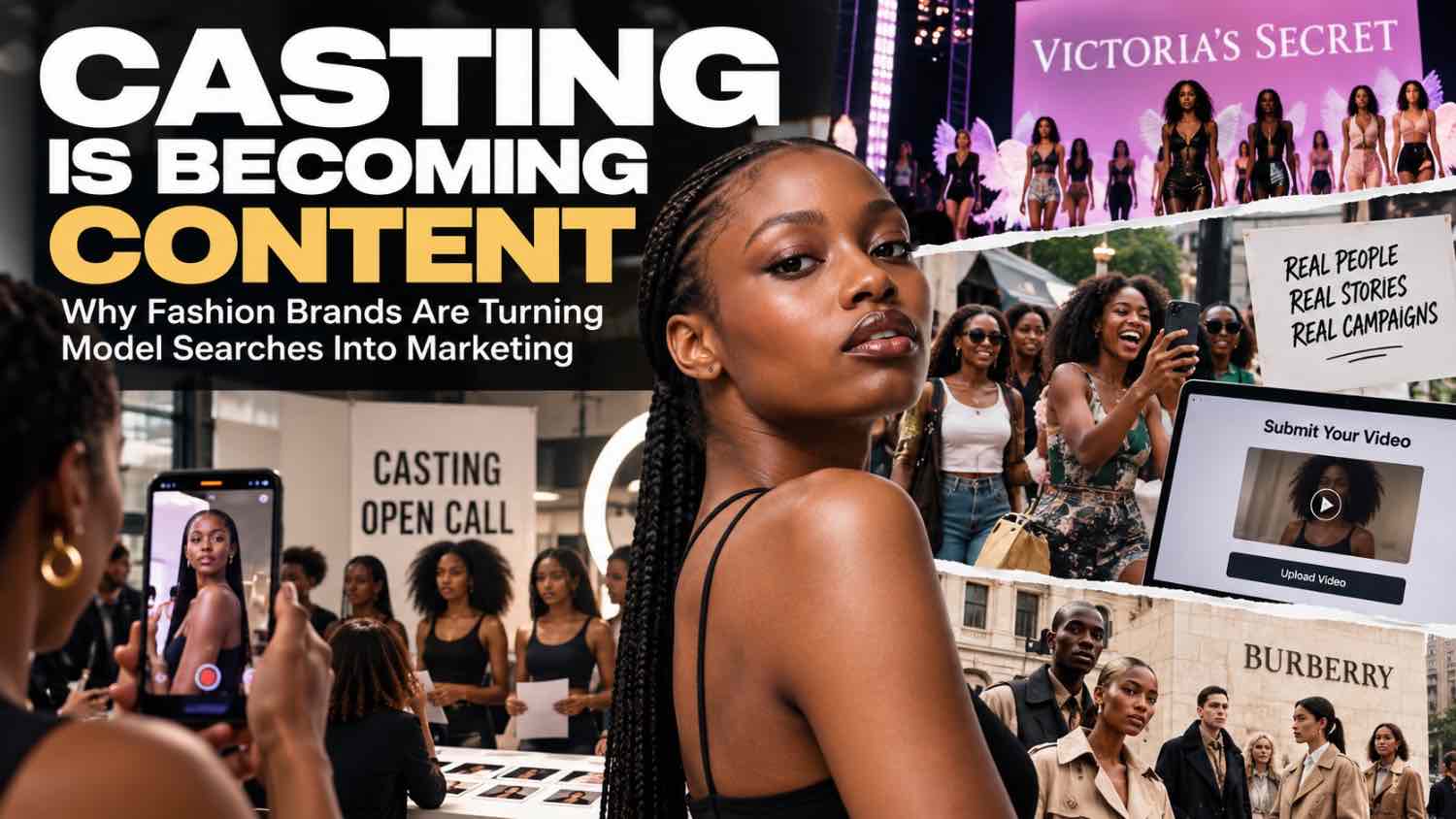
Casting is becoming content. Fashion and beauty brands are increasingly discovering that the search for the people in a campaign can generate attention, participation and storytelling before the finished campaign even exists.
Traditionally, model casting happened mostly away from the audience.
A client created a brief.
An agency or casting director received it.
Models were submitted.
A shortlist was created.
Someone got booked.
Then the public saw the final advertisement.
That system still works and professional casting remains essential.
But something else is happening alongside it.
Victoria’s Secret turned a nationwide model search into a YouTube docuseries. Torrid positioned its casting call as a community experience. A Lagos fashion brand invited women to submit themselves and allowed its community to participate in the selection process. Burberry’s latest anniversary campaign deliberately combines professional models with employees, students, creatives, athletes and street-cast people.
The model search is no longer always something that happens before the marketing. Sometimes, the model search is part of the marketing.
For fashion brands, agencies and casting teams, this creates a new opportunity.
For aspiring models, it also changes where discovery can happen.
Why Casting Is Becoming Content
The simple reason is participation.
A finished campaign asks the audience to watch.
An open model search can ask the audience to:
- Apply
- Nominate someone
- Create a video
- Share a story
- Vote
- Comment
- Follow contestants
- Watch behind-the-scenes content
- Return for the final reveal
That creates a longer relationship with the campaign.
Instead of appearing one morning with polished photographs and asking people to care, the brand can build anticipation before the final shoot even happens.
01 Victoria’s Secret Turned Casting Into Entertainment
One of the clearest current examples is Victoria’s Secret.
The company opened a nationwide search for its next Angel.
According to Victoria’s Secret & Co., more than 100,000 aspiring applicants responded.
But the brand did not stop at collecting applications.
The search became Angels Among Us, a YouTube docuseries following selected women through the process toward the Victoria’s Secret Fashion Show.
By October 2026, the competition had progressed to nine finalists, with the eventual winner scheduled to be revealed as part of the fashion-show journey.
Think about what happened commercially.
Victoria’s Secret did not only find potential talent.
It created:
- A casting call
- Social conversation
- Contestants people could follow
- YouTube episodes
- Behind-the-scenes storytelling
- Audience anticipation
- A runway reveal
The casting process became intellectual property.
That is significantly different from quietly selecting a model and publishing a campaign later.
02 A Lagos Brand Let the Community Enter the Casting Room
The same idea is appearing much closer to home.
For its Heat Check campaign, Lagos womenswear brand Femme Nature opened its search for campaign talent directly to women across Lagos.
According to Pulse Nigeria, applicants were encouraged to create original videos showing themselves and their interpretation of the brand’s world.
Some filmed at home.
Others used Lagos streets.
Some involved friends.
There was no requirement for a traditional modelling portfolio or previous agency experience.
The community then became involved in the process of deciding who progressed.
Again, the brand gained more than three campaign faces.
It gained:
- User-generated content
- Community conversation
- Organic sharing
- Applicant stories
- Audience participation
- Brand discovery
- A narrative leading into the product launch
The casting did not interrupt the marketing campaign. The casting became one of the marketing campaign’s strongest assets.
03 Torrid Built Community Around Its Model Search
Torrid is another useful example because the company explicitly describes its casting strategy as something larger than conventional model recruitment.
In announcing its 2026 Casting Call, Torrid described the programme as a platform for confidence, connection and community.
Applicants were invited to submit photographs and short videos explaining who they were and why they wanted to model for the brand.
The wider experience included:
- Digital applications
- Physical casting events
- In-store casting parties
- Virtual Q&A sessions
- Community participation
- Final campaign opportunities
This works particularly well for a brand whose commercial identity depends on representation and belonging.
Instead of hiring models who merely demonstrate the clothing, the brand invites potential customers and community members into the story of who represents it.
04 Burberry Is Expanding Who Gets to Represent a Fashion House
Not every example involves an open competition.
Burberry’s September 2026 campaign, 170: The Anniversary Portraits, demonstrates another side of the same shift.
According to Burberry, the campaign features 170 people across London, New York, Seoul and Shanghai.
The cast includes professional models.
But it also includes:
- Students
- Artists
- Musicians
- Athletes
- Teachers
- Retail workers
- A dentist
- Burberry employees
- Street-cast locals
The point is not that professional models are disappearing.
They are not.
The point is that fashion brands increasingly understand that the story of who is wearing the product can be as important as the styling itself.
What Has Changed in the Casting Funnel?
The traditional model looks something like this:
Campaign Brief → Agency/Casting Director → Model Submissions → Shortlist → Selection → Campaign
The emerging content-led version can look more like:
Open Call → Public Submissions → Social Conversation → Shortlist → Behind-the-Scenes Content → Selection → Reveal → Campaign
Professional casting can still sit inside that system.
In fact, it usually should.
The difference is that the audience can now see part of the journey.
When Casting Is Becoming Content, Brands Gain More Than Models
A well-designed public casting process can produce several forms of value simultaneously.
1. Audience Participation
People become more emotionally invested when they can participate.
Someone who submitted an application may follow the campaign long after being eliminated.
Their friends may follow too.
People who vote or comment have now interacted with the brand before the final advertisement launches.
2. User-Generated Content
If applicants are asked to create videos, photographs or stories, the brand can generate significant organic conversation around the campaign.
This has to be handled carefully from a rights and consent perspective.
But when structured properly, the application itself becomes a content engine.
3. Talent Discovery
Open calls can reveal people who may never have entered the brand’s traditional agency pipeline.
That can include:
- New faces
- Creators
- Customers
- People from underrepresented communities
- People outside established fashion networks
- Potential future brand ambassadors
4. Consumer Research
Casting submissions can also show brands how their audience sees itself.
What styles do applicants choose?
What language do they use?
Which cities respond?
What kinds of people feel represented by the brand?
What stories repeatedly appear?
A model search can unintentionally become a form of qualitative audience research.
5. Earned Media
Traditional casting rarely becomes news.
A distinctive open call can.
Victoria’s Secret’s search became entertainment coverage.
Femme Nature’s campaign casting became editorial coverage.
Torrid’s casting programme became part of its corporate communications.
The casting mechanism itself creates a story journalists and creators can discuss.
Casting Is Becoming Content, But Professional Casting Still Matters
This is where brands can misunderstand the trend.
A public vote does not automatically identify the best model.
The person with the most likes may not be able to:
- Take direction
- Move naturally on camera
- Fit the garments
- Work a demanding production day
- Deliver dialogue
- Perform consistently across multiple takes
- Meet the required measurements
- Work professionally with a crew
Popularity is data.
It is not the same thing as professional suitability.
The smartest brands are not replacing professional casting with social media. They are making the casting process itself part of the audience experience.
The Danger of Turning Casting Into a Popularity Contest
Community involvement can be powerful.
But there is a difference between asking the audience to participate and allowing engagement metrics to make every professional decision.
A brand may love an applicant’s personality online but still discover that another person performs better during the actual production assessment.
The process should be designed so that public participation supports professional judgment rather than replacing it.
Open Casting Does Not Mean No Standards
Another misconception is that an open casting means:
“Anybody can get the job.”
An open casting usually means anybody who meets the stated eligibility requirements can apply.
Selection still happens.
The client may still evaluate:
- Appearance
- Age range
- Height or measurements where relevant
- Movement
- Personality
- Performance
- Availability
- Location
- Brand alignment
- Professionalism
Accessibility and selectivity can exist at the same time.
Brands Need Clear Casting Terms
Once public participation enters the process, the legal and operational details become even more important.
A public casting brief should clearly explain things such as:
- Who can apply
- Required age
- Location requirements
- What applicants must submit
- Submission deadline
- How shortlisted people will be contacted
- Whether public voting is involved
- What the selected talent receives
- How applicant content may be used
- Whether social posts may be reposted
- Any applicable campaign usage
DXC has a separate guide for brands that need help structuring the underlying information:
Model Casting Brief Template for Brands & Agencies.
Applicant Content Rights Need to Be Clear
This is one area where content-led casting can go wrong very quickly.
Imagine 2,000 people send videos to a brand.
Does that automatically mean the brand can:
- Use every video in paid advertising?
- Edit applicants into promotional montages?
- Keep using their faces after the casting ends?
- License the material to partners?
- Create AI-generated content from the submissions?
Those questions should not be left vague.
Application terms should clearly explain what participants are granting.
For campaigns involving professional talent, brands should also understand the broader distinction between production fees and commercial usage.
Read:
Model Usage Rights in Nigeria.
Do Not Create Fake Casting Calls Just for Engagement
This should be obvious.
But attention can tempt brands into bad behaviour.
A company should not publish:
“MODELS WANTED. Apply now.”
collect thousands of photographs and videos, generate social engagement and then reveal that there was never a genuine opportunity.
That damages trust.
It can also create unnecessary privacy, consent and reputational issues.
If the campaign is a casting call, there should be a real casting process behind it.
What This Trend Means for Modeling Agencies
Some people may assume that public casting makes agencies less relevant.
We think the opposite can happen.
The larger the applicant pool, the more important professional filtering becomes.
Imagine a brand receives:
5,000 submissions.
Who checks eligibility?
Who verifies measurements?
Who identifies duplicates?
Who screens unsuitable submissions?
Who communicates with shortlisted talent?
Who assesses movement?
Who organises physical castings?
Who negotiates rates?
Who manages usage?
Who confirms bookings?
That is where structured casting expertise becomes even more valuable.
For DXC, Casting Can Become a Brand Service
This trend creates a wider opportunity for modelling agencies and casting companies in Nigeria.
Instead of simply receiving a brief that says:
“Send us five female models.”
an agency can help a brand create the entire talent-discovery mechanism.
For example:
- The brand defines the campaign objective.
- DXC develops the casting brief.
- An open call is launched.
- Applications are collected.
- DXC screens eligibility.
- Potential talent is shortlisted.
- Selected applicants attend assessment or physical casting.
- The brand reviews professional recommendations.
- Final talent is booked.
- The campaign proceeds with clear usage and production terms.
The public sees an exciting discovery journey.
Behind the scenes, the process remains organised.
What This Means for Aspiring Models
For aspiring models, the change is exciting because the number of entry points is expanding.
You may encounter opportunities through:
- Model agencies
- Open calls
- Social media
- Community castings
- Creator campaigns
- Street casting
- Customer casting
- Brand activations
That does not mean everybody who applies will become a professional model.
But it does mean the route into a campaign is not always as closed as people assume.
Do You Have to Look Like a Traditional Runway Model?
Increasingly, the answer depends on the job.
Runway fashion can still have very specific requirements.
But commercial advertising, lifestyle campaigns, beauty, social campaigns and community-led castings can require a much wider range of people.
Burberry’s current campaign demonstrates that a fashion house may intentionally cast:
professional models alongside teachers, creatives, athletes, students and other people whose identity contributes to the campaign story.
That does not make professional modelling irrelevant.
It expands the definition of who may be useful to a particular campaign.
If Everybody Wants to Model, Brands Now Have a Huge Talent Pool
This is one reason the trend has so much potential in Nigeria.
There is enormous interest in modelling.
Young people search for:
model castings,
agencies,
modelling jobs,
fashion opportunities,
open calls,
and ways to get discovered.
Parents also increasingly search for opportunities for their children.
Brands can either ignore that demand or design responsible ways of engaging with it.
A well-structured open casting can potentially turn that existing aspiration into useful brand participation.
But Aspiring Models Still Need to Be Ready
More opportunities do not remove the need for preparation.
If an open casting appears tomorrow, can you provide:
- Your correct measurements?
- Clean current photographs?
- A usable portfolio if requested?
- A short introduction video?
- Your location?
- Your availability?
- Your social profiles?
If shortlisted, can you:
- Take direction?
- Move?
- Pose?
- Arrive on time?
- Communicate professionally?
Opportunity does not eliminate preparation.
It makes preparation more valuable.
How Brands Can Turn a Casting Into Content Without Losing Professionalism
A strong process can look like this:
Stage 1: Clear Public Brief
Explain exactly who you want and what applicants must submit.
Stage 2: Easy Application
Do not make applicants complete an unnecessarily complicated process merely to generate engagement.
Stage 3: Moderated Public Storytelling
Feature interesting applicants, stories or behind-the-scenes moments without exposing unnecessary personal information.
Stage 4: Professional Screening
Use experienced casting professionals to evaluate actual job suitability.
Stage 5: Shortlist
Create a manageable group of applicants who genuinely fit the brief.
Stage 6: Audience Participation, If Appropriate
Let the community participate without pretending popularity is the only selection criterion.
Stage 7: Final Casting Decision
The production requirements still matter.
Stage 8: Reveal
The final selection becomes another strong content moment.
Stage 9: Campaign
Now the audience already understands the people behind the finished work.
What Should Brands Measure?
If the casting is part of a marketing strategy, do not measure only the number of applicants.
Useful metrics may include:
- Qualified applications
- Video submissions
- Organic mentions
- Shares
- Comments
- Profile visits
- Community growth
- Email sign-ups
- Website traffic
- Earned media
- Campaign engagement after selection
The objective is not simply:
“How many people wanted to model for us?”
The better question is:
“Did the casting strengthen the campaign and help us find the right people?”
DXC VIEW
Casting is changing because audiences increasingly want to see people, not only finished advertising.
They want stories.
They want personalities.
They want participation.
They want to understand how somebody became the face they eventually see on the billboard.
For brands, that creates an opportunity.
But casting should not become fake engagement bait.
Professional judgment still matters.
Clear rights still matter.
Good briefs still matter.
The smartest approach combines both worlds:
open discovery in public, professional decision-making behind the scenes.
Frequently Asked Questions About Casting as Marketing
What does “casting is becoming content” mean?
It means brands are increasingly making the search, application, selection and behind-the-scenes casting process visible to audiences instead of keeping the entire process private until the final campaign launches.
Why are brands using open casting calls?
Open casting can help brands discover new faces, involve their communities, generate user-created content and build attention around a campaign before the finished advertising appears.
Does public voting replace professional casting?
It should not. Audience participation can influence a campaign, but professional casting still evaluates whether talent meets the practical and creative requirements of the job.
Do open castings help new models?
Yes. Open calls can give aspiring models and people outside traditional agency networks another route to be seen. Selection is still competitive and depends on the individual brief.
Can ordinary people appear in major fashion campaigns?
Yes, depending on the campaign. Some brands intentionally combine professional models with customers, creators, employees, athletes, artists and street-cast people when those identities support the campaign concept.
Should a brand use applicant videos in advertising?
Only within the scope of the permissions and terms applicants have agreed to. Brands should clearly explain how submitted content may be used before participants apply.
Can DXC manage an open casting for a brand?
DXC Models can support brands and production teams with casting briefs, talent discovery, applicant screening, shortlisting, physical casting coordination and professional model-booking processes.
Planning a Casting or Community-Led Model Search?
DXC Models works with fashion, beauty, lifestyle, advertising and production teams that need talent discovery and professional casting support.
Whether you need five specific models or want to build a wider open-casting campaign, DXC can help structure the brief, screen applicants, shortlist suitable talent and coordinate the casting process.
Industry note: Brand examples in this article are discussed as current examples of evolving casting and marketing strategies. DXC Models is not affiliated with Victoria’s Secret, Torrid, Burberry or Femme Nature unless explicitly stated otherwise.