YOUNG MODELS • PARENTS • MODEL SAFETY
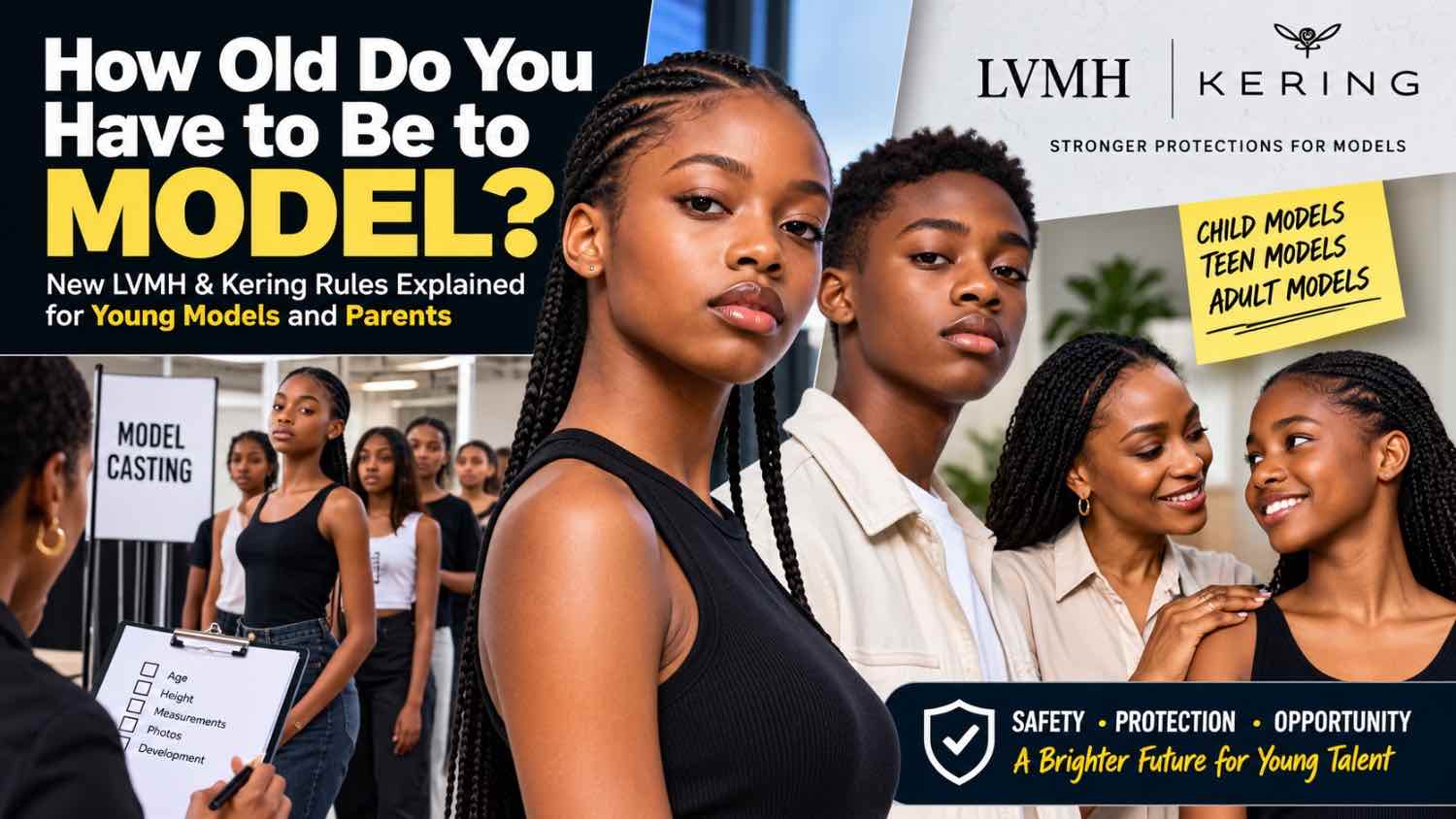
How Old Do You Have to Be to Model? New LVMH & Kering Rules Explained for Young Models and Parents
If you are asking how old do you have to be to model, the answer is not simply “18.” Children and teenagers can still work in modelling, but age can determine the type of work they can do, the protections they need and which brands can hire them.
That distinction has become especially important after two of the world’s largest luxury groups, LVMH and Kering, announced stronger protections for models.
Their updated joint charter sets 18 as the minimum age for models representing adults in fashion shows or photo shoots for the Houses covered by the charter.
The strengthened rules are expected to take effect beginning with the next Paris Fashion Week in 2027.
But this does not mean:
“Nobody under 18 can model anymore.”
And it certainly does not mean children’s modelling has disappeared.
The important question is not only how old you have to be to model. It is what kind of modelling is appropriate for your age, and what protections should exist around you.
How Old Do You Have to Be to Model?
There is no single age that applies to every modelling job, every country, every agency and every brand.
Children can work as child models.
Teenagers can participate in age-appropriate modelling opportunities.
Adults can work across a wider range of professional modelling categories.
What changes with age is usually the type of work, working conditions, supervision, legal requirements and client policies.
That is why a 10-year-old modelling children’s clothing and a 16-year-old being styled to portray an adult in a luxury fashion campaign should not be treated as the same situation.
01 The New LVMH & Kering Rule Is About Models Representing Adults
On 8 October 2026, Kering and LVMH announced a strengthened version of their joint charter for the respect and protection of models.
One of its most important changes is the decision to set the minimum age at 18 for models representing adults during fashion shows or photo shoots.
You can read the official announcements from
Kering
and
LVMH.
The wording matters.
It does not simply say:
“Nobody below 18 can ever model.”
It specifically addresses under-18 talent being used to represent adults.
02 Can You Be a Model at 16 or 17?
Yes, depending on the type of modelling, the client, the agency, the location and the applicable rules.
Being 16 or 17 does not automatically mean you cannot begin developing as a model.
A teenager may potentially participate in age-appropriate:
- Commercial modelling
- Teen fashion campaigns
- Editorial work
- Catalogues
- E-commerce
- Beauty work where suitable
- Age-appropriate runway
- Training and model development
But some clients may choose to work only with adults even when the law would otherwise permit younger talent.
That is exactly what the strengthened LVMH and Kering charter demonstrates.
A brand can establish a higher internal minimum age than the basic threshold that may apply elsewhere.
03 Can Children Become Models?
Yes.
Children’s modelling is a distinct part of the industry.
Brands regularly need children for:
- Children’s clothing
- Family advertising
- School-related campaigns
- Toys
- Food and household advertising
- Healthcare and lifestyle campaigns
- E-commerce
- Television commercials
- Print and digital advertising
A seven-year-old appearing as a seven-year-old in a children’s campaign is fundamentally different from placing a teenager into work designed to portray an adult.
Parents interested in this area can read our guide to
Kids Modeling in Lagos.
04 Under 18 Should Never Mean “Handle Everything Yourself”
For DXC, this is one of the most important principles.
If you are a minor, a parent or responsible guardian should know about your modelling activities.
That includes:
- Agency applications
- Castings
- Training
- Photoshoots
- Contracts
- Travel
- Payment arrangements
- Usage agreements
- Communication with clients
A legitimate opportunity should not depend on convincing a child to hide information from their parent or guardian.
If an adult in the industry is telling a young model to keep professional communication secret from their parent or guardian, that should immediately raise concern.
05 The New Charter Goes Beyond Age
The LVMH and Kering announcement is important because the age rule is only one part of the update.
The strengthened charter also establishes zero tolerance for harassment, abuse and violence, including gender-based and sexual violence.
The groups also announced stronger measures including:
- Training and awareness for brands, agencies and teams involved in casting and production
- Greater monitoring throughout collaborations with models
- Stricter protections around nudity and partial nudity
- Prior formal agreement for those situations
- Dedicated changing spaces
- Protection against being left alone with a production-team member while undressed
- Anonymous reporting procedures
- Protection for witnesses
- Unannounced workplace checks and audits
The significance is bigger than an age number.
It reinforces the principle that models should be treated as professionals whose safety, dignity and working conditions matter.
06 A Young Model Does Not Need to Look Older to Be Taken Seriously
This is especially important for teenagers who want to enter fashion.
You do not need to manufacture adulthood.
You do not need excessive makeup to appear “professional.”
You do not need highly sexualised photographs to prove that you can model.
You do not need to pretend to be older than you are.
A good agency should be able to assess:
- Your face
- Your proportions
- Your movement
- Your confidence
- Your expression
- Your development potential
- Your suitability for age-appropriate work
Your age is not something that needs to be disguised.
07 Starting Young Should Mean Developing, Not Rushing
Young aspiring models sometimes feel that if they have not achieved something internationally by 16 or 17, they are already late.
That is not a healthy way to understand a career.
There is valuable work a young model can do before adulthood:
- Learn runway fundamentals
- Improve posture
- Develop movement
- Understand posing
- Learn how castings work
- Take clean current photographs
- Learn professional communication
- Understand basic measurements
- Develop confidence
- Learn how to recognise suspicious opportunities
Model development does not require rushing somebody into adult situations.
In many cases, being properly developed before the pressure increases can be an advantage.
What Did the Original LVMH & Kering Charter Say?
The two luxury groups first introduced their joint charter in 2017.
At that time, the charter established a minimum age of 16 for models representing adults and introduced additional protections for models aged 16 to 18.
Those protections included restrictions on overnight work and requirements involving guardians or chaperones.
Kering later went further in 2019 by committing its Houses to using models aged 18 and over to represent adults.
The October 2026 update now aligns the strengthened joint charter around the 18-year threshold for this type of work.
Does This Mean You Must Be 18 to Join a Modeling Agency?
No.
Agencies can represent younger talent where appropriate.
Some agencies have:
- Kids divisions
- Teen divisions
- Development boards
- New-face programmes
The important question is not simply whether an agency accepts minors.
Parents should understand exactly:
- What the programme involves
- What type of work the child may be submitted for
- How communication is handled
- Who supervises the child
- What fees, if any, are for specific services
- How bookings are managed
- How images may be used
Representation should also never be presented as a guarantee that a child will receive paid modelling jobs.
What Age Is Best to Start Modeling?
There is no universal “best” age.
It depends on the person and the category.
A child may begin children’s modelling at a young age with proper parental involvement.
A teenager may begin developing skills and taking age-appropriate opportunities.
Someone else may start at 18, 21, 25 or later and still find suitable commercial, fashion, beauty or lifestyle opportunities.
Different modelling markets value different things.
Starting younger does not automatically mean having a better career.
Can You Start Modeling at 18?
Absolutely.
Eighteen is actually a practical age for many aspiring models because a person can begin navigating adult professional opportunities without the additional restrictions associated with being a minor.
That does not mean success becomes automatic.
You still need suitability, development, professionalism and the right market.
Can You Start Modeling in Your 20s?
Yes.
The idea that every model must begin at 14 or 15 comes largely from a narrow view of high-fashion history.
Commercial modelling encompasses much broader age groups.
Campaigns need:
- Young adults
- Parents
- Professionals
- Families
- Mature adults
- Different body types
- Different lifestyles
The useful question is not:
“Am I too old to model?”
It is:
“What modelling market could realistically need someone like me?”
What Parents Should Ask Before a Child Attends a Casting
Parents should be comfortable asking questions.
Before allowing a child or teenager to attend an opportunity, establish:
- Who is organising the casting?
- Which brand or production is involved?
- Where will it take place?
- What time does it begin and end?
- What will the child be expected to wear?
- Will photographs or video be taken?
- How will those materials be used?
- Who will supervise the child?
- Is payment involved?
- What happens if the child is selected?
A parent asking sensible questions should not be treated as difficult.
When minors are involved, responsible adults should expect scrutiny.
Should a Young Model Attend a Photoshoot Alone?
For minors, parental or guardian involvement is extremely important.
Exactly what supervision is legally required can depend on the location and nature of the work, but from a safety perspective, parents should not normalise sending a child into unknown professional environments without understanding who is responsible for them.
The younger the talent, the more structured the protection should be.
What About Revealing Clothing or Nudity?
This is an area where boundaries need to be exceptionally clear.
The updated LVMH and Kering charter specifically strengthens controls around nudity and partial nudity for professional models, including prior formal agreement, dedicated spaces and safeguards during production.
For minors, DXC’s position is straightforward:
Age-appropriate modelling should remain age appropriate.
A young aspiring model should never feel pressured to accept inappropriate imagery because someone claims it is necessary to prove they are “serious about fashion.”
Parents Should Understand Image Usage Too
A photoshoot does not end when the photographer stops taking pictures.
Parents should understand where a child’s image may appear.
That might include:
- Social media
- Websites
- Online advertising
- Billboards
- E-commerce
- Video campaigns
Usage should be discussed clearly rather than assumed.
For a broader explanation of commercial image usage, read our guide:
Model Usage Rights in Nigeria.
Young Models Should Be Careful With Social Media “Scouts”
Social media has made legitimate discovery easier.
It has also made it easier for strangers to claim they are:
- Scouts
- Agents
- Photographers
- Casting directors
- Brand representatives
If you are under 18, do not allow somebody to move professional communication into secrecy.
Do not send intimate photographs.
Do not hide meetings from your parents.
Do not travel to an unfamiliar location simply because somebody claims they can make you famous.
A genuine modelling opportunity should be capable of surviving basic verification.
What Should a 15, 16 or 17-Year-Old Aspiring Model Work On?
If you are serious about modelling but still under 18, you have plenty to work on.
Start with:
Clean Current Polaroids
Learn how to show what you genuinely look like without hiding behind filters.
Read:
How to Take Modeling Polaroids at Home.
Movement
Practise posture, walking, turning and body awareness.
Measurements
Know your correct current measurements instead of guessing.
Professional Communication
Learn how to respond clearly and respectfully when applying for opportunities.
Industry Understanding
Know the difference between a legitimate agency, a model academy, a casting company and somebody simply messaging you online.
Our guide to
Choosing the Right Modeling Agency in Lagos
can help.
You Do Not Have to Rush Adulthood to Become a Model
This may be the most important message for younger aspiring talent.
Fashion is changing.
Major industry groups are putting greater emphasis on age, dignity, harassment prevention and safer working conditions.
A teenager should not interpret that as:
“Fashion no longer wants me.”
A better interpretation is:
“There is time to develop properly.”
Being young should not create pressure to enter situations meant for adults.
DXC VIEW
There is nothing impressive about rushing a young person into adulthood because they want to model.
A 16-year-old can have potential without pretending to be 21.
A child can develop confidence without being exposed to inappropriate work.
A teenager can learn runway, movement, posing and professional discipline while still being protected as a teenager.
The industry’s responsibility is not simply to discover young talent.
It is to develop talent responsibly.
And parents should never feel that protecting their child somehow makes them an obstacle to a modelling career.
So, How Old Do You Have to Be to Model in Nigeria?
There is no single universal age that applies to every modelling opportunity in Nigeria.
Children and teenagers participate in age-appropriate campaigns, while individual brands, agencies and productions may impose their own age requirements.
For minors, parents and organisations should also ensure that any engagement complies with applicable Nigerian child-protection, employment and production requirements.
The LVMH and Kering announcement should therefore not be mistaken for a new Nigerian law.
What it does show is a broader international direction:
major fashion businesses are increasingly treating model welfare and protection as professional standards rather than optional extras.
Frequently Asked Questions
How old do you have to be to model?
There is no single age for every type of modelling. Children can work in age-appropriate child modelling, teenagers may have suitable modelling opportunities with proper protections, and adults can work across broader professional categories.
Do you now have to be 18 to become a model?
No. The new LVMH and Kering rule sets 18 as the minimum age for models representing adults in fashion shows or photo shoots for their covered Houses. It is not a worldwide ban on modelling under 18.
Can a 16-year-old become a model?
Yes. A 16-year-old can potentially develop and work in appropriate modelling categories depending on the client, agency, jurisdiction and working conditions. Parent or guardian involvement is particularly important for minors.
Can a 17-year-old be a fashion model?
Potentially, yes, although individual brands may refuse to use models under 18 for particular work. LVMH and Kering Houses will apply an 18-year minimum when models are being used to represent adults under their strengthened charter.
Can a 13-year-old model?
Children and younger teenagers can participate in age-appropriate modelling where permitted and properly supervised. They should not be treated as adult models, and parental involvement is essential.
Can my child become a model in Lagos?
Yes, there are children’s modelling opportunities in Lagos. Parents should work with credible organisations, understand what any programme or representation involves, verify castings and remain actively involved in the child’s professional activities.
Do young models need professional photos?
Not always. Agencies often initially need simple, clear and current photographs rather than expensive portfolios. Requirements differ by agency and opportunity.
Should I pay an agency to guarantee my child modelling jobs?
Be cautious of anyone promising guaranteed bookings in exchange for payment. Legitimate training, development, photography or other clearly defined services may have fees, but paying for a service is not the same as buying a guaranteed modelling job.
Can models under 18 travel internationally for work?
This depends on the destination, production, immigration requirements, agency arrangements and rules governing minors. Parents or guardians should be closely involved in any international opportunity involving a minor.
When do the new LVMH and Kering rules start?
The groups state that the strengthened rules will take effect beginning with the next Paris Fashion Week in 2027.
Want to Start Modeling?
Your next step depends partly on your age.
UNDER 18?
A parent or guardian should be involved from the beginning. Explore DXC’s kids and young-talent pathway and understand the right development route before applying for professional opportunities.
18 OR OLDER?
If you want to explore professional modelling, DXC can assess your potential, explain suitable modelling categories and help you understand your next development steps.
Important: This article provides general industry information and should not be treated as legal advice. Rules governing minors, employment, contracts, travel and commercial productions vary by jurisdiction and type of work. Parents, agencies and brands should verify the requirements that apply to each specific job.