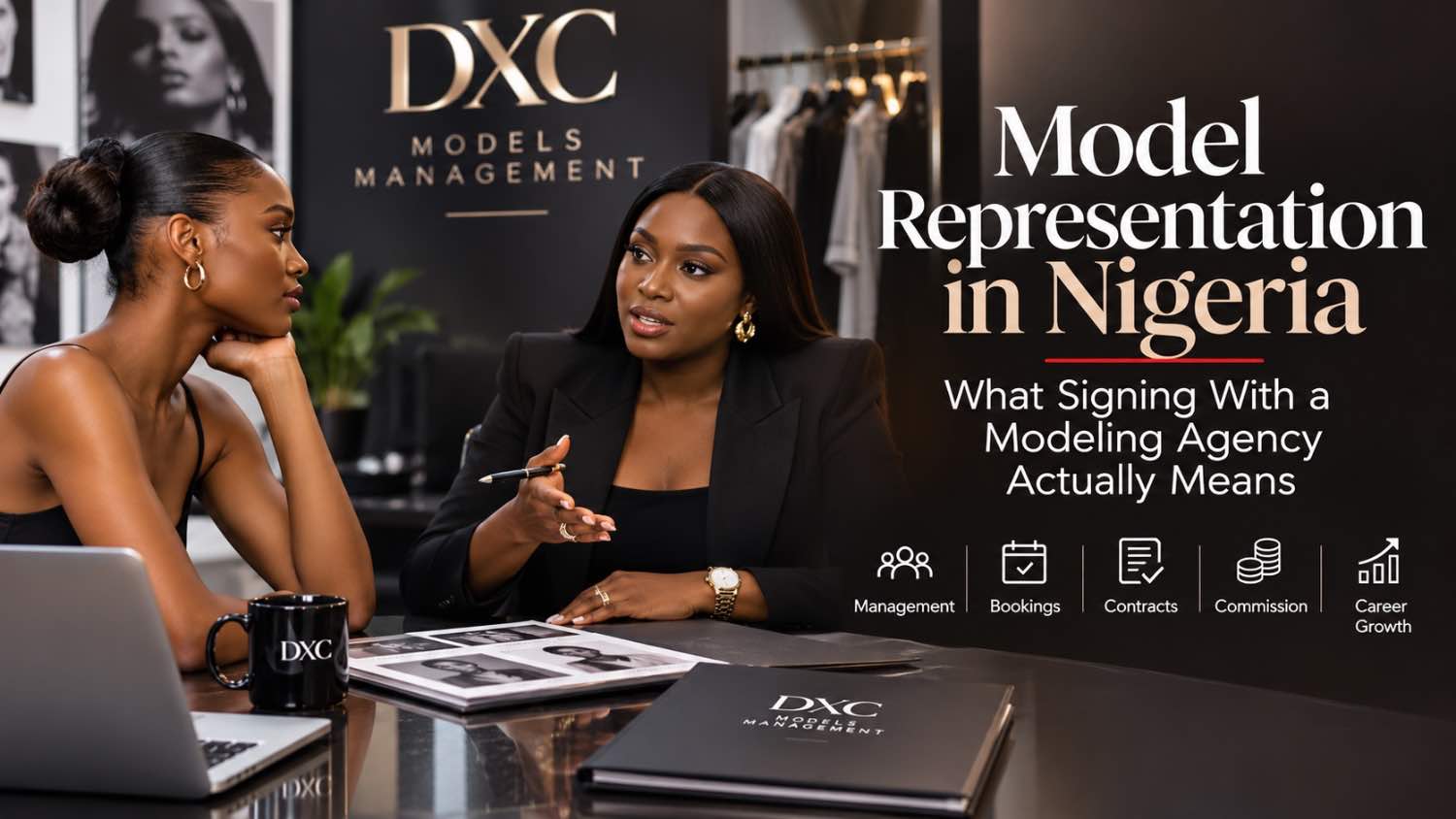
MODEL MANAGEMENT • REPRESENTATION • BOOKINGS
Model Representation in Nigeria: What Signing With a Modeling Agency Actually Means
“I’m signed to an agency.”
It sounds simple, but aspiring models sometimes use the word signed without really understanding what has changed.
Being represented by a modeling agency is not the same thing as attending model training, joining a WhatsApp community, registering for a casting or having your photographs uploaded somewhere online.
Professional model representation in Nigeria is a business relationship between a model and an agency that agrees to manage, position or present that model for suitable opportunities under agreed terms.
And just as importantly, being represented does not mean somebody has guaranteed you jobs.
What Does a Modeling Agency Actually Do?
A modeling agency sits between talent and the market.
On one side are models looking for professional opportunities. On the other side are fashion brands, advertising agencies, designers, photographers, production companies, casting teams and other clients looking for suitable talent.
The agency’s job is not simply to collect photographs of attractive people.
Depending on the type of agency and the agreement with the model, management may involve:
- Assessing the model’s market potential
- Deciding how the model should be positioned
- Maintaining suitable photographs, digitals and portfolio material
- Submitting the model for relevant castings or briefs
- Communicating with clients
- Negotiating booking terms
- Confirming availability
- Coordinating fittings, call times and production details
- Discussing fees and usage where applicable
- Managing professional expectations
- Guiding career development
- Helping the model avoid opportunities that do not make sense for their positioning
Some agencies specialise heavily in high fashion. Others work predominantly in commercial modelling. Some manage children, creators, curve talent, mature models, fitness talent or other specialist categories.
That is why being rejected by one agency does not automatically mean you cannot model. Your look may simply fit another part of the market better.
Representation Is Not the Same as Training
This distinction causes a lot of confusion in Nigeria.
A model academy or training programme teaches skills.
That may include runway walking, posing, camera confidence, casting preparation, grooming, professional etiquette and understanding how the industry works.
A modeling agency, on the other hand, manages and presents suitable talent to the market.
Those two services can exist within the same organisation, but they are not automatically the same thing.
You can attend training without becoming represented.
You can also be assessed for representation without first attending a particular academy, depending on the agency and the model.
Training develops skill. Representation manages a professional relationship between the model and the market.
What Does “Signed” Actually Mean?
In the clearest sense, being signed means you and an agency have agreed to a professional representation arrangement.
That arrangement may be documented through a contract or another formal agreement setting out how the relationship works.
It should answer practical questions rather than simply giving you the excitement of saying you have an agency.
For example:
- What exactly is the agency representing you for?
- Is the agreement exclusive or non-exclusive?
- How long does it last?
- Which territory does it cover?
- What commission applies to bookings?
- How and when are models paid?
- Who can negotiate jobs on your behalf?
- Can you work directly with clients?
- What happens if either party wants to end the relationship?
Do not be afraid to understand your contract.
A professional agreement should clarify the relationship, not make the model too scared to ask questions.
Exclusive vs Non-Exclusive Representation
Not every agency relationship is structured in the same way.
An exclusive agreement may give one agency the right to represent the model within a specified market, territory or category.
A non-exclusive arrangement may allow the model to work with more than one agency or seek some work independently, depending on the actual terms.
Neither word should be judged in isolation.
Read what the agreement actually says.
An exclusivity clause covering commercial bookings in Nigeria is different from an agreement claiming worldwide control over every type of work you may ever do.
How Does an Agency Make Money?
One common model is commission.
When an agency secures or manages a paid booking, it may receive an agreed percentage or agency fee connected to that work.
The exact structure varies.
Models should know:
- What percentage or agency fee applies
- Whether it is deducted from the model’s agreed fee or charged separately to the client
- Whether taxes or other deductions apply
- Whether expenses can be deducted
- When payment is expected after the client pays
Do not assume every agency in Nigeria uses exactly the same percentage or payment structure.
Ask.
The important thing is transparency.
Can an Agency Also Charge for Training, Photos or Development?
Sometimes representation and development services are confused because the same organisation may provide both.
Training, portfolio photography, studio sessions, workshops and other development services can have genuine costs.
The important question is what you are paying for.
If you pay for a runway class, you should understand that you are paying for training.
If you pay a photographer, you should understand the photography service and what images you will receive.
If an organisation asks for money while claiming that payment guarantees representation or guaranteed modelling jobs, that is a different conversation.
Professional opportunities ultimately depend on briefs, suitability, client decisions, availability and market demand.
Being Represented Does Not Mean You Will Automatically Be Booked
This is probably one of the biggest misunderstandings aspiring models have.
An agency can submit you.
It cannot force a client to choose you.
Imagine a skincare brand needs a woman between a specific age range with natural hair, clear close-up skin, strong facial expressions and availability on Tuesday.
The agency may have fifteen excellent female models.
Only three may fit that particular brief.
And the client may eventually choose one.
The fourteen models who were not selected have not suddenly become bad models.
They simply were not selected for that job.
What Happens When a Client Sends a Brief?
This is where actual agency work becomes clearer.
A client may contact an agency and say:
“We need three female models and two male models for a lifestyle banking campaign in Lagos.”
A useful brief might include:
- Age range
- Gender or casting profile
- Look or character required
- Shoot date
- Location
- Working hours
- Wardrobe requirements
- Deliverables
- Usage
- Budget
- Exclusivity
The agency reviews its roster and submits models who reasonably fit.
The client may shortlist from photographs, digitals or videos. Sometimes there may be a callback or physical casting. Other times the booking can be made directly from current model materials.
Once a model is selected, the agency confirms availability, discusses the commercial terms and coordinates the booking.
What Does an Agency Negotiate?
The model’s fee is only one part of a professional booking.
For commercial campaigns, the agency may also need to understand how the model’s photographs or videos will be used.
That can involve:
- Shoot fee
- Number of working hours
- Overtime
- Usage duration
- Advertising media
- Territory
- Paid advertising
- Exclusivity
- Renewals or campaign extensions
A three-hour social-media shoot and a nationwide campaign using the same model for a year are not automatically the same commercial proposition.
DXC has a separate guide explaining model usage rights in Nigeria, including duration, territory, paid advertising and buyouts.
Why Do Agencies Ask for Measurements, Digitals and Current Photos?
Because clients need accurate information.
A model’s materials are working documents, not decoration.
If your profile says your waist is 26 inches but it is currently 30 inches, a stylist may prepare clothing based on incorrect information.
If your digitals are two years old and you now look significantly different, the client is not assessing the person who will arrive on set.
Good representation depends on current information.
Can You Be Represented by an Agency Without Being Famous?
Of course.
Professional modelling and social-media fame are not the same career.
Some clients may care about reach when they are booking influencers or creators.
Many modelling briefs are looking for the right face, body type, movement, personality, age, skill or commercial fit.
A model can work professionally without having tens of thousands of Instagram followers.
What Is the Difference Between an Agency Roster and a Talent Network?
This depends on how an organisation structures its business.
A main agency roster usually contains talent the agency is actively presenting or managing within a defined relationship.
A broader talent network may contain people who can be considered for occasional briefs without necessarily receiving the same level of career management or exclusivity.
Models should understand which category they are entering.
Being added to a database should not automatically be described as being formally signed to an agency.
How Is a Mother Agency Different?
A mother agency typically plays a deeper career-management role.
It may discover and develop a model, build the model’s initial materials and positioning, then help connect that model with partner agencies or markets elsewhere.
International placement requires more than simply sending photographs abroad.
Market suitability, documentation, travel readiness, agency relationships, timing and professional development can all matter.
What Should You Check Before Signing With an Agency?
Before agreeing to representation, understand:
- Who the agency is
- What categories it actually represents
- Whether the agreement is exclusive
- The duration of the agreement
- The agency commission or fee structure
- How bookings are communicated
- How client payments are handled
- Whether expenses may be deducted
- What happens when you want to leave
- Whether the agency can use your photographs for promotion
- Whether there are restrictions on direct work
- Who you contact when there is a problem
Do not sign something simply because you are excited that somebody called you a model.
Your career is still your business.
Do You Need Training Before Representation?
Not every model needs the same development path.
Some people arrive with natural movement, strong photographs and good market potential but need professional guidance.
Others may have potential but are not yet ready for castings or clients.
That person may benefit from structured development before being heavily marketed.
This is one reason an assessment should come before unrealistic promises.
How DXC Separates Development From Representation
DXC operates across several parts of the model-development and talent-management journey.
DXC Model Academy focuses on training and development.
DXC Models Management focuses on model management, positioning, representation and suitable professional opportunities for selected talent.
DXC Kids Division provides an age-appropriate pathway for children and parents.
CURV Models focuses on curve, plus-size and diverse talent.
The fact that these services exist within the same ecosystem does not mean every student automatically becomes represented or every represented model must follow exactly the same development route.
Assessment, readiness, market potential and professional fit still matter.
If You Want to Apply for Representation
Do not begin by spending money on an expensive portfolio because you think an agency will only look at professionally retouched photographs.
Clear current images are often more useful at the assessment stage.
DXC’s current application process starts with basic information and simple photographs that allow us to see what you actually look like.
Read our guide on how to apply to a modeling agency in Nigeria before submitting.
Frequently Asked Questions About Model Representation in Nigeria
Does signing with an agency guarantee modelling jobs?
No. Representation gives an agency the ability to manage and present you for suitable opportunities, but individual clients still decide who they book.
Do modelling agencies take commission?
Many agency relationships include commission or agency fees connected to paid bookings. The exact amount and structure should be clearly stated in the agreement rather than assumed.
Is model training the same as agency representation?
No. Training develops modelling skills. Representation involves professional management and presenting suitable talent to clients and opportunities.
Can I join an agency if I have never modelled before?
Possibly. Agencies assess potential differently. A beginner may be considered for development, while another applicant may already be ready for professional presentation.
Can I have more than one modeling agency?
That depends on your agreements. Some representation is exclusive while some arrangements allow multiple agencies, territories or categories. Read the actual contract before working elsewhere.
Do I need professional photographs before applying?
Not necessarily. For an initial assessment, current natural photographs can often be more useful than heavily edited portfolio images.
What happens when a client books me through my agency?
The agency typically confirms the brief, your availability and the agreed commercial terms, then communicates the production details. The exact process depends on the agency and booking.
Interested in DXC Models Management?
If you want DXC to assess your potential, send your basic information and current photographs through our official WhatsApp channel.
Please include your full name, age, location, height, one clear headshot, one side-profile photograph and one full-length photograph.
Important: Application, training, development or representation does not guarantee modelling bookings. Clients make their own casting and booking decisions based on each project.