COMMERCIAL MODELLING • CONTENT • BRAND WORK
Model vs Content Creator in Nigeria: Why Brands Now Want Both
A brand says it needs a model.
You arrive expecting photographs.
Then somebody hands you the product and says:
“Okay, now talk about it naturally for the Reel.”
Welcome to commercial modelling in 2026.
The line between model and content creator is becoming much less obvious, especially for brands producing daily content for Instagram, TikTok, websites, e-commerce and paid advertising.
That does not mean every model now has to become an influencer.
But it does mean understanding the difference between modelling, content creation, UGC and brand ambassadorship is becoming more important.
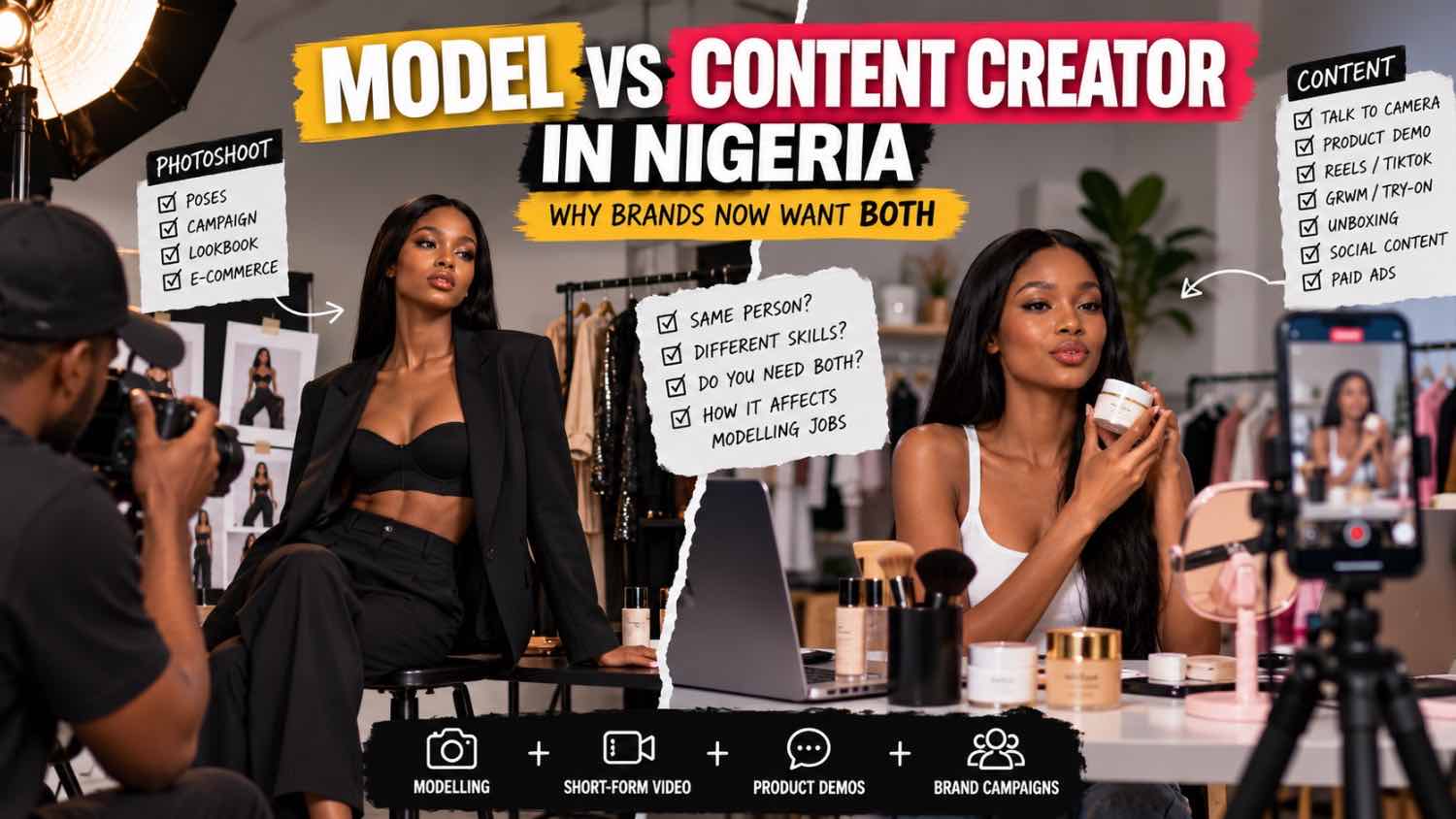
A Model and a Content Creator Are Not the Same Job
A model is primarily hired to visually represent a product, service, concept or brand.
That may involve posing, movement, runway, acting naturally within a scene or following creative direction during a campaign.
A content creator does something different.
They may be expected to develop ideas, speak on camera, demonstrate products, record themselves, create short-form videos, write captions or produce content specifically designed for social platforms.
One person can do both.
But the skills are not automatically the same.
Why Are Nigerian Brands Combining the Roles?
Because brands need far more content than they used to.
A campaign is no longer necessarily:
One photographer.
Five final photographs.
Billboard.
Finished.
A single product launch may now need:
- Campaign photographs
- Website images
- Instagram Reels
- TikTok videos
- Product demonstrations
- Behind-the-scenes footage
- Talking videos
- Stories
- Paid social advertisements
- E-commerce material
So a model who can look good in the campaign and comfortably create usable short-form video becomes extremely convenient for some brands.
The commercial model of today may be asked not only to pose for the product, but to help make the product feel believable on camera.
What Is a Brand Model?
“Brand model” can mean different things depending on the company.
Some brands use the term for models they hire repeatedly for e-commerce, product shoots and campaigns.
Others want somebody who becomes a recognisable face across their social channels.
A brand model may be expected to:
- Model clothing or products
- Appear in campaign photographs
- Create regular video content
- Demonstrate products
- Speak naturally on camera
- Attend brand events
- Work with the brand repeatedly
That can be a much broader responsibility than attending one photoshoot and going home.
What Is UGC?
UGC means User-Generated Content.
In professional marketing, the term is often used for content deliberately produced to feel natural, relatable and similar to something an ordinary customer might post.
Think:
“Come with me while I try this skincare product.”
“Three ways I styled this dress.”
“Here’s what I ordered versus what I received.”
“Get ready with me.”
The creator may not even post the content on their own account.
The brand may hire them simply to create the video and then use it on the brand’s channels or advertisements.
That distinction matters.
Do You Need Thousands of Followers to Create UGC?
Not necessarily.
This is where people sometimes confuse content creators with influencers.
An influencer is often valuable partly because of the audience they already have.
A UGC creator can be valuable because of their ability to produce believable content.
The brand may care much more about how naturally you speak, demonstrate a product and hold attention on camera than how many followers you personally have.
So What Is an Influencer?
An influencer usually brings audience distribution into the arrangement.
The brand is not only buying your appearance or your ability to produce content.
It may also be paying for access to your followers.
That means a campaign involving an influencer can include:
- Content creation
- Posting on the influencer’s account
- Story posts
- Links or discount codes
- Engagement expectations
- Exclusivity
- Paid-ad whitelisting or boosting
That is different from simply being hired as a model.
And What About a Brand Ambassador?
A brand ambassador arrangement is usually more ongoing.
The person becomes publicly associated with the brand for an agreed period.
There may be campaign appearances, social posts, events, exclusivity and image usage involved.
Someone can be a model in one campaign without becoming a brand ambassador.
Someone can also be an ambassador without being a professional model.
Again, the terms matter.
The New Skill Brands Keep Asking For: Talking to Camera
This is where many traditional models struggle.
They are comfortable posing.
The camera starts recording video.
Still fine.
Then somebody says:
“Just talk naturally about the product.”
Suddenly everything changes.
Talking naturally on camera is a skill.
You have to think while maintaining expression, energy, eye contact and believable delivery.
For some commercial jobs, this is becoming extremely useful.
Does This Mean Every Model Must Become a Content Creator?
No.
There are still jobs where the model’s role is simply to model.
High-fashion runway does not suddenly require every model to film a GRWM.
An editorial shoot may require no spoken content whatsoever.
A beauty campaign may focus entirely on close-ups.
But if your goal is commercial modelling, especially working repeatedly with Nigerian fashion, beauty and lifestyle brands, being comfortable with short-form content can expand the kinds of briefs you can handle.
What Should Models Learn?
Not everybody needs to become a full-time TikTok creator.
But useful commercial skills now include:
- Speaking naturally to camera
- Basic product demonstration
- Understanding short-form video pacing
- Taking simple direction for Reels and TikTok
- Maintaining expression while speaking
- Working comfortably with products
- Understanding basic social-media framing
- Creating believable lifestyle moments
The more useful you are on set, the more types of commercial jobs you may be able to handle.
But Brands Should Also Stop Combining Five Jobs Into One Fee
There is another side to this conversation.
If the brief originally says:
Model needed for photoshoot.
Then the model arrives and discovers they are also expected to:
- Develop content concepts
- Write scripts
- Speak on camera
- Film UGC
- Post on their personal account
- Give the brand paid advertising rights
that is no longer the same brief.
More deliverables can mean more value being created.
Models should understand what they are agreeing to before the shoot.
Brands should also communicate the scope clearly.
Model Fee vs Content Creation Fee
There is no universal pricing formula that applies to every project.
But conceptually, these can be different services.
A model fee may cover your time and performance during the shoot.
Content creation may involve additional preparation, speaking, concept development or deliverables.
Posting the content to your personal audience may add another layer.
Paid advertising usage may add another.
Exclusivity may add another.
This is why a brief should be clear before anybody starts negotiating fees.
A Strong Social Media Presence Can Still Help Models
Even when the brand is not hiring you as an influencer, your social presence can help.
It can show:
How you move.
How you dress.
How comfortable you are on camera.
How you communicate.
What your personality feels like.
And whether you understand how modern visual content works.
This does not mean turning your Instagram into a fake modelling portfolio.
It means recognising that clients may see more of you than your comp card.
The Nigerian Commercial Market Is Broader Than Runway
This is something aspiring models need to understand early.
Banks need campaign faces.
Telecom brands need relatable people.
Fashion brands need e-commerce models.
Beauty businesses need demonstrations.
Restaurants and hospitality companies need lifestyle content.
Automotive brands need promotional talent.
Skincare companies need people who can explain products naturally.
Some of these jobs may look nothing like the traditional image people have in their head when they hear the word “model.”
They are still part of the commercial talent market.
The Model Who Can Do Both Has an Advantage
Not because being a content creator suddenly makes you a better fashion model.
But because you become usable across more types of commercial production.
A client may be able to get:
Strong still photographs.
Natural product interaction.
A confident talking video.
Lifestyle content.
Social-first material.
from the same person.
For some brands, that versatility matters.
BEFORE ACCEPTING A MODEL + CONTENT JOB, ASK:
Am I modelling only?
Am I expected to speak on camera?
How many videos are required?
Am I creating the concepts or following a script?
Do I need to post on my own account?
Where will the content be used?
Will it be used for paid ads?
How long can the brand use it?
Is there exclusivity?
Frequently Asked Questions
What is the difference between a model and a content creator?
A model is primarily hired to visually represent a product, concept or brand, while a content creator may be responsible for developing or performing social-media content such as Reels, TikTok videos, demonstrations and talking videos. One person can perform both roles.
Can models also become content creators?
Yes. Many commercial models develop content skills because brands increasingly require both still photography and short-form video material.
Do models need followers to get brand jobs?
Not always. Some jobs require modelling ability rather than audience size. UGC-style work may also value your ability to create believable content even if you do not have a large following.
Is a brand model the same as a brand ambassador?
No. A brand model may simply work repeatedly on campaign or product content. A brand ambassador generally has a more ongoing public association with the company and may have additional promotional responsibilities.
Should models charge extra for creating videos?
The fee depends on the scope of the project, but models should understand whether video creation, speaking, personal social posting, paid advertising or other deliverables are included before agreeing to a price.
Does being good at TikTok make someone a professional model?
No. Content creation and professional modelling require overlapping but different skills. Strong social-media ability can complement modelling but does not replace model development, direction, movement and professional conduct.
Want to Develop for Commercial Modelling?
DXC works with aspiring and developing talent preparing for fashion, commercial, beauty, lifestyle and brand opportunities.
Send us your age, location, height and clear current photographs on WhatsApp to start the conversation.
Important: Training, development or representation does not guarantee modelling bookings. Individual clients determine their own campaign and casting requirements.