A brand sends out a casting brief.
It says:
“We need influencers for a campaign.”
But when you look at the actual job, the talent will not be posting anything to their own audience.
The brand needs them to appear in photographs and videos.
That sounds more like modelling.
Another client says:
“We need models.”
But the brief requires each person to film, edit and deliver several TikTok-style videos from their own phone.
That is also content creation.
Then another campaign wants talent to appear in the advertisement, create their own content and publish it to an established audience.
Now we are talking about a combination of roles.
This confusion matters because:
a model, a content creator and an influencer are not automatically the same thing.
They can overlap.
Sometimes one talented person can do all three.
But brands should know what they are actually buying before they start casting.
Creator-led advertising is becoming increasingly important. IAB’s creator-economy research now treats creator advertising as a major marketing channel rather than simply an occasional social-media add-on, while TikTok’s 2026 trend research continues to push brands toward real people, human stories and platform-native content.
Nigeria is also experiencing a significant expansion of its creator economy, with brand partnerships becoming an important revenue source for many creators.
For brands, that creates more options.
But more options also require better briefs.
First: What Is a Model?
A model is talent primarily hired to visually perform a creative brief.
That could mean:
- wearing clothing
- demonstrating a product
- appearing in campaign photographs
- performing in commercial video
- walking a runway
- interacting with another model
- representing a lifestyle
- communicating an emotion
- appearing in e-commerce imagery
The model’s main value to the campaign is their ability to perform effectively in front of the camera or audience.
A good model understands things such as:
posing,
movement,
expression,
product interaction,
body awareness,
continuity,
taking direction
and professional set behaviour.
They do not necessarily need a large following.
They do not necessarily need to edit videos.
And they do not automatically need to publish anything themselves.
If a bank needs a woman to appear as a young professional in a billboard and television campaign, the strongest person for the job may simply be the model who fits the brief and performs it convincingly.
Her follower count may be irrelevant.
What Is a Content Creator?
A content creator is primarily hired to make content.
The content may be:
- TikTok videos
- Instagram Reels
- product demonstrations
- tutorials
- lifestyle videos
- unboxings
- reviews
- talking-head content
- comedy
- behind-the-scenes content
- UGC-style advertising
A creator’s value is not only what they look like.
It is their ability to turn an idea into something people will actually watch.
They may understand:
hooks,
storytelling,
camera framing,
short-form pacing,
platform language,
editing,
voice,
personality
and audience behaviour.
And importantly:
a creator does not necessarily need a large audience.
A brand can hire someone purely to produce content that the brand itself will publish or advertise.
That person may have 700 followers.
It does not matter if distribution is not part of what the client is buying.
This is one reason the word “influencer” is sometimes incorrectly used for almost anyone appearing in social-media content.
What Is an Influencer?
An influencer brings something additional:
access to an audience.
The brand is not only hiring the person to appear in content.
It is also paying for some degree of:
- reach
- distribution
- audience trust
- community
- credibility
- cultural relevance
- attention
An influencer may create the content themselves.
They may also work with a production team.
But an important part of the commercial value is:
“This person has an audience we want to reach.”
That is why metrics such as:
- follower count
- engagement
- audience demographics
- geography
- content performance
- audience relevance
- brand affinity
can matter much more in influencer selection than they would in a normal modelling booking.
Globally, creator advertising continues to attract increasing brand investment, with IAB projecting U.S. creator ad spending at about $44 billion in 2026 and reporting that many advertising buyers now treat creators as a core media channel.
But follower numbers alone still do not tell you whether the person is right for your campaign.
So What Is a Model-Creator?
This is where things become interesting.
A model-creator is someone who can professionally perform a modelling brief and produce usable social-first content.
For example, a skincare company could book one person who can:
appear in polished campaign photography,
perform naturally in the commercial,
film a simple morning-routine Reel,
speak confidently to camera,
and create additional vertical content for the brand.
That person may or may not have a major audience.
Their value comes from combining:
modelling ability + content ability.
For certain campaigns, that combination can be extremely useful.
It gives the production team more creative flexibility and potentially creates more assets from one booking.
And What Is a Model-Creator-Influencer?
Now add audience distribution.
The same talent can:
**model the campaign
- create platform-native content
- publish to an established audience.**
That person is effectively performing three commercial functions.
And this is exactly why brands should stop assuming that all talent should cost the same.
You are buying different things.
Think of It This Way
MODEL
The brand is primarily buying:
performance.
“Can this person execute our visual brief?”
CREATOR
The brand is primarily buying:
content production.
“Can this person make content that works naturally on the platform?”
INFLUENCER
The brand is also buying:
distribution and audience access.
“Can this person’s platform help us reach or influence the audience we want?”
HYBRID TALENT
The brand may be buying:
performance + creation + distribution.
Understanding that distinction can improve both casting and budgeting.
When Should a Brand Book a Model?
Book primarily for modelling when you need things such as:
Campaign photography
You already have the photographer, creative team and production.
You need suitable talent to execute the concept.
E-commerce
You need somebody who can present clothing or products consistently and efficiently.
Runway
You need talent who can professionally present a designer’s collection.
Commercial video
You need someone who can follow a director and perform the required actions or expressions.
Beauty campaigns
You need a face, features or presentation suited to the product and concept.
Lifestyle advertising
You need believable talent who fit the consumer or world being represented.
In these situations, modelling suitability should normally come before follower count.
When Should a Brand Book a Content Creator?
Choose a creator when the main deliverable is something like:
“We need five TikTok-style videos.”
or:
“We need somebody to demonstrate this product naturally.”
or:
“We need content that feels like it came from a normal user rather than an advertisement.”
The person needs to understand how to create.
A professional model may be able to do this.
But do not automatically assume that because someone photographs well, they know how to:
write a hook,
talk naturally to camera,
structure a 30-second story,
or shoot platform-native content.
Those are different skills.
TikTok’s 2026 trend outlook specifically points toward greater demand for unfiltered stories, behind-the-scenes material and content built around real human experience rather than overly polished brand presentation.
That makes creator ability increasingly valuable for social-first campaigns.
When Should a Brand Book an Influencer?
Choose an influencer when their audience is part of the media strategy.
For example:
You want to launch a new beauty product.
The person will create content.
But you also specifically want that content to reach:
young Nigerian beauty consumers,
working mothers,
Lagos fashion audiences,
fitness communities,
tech enthusiasts,
or another defined audience.
Now the person’s community becomes part of the product you are buying.
At that point, you need to evaluate more than appearance.
Ask:
Who actually follows this person?
Where are those people located?
Do they trust them?
Does their normal content fit the brand?
How does their sponsored content usually perform?
Are their followers real?
A large number is not automatically a useful audience.
The Mistake: Casting Influencers When You Actually Need Models
Imagine a luxury fashion brand chooses talent primarily because of follower count.
The campaign goes into production.
Then the team discovers:
the talent struggles to take direction,
cannot repeat poses consistently,
does not understand garment presentation,
has limited body awareness,
or is uncomfortable with the type of movement the campaign requires.
The brand may have purchased reach.
But it did not necessarily purchase professional modelling ability.
If the campaign’s main requirement was visual execution, that can become expensive.
The solution is not:
“Never use influencers as models.”
Many influencers are excellent on camera.
Some have substantial professional modelling or acting ability.
The solution is:
test for the skill you actually require.
The Opposite Mistake: Booking Models When You Actually Need Creators
The reverse also happens.
A brand books models for a social-first campaign.
Then, on set, somebody says:
“Okay, now everyone should create three fun TikTok videos.”
But content creation was never part of the original casting requirement.
Some models may perform brilliantly.
Others may have no idea what to do.
That is not necessarily their failure.
It may be a briefing failure.
If content creation is part of the job, state it before casting.
Then agencies can send people who are comfortable doing it.
And the Third Mistake: Expecting Free Audience Reach From Talent
A model is booked for a campaign.
The client pays for the shoot.
Then somebody casually says:
“Just post it on your Instagram too.”
That is not always a minor addition.
If the brand now wants access to the talent’s personal audience, distribution has been added to the job.
The same applies to creators and influencers.
The agreement should clarify what the brand is buying:
appearance?
content production?
posting?
usage rights?
exclusivity?
audience distribution?
Clear deliverables prevent misunderstandings later.
One Person Can Perform Several Roles — But Price Them Properly
This is where hybrid talent becomes commercially interesting.
Imagine the client books someone who can:
model the campaign,
deliver three polished vertical videos,
and publish two posts to an engaged audience.
Instead of treating all of that as:
“one modelling job,”
break the value apart.
The fee may include:
Modelling fee
For performing in the production.
Usage
For how the campaign images/video will be used.
Content creation
For additional assets the talent personally produces.
Posting/distribution
For publication to the talent’s own audience.
Exclusivity
If the person cannot work with competing brands for a defined period.
Additional rights
Where relevant, including extended digital or synthetic/AI use.
Brands deserve clarity.
Talent deserves clarity.
Agencies can negotiate much more effectively when everyone understands what is actually being purchased.
Brands Should Start With the Campaign Objective
Before asking:
“Which influencer should we use?”
or:
“Can you send models?”
start one step earlier.
Ask:
What problem are we trying to solve?
If the objective is:
beautiful campaign imagery
you may primarily need a model.
If the objective is:
native TikTok/Reel assets
you may primarily need a creator.
If the objective is:
reach a specific established audience
you may primarily need an influencer.
If the objective is:
create great campaign imagery + social content
you may need a model-creator.
If the objective is:
campaign performance + content + audience distribution
you may need hybrid talent capable of all three.
Casting becomes easier once the job is defined.
A Better Casting Brief
Instead of:
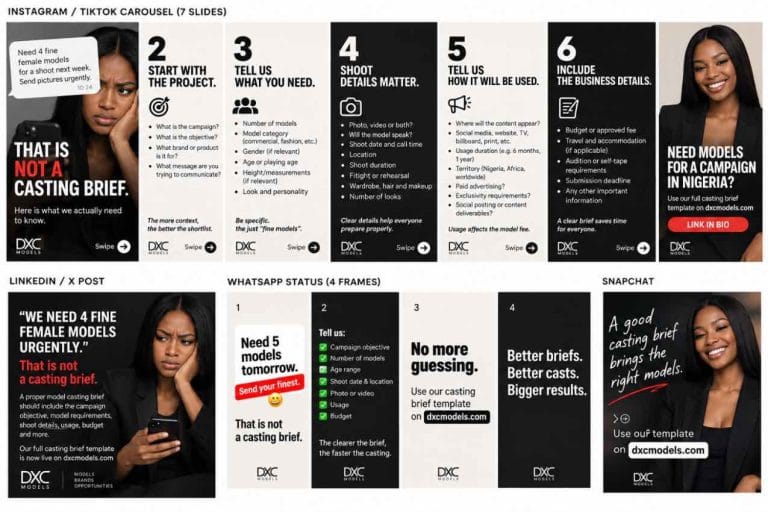
“We need 5 influencers.”
try:
We require five female talents aged approximately 22–30 for a skincare campaign.
Talent must be comfortable modelling still photography and performing naturally in vertical video.
Each talent will also be required to create two short-form product videos.
Posting to personal social platforms is/is not required.
Where posting is required, please include audience insights and average engagement with the submission.
Now the agency knows exactly what to send.
What Should Brands Evaluate?
Depending on the role:
When evaluating a MODEL:
Look at:
- suitability for the brief
- portfolio
- current polaroids
- movement
- expression
- professionalism
- ability to take direction
- relevant experience
If you need help understanding appropriate model submission photographs, see our guide How to Take Modelling Polaroids at Home With Your Phone.
When evaluating a CREATOR:
Look at:
- quality of ideas
- storytelling
- video confidence
- filming ability
- editing
- hooks
- consistency
- whether the content feels natural to the platform
- ability to interpret a brief
When evaluating an INFLUENCER:
Also consider:
- audience size
- actual engagement
- audience location
- demographics
- credibility
- brand fit
- previous partnerships
- performance
- reputation
Models Should Understand This Too
This conversation is not only for brands.
For models, understanding these distinctions can help you identify additional skills worth developing.
You do not need to become an influencer to become a model.
We have already explained that in our guide Do Models Need Social Media in 2026? What Nigerian Brands Are Actually Looking For.
But you can ask yourself:
Can I model?
Then:
Can I also perform naturally on video?
Can I speak confidently?
Can I understand a short-form content brief?
Can I create a simple usable video?
Those additional skills may open categories of commercial work that were not traditionally considered modelling.
Creators Should Also Respect Modelling as a Skill
The growing overlap should not lead to the opposite assumption:
“Everyone who has a phone can model.”
Modelling is a professional discipline.
Runway takes development.
Commercial expression takes practice.
Product interaction is a skill.
Body awareness is a skill.
Taking direction is a skill.
Maintaining continuity across repeated shots is a skill.
The strongest hybrid talent understands both sides of the job.
Brands Should Not Automatically Pay for Followers They Don’t Need
This is another commercial consideration.
If the campaign does not require the person to publish to their audience, ask yourself:
Why are we using follower count as a major casting criterion?
You may be paying a premium for something you are not actually using.
Similarly, if audience reach is essential, casting somebody purely because they look perfect without evaluating their audience may fail the campaign objective.
Spend against the job that needs to be done.
The Future of Commercial Talent Is Becoming More Flexible
The lines between traditional advertising, creator content and social distribution are becoming increasingly connected.
IAB has documented creators increasingly serving as the creative foundation for campaigns that extend beyond the creator’s original social post into broader advertising and brand-owned media.
That does not mean models disappear.
It means brands have a broader talent ecosystem to choose from.
The opportunity is not to force everybody into the same category.
It is to become better at matching people, skills and audiences to the campaign objective.
DXC VIEW
A model, creator and influencer are not three different words for the same person.
A model primarily brings performance.
A creator brings content ability.
An influencer also brings audience and distribution.
Sometimes one person brings all three.
The brand’s job is to know which value it actually needs.
Before You Send Your Next Casting Brief
Ask these five questions:
1. Do we need professional modelling ability?
2. Does the talent need to create content themselves?
3. Does the talent need to publish the content?
4. Is access to their audience part of the campaign strategy?
5. Are we asking one person to do several of these things?
The answers tell you whether you need:
a model,
a creator,
an influencer,
or hybrid talent.
Looking for Talent for a Campaign?
DXC Model Management works with brands, agencies, designers and production teams to identify talent based on the actual requirements of the brief.
Rather than beginning with:
“Send us models,”
tell us:
who the campaign is speaking to,
what the talent needs to do,
where the content will appear,
whether social content is required,
and whether audience distribution is part of the campaign.
The clearer the brief, the better the casting.
Visit DXCModels.com through our official channels to discuss talent requirements.