MODEL BUSINESS • BOOKINGS • NIGERIA
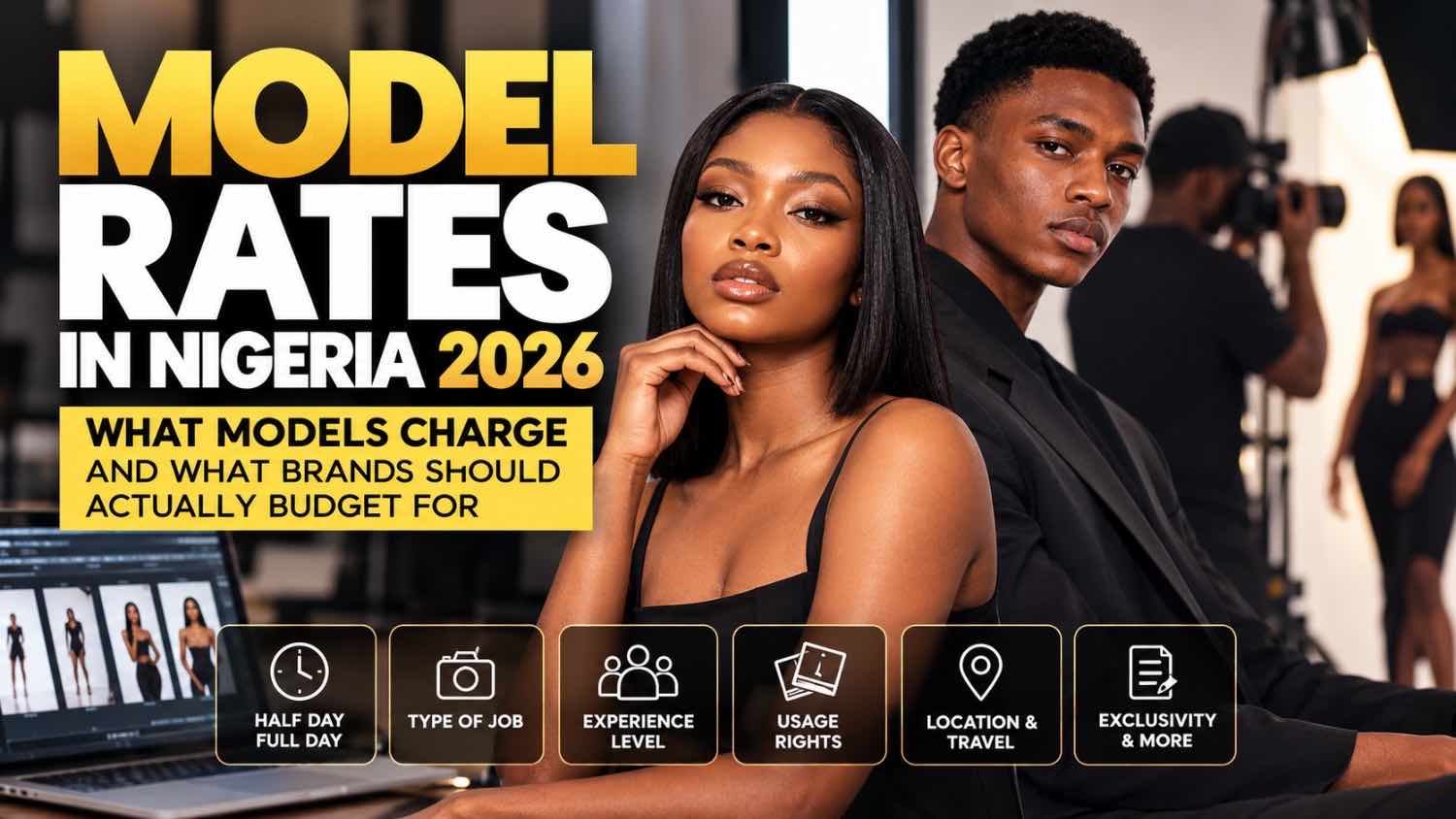
Model Rates in Nigeria 2026: What Models Charge and What Brands Should Actually Budget For
“How much does a model cost in Nigeria?”
It sounds like a simple question.
It usually is not.
A model booked for a two-hour e-commerce shoot is not necessarily priced the same way as a model appearing in a nationwide advertising campaign.
A new face may not command the same fee as an experienced commercial model. A four-hour booking is different from an eight-hour production day. A social-media shoot is different from a campaign that will run on billboards, paid ads and packaging.
So when people ask about model rates in Nigeria, the more useful question is:
What exactly are you hiring the model to do, for how long, and what will happen to the content afterwards?
This guide explains how model pricing actually works in Nigeria, what models should understand before quoting a fee, and what brands should budget for before contacting an agency.
Is There a Standard Model Rate in Nigeria?
No.
There is no single official Nigerian price that every model, agency, designer or production company follows.
Rates can vary according to:
- The type of modelling job
- The model’s experience
- The model’s agency or management
- The number of hours required
- The number of looks or outfit changes
- The client and size of the campaign
- The media in which the content will appear
- How long the content will be used
- The territory of the campaign
- Whether exclusivity is required
- Travel and transport requirements
- Fittings, rehearsals or additional production days
- Urgency and complexity of the booking
This is why internet articles that simply say “runway models earn X” or “commercial models earn Y” can be misleading.
The category of modelling is only one part of the quotation.
01 Start With the Model’s Time
The first component is usually the actual working time required.
Bookings may be structured as:
- Hourly bookings
- Half-day bookings
- Full-day bookings
- Multi-day bookings
- Show or event fees
- Project fees
There is no universal Nigerian definition that every company uses, so the number of hours should always be stated clearly.
For example, Pages Model Management currently defines a half day as four hours and a full day as eight hours on its public booking page.
Its page also states that the model’s time starts from the agreed call arrangement and that additional hours attract additional fees depending on the model’s board.
The lesson is not that every Nigerian agency must use the same structure.
The lesson is that time has commercial value.
02 Half Day Is Not Automatically “Half the Price”
Brands sometimes assume that if an eight-hour booking costs a particular amount, a four-hour booking should automatically cost exactly half.
That is not always how talent pricing works.
A model still has to:
- Keep the date available
- Prepare for the job
- Travel to the location
- Arrive camera-ready
- Potentially decline another booking that overlaps
An agency or model may therefore have established half-day and full-day structures rather than dividing one number mathematically.
Brands should ask for the relevant booking rate instead of calculating it themselves.
03 The Type of Job Matters
Different modelling jobs create different demands.
E-commerce
E-commerce can involve photographing many products or outfits within a limited production window.
The model may be expected to move quickly, repeat poses consistently and maintain energy across multiple looks.
Lookbook
A lookbook may require fewer images than e-commerce but more deliberate styling, posing and creative direction.
Runway
Runway jobs may involve fittings, rehearsals, backstage call times and the actual show.
The time spent on site can therefore be much longer than the minutes a model is physically walking on the runway.
Commercial campaign
Commercial campaigns can involve still photography, video, acting, dialogue, multiple locations or extensive usage after production.
This is where the final value can rise significantly because the brand is not merely paying for a model to stand in front of a camera.
Editorial
Editorial work may sometimes operate differently from advertising because the commercial purpose, publication and creative value can be different.
Models should still understand exactly what they are agreeing to.
04 New Face, Development Model and Experienced Model May Be Priced Differently
Experience can affect pricing.
An experienced model may be able to:
- Pose efficiently without constant correction
- Understand lighting and camera angles
- Work through a high number of looks
- Take direction quickly
- Perform consistently on video
- Handle demanding production environments
That efficiency has value to a client.
Pages Model Management’s current public booking information, for example, lists different overtime amounts for its New Face, Development and Main Board categories.
This demonstrates an important point:
Two models can be physically present for the same number of hours and still have different booking values.
05 Extra Looks Can Cost Extra
One of the easiest ways for a shoot to exceed its original scope is through additional outfits.
A client may initially brief:
“Five looks.”
Then production arrives with twelve.
More looks can mean:
- More changing time
- More hair and makeup adjustments
- More posing
- More photographs
- A longer working day
Some agencies therefore place a maximum number of looks within a booking period or charge for additional looks.
Pages currently publishes maximum-look guidance for its half-day and full-day bookings and separately lists additional-look fees.
Again, this should not be copied as a universal Nigerian rule.
It shows why the number of looks belongs in the original brief.
06 Overtime Matters
If a model is booked until 4 PM and production runs until 7 PM, somebody needs to account for those additional hours.
Delays happen.
Lighting changes.
Clients arrive late.
Wardrobe takes longer than expected.
The creative team adds another shot.
But a production delay does not automatically turn a six-hour booking into an unlimited working day.
Brands should clarify:
- When the clock starts
- When the booking ends
- The overtime rate
- Whether there is a minimum overtime increment
Models should also avoid leaving a set abruptly without communicating through the appropriate agency, manager or production contact.
Professionalism works both ways.
07 Usage Can Change the Value of a Job Completely
This is one of the biggest reasons two apparently similar shoots can have very different prices.
Consider these two bookings:
Job A: A model photographs five outfits for a designer’s organic Instagram content.
Job B: A model photographs five outfits for a campaign that will run on Meta ads, billboards, e-commerce, packaging and retail displays for one year.
The production day might be identical.
The commercial use is not.
Usage can involve:
- Organic social media
- Paid advertising
- Website
- E-commerce
- Billboards
- Television
- Packaging
- Point-of-sale materials
- Regional or international campaigns
The duration and territory matter too.
We explain this in detail in our guide to Model Usage Rights in Nigeria.
08 Exclusivity Has a Price
Suppose a bank books a model for a major campaign and prevents that model from appearing in advertisements for competing banks for the next twelve months.
That restriction may remove other potential jobs from the model’s calendar.
Exclusivity should therefore be discussed clearly.
The agreement should ideally define:
- The restricted industry or category
- The competitors involved
- The duration
- The territory
A narrow three-month restriction is different from a broad multi-year restriction covering an entire industry.
09 Transport and Location Should Not Be an Afterthought
A model living in Ikeja and a production taking place nearby is one situation.
A 5 AM call time on the opposite side of Lagos is another.
An out-of-state production is another situation entirely.
For jobs involving significant travel, the brief should clarify whether the client is providing or reimbursing:
- Transport
- Fuel or travel allowance
- Flights
- Accommodation
- Airport transfers
- Meals or per diem where applicable
Box Models’ public booking form currently asks clients whether they will take care of the models’ travel expenses and hospitality.
That is a useful reminder that logistics belong in the booking discussion, not as a surprise after the rate has been agreed.
10 Fittings and Rehearsals Use the Model’s Time Too
A fashion show may happen on Saturday.
But the model might be required to attend:
- A fitting on Thursday
- A rehearsal on Friday
- An early backstage call on Saturday
The visible show may last twenty minutes.
The model’s actual commitment may span three days.
Brands, designers and production teams should therefore state fittings and rehearsals before confirming the booking.
Whether those sessions are included in the main rate or quoted separately depends on the agreement.
11 Child Models Require Different Logistics
When booking children, production is not only booking the child’s time.
A parent or guardian may need to:
- Travel with the child
- Remain on set
- Take time away from work
- Manage school commitments
- Arrange meals and transport
Location therefore becomes particularly important.
A low-budget booking may become impractical if a parent and child must spend several hours crossing Lagos for a short shoot.
Brands requesting child talent should provide the location, expected hours and production requirements early so the agency can suggest realistic options.
12 Agency Fees and Model Fees May Not Be the Same Number
Brands should ask whether a quotation is:
- The model’s fee only
- Inclusive of agency fees
- Exclusive of agency fees
- Inclusive or exclusive of applicable production-related charges
Likewise, models represented by an agency should understand what their representation agreement says about commission and deductions.
There is no reason to guess.
Ask.
13 What Do Public Nigerian Agency Prices Actually Show?
Publicly available Nigerian agency information gives us useful context, but it should not be mistaken for an official national rate card.
For example, Box Models Agency currently states that its model and agency fees are generally based on the client’s budget, requirements and usage, while citing a minimum of ₦35,000 per model for most projects.
A separate Box booking form allows clients to indicate per-model budget bands including:
- ₦20,000 to ₦40,000
- ₦40,000 to ₦60,000
- ₦60,000 to ₦80,000
- ₦80,000 to ₦100,000
- ₦100,000 to ₦200,000
- ₦200,000+
Those bands show the width of the Nigerian market rather than proving that every model should charge within one specific range.
Meanwhile, Pages Model Management publicly defines its booking structure around four-hour half days and eight-hour full days and separately publishes charges for additional hours and additional looks.
The bigger lesson is clear:
Professional model pricing is structured around the booking, not pulled from one universal Nigerian price list.
14 So How Much Should a Beginner Model Charge?
This is usually the question aspiring models actually want answered.
The mistake is trying to choose one permanent number before understanding the job.
Instead, ask:
- Who is the client?
- What exactly am I modelling?
- How many hours?
- How many looks?
- Where is the shoot?
- Will there be video?
- Where will the images appear?
- How long will they be used?
- Is paid advertising involved?
- Is there exclusivity?
- Are transport and meals covered?
A beginner does not need to charge the same as an established campaign model.
But being new does not mean every job must be free either.
Portfolio collaborations, test shoots and genuinely paid commercial bookings are different arrangements and should be understood as such.
15 Models: Do Not Quote Before You Understand the Brief
Someone sends:
“Hi dear. How much do you charge for modelling?”
Do not rush to send one random figure.
Ask for the job details first.
A professional response can be as simple as:
That is not being difficult.
That is understanding the work before pricing it.
16 Brands: “What Is Your Rate?” Is Often the Wrong First Question
A brand may contact five agencies asking:
“How much is a model?”
Without providing:
- Date
- Location
- Hours
- Number of models
- Age range
- Required measurements
- Campaign type
- Usage
- Deliverables
- Budget
The agency is then expected to produce an accurate quotation from almost no information.
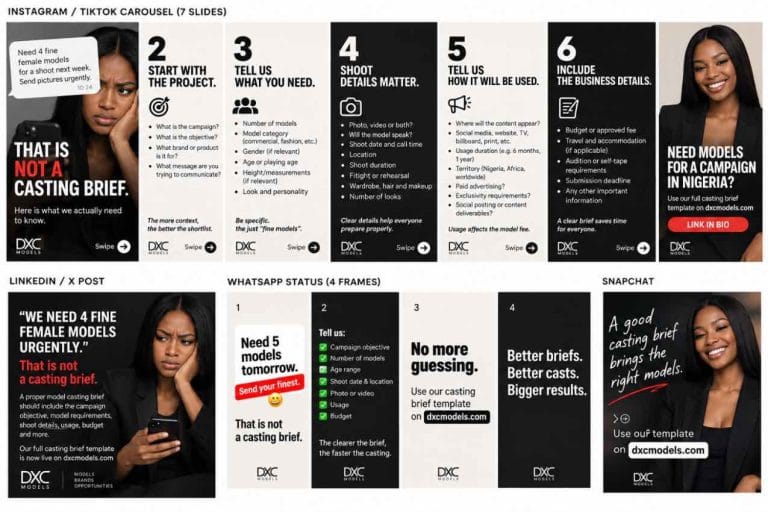
A better approach is to send a proper casting or booking brief first.
You can use our Model Casting Brief Template for Brands and Agencies as a starting point.
17 A Simple Way to Think About a Model Booking Budget
Instead of asking only for the model’s day rate, brands can think about the total talent budget like this:
TOTAL TALENT BUDGET = WORKING FEE + USAGE + AGENCY COSTS + LOGISTICS + ADDITIONAL PRODUCTION REQUIREMENTS
Depending on the job, additional production requirements could include:
- Overtime
- Extra looks
- Fittings
- Rehearsals
- Travel
- Accommodation
- Exclusivity
- Campaign extensions
Not every project will contain every item.
But this framework prevents the common mistake of treating the model’s physical presence on set as the entire cost of talent.
18 What If the Client’s Budget Is Low?
A smaller budget does not automatically mean the project cannot happen.
It means expectations may need to change.
The agency may suggest:
- New faces instead of more established talent
- Models closer to the location
- A shorter booking
- Fewer looks
- Narrower usage
- Fewer models
- Different production dates
What should not happen is pretending the budget can buy a scope it cannot realistically support.
A professional agency’s job is not simply to say yes.
It is to help the client understand what can reasonably be delivered.
19 Why Extremely Low Rates Can Cost the Production More
The cheapest model is not automatically the cheapest production decision.
An experienced model who understands posing, movement, lighting and direction may help a team complete a shoot faster.
An unsuitable model may require:
- More direction
- More takes
- Longer photography time
- Extra retouching
- Reshoots
Budget matters.
So does fit.
The goal should be to find the right talent for the job at a budget both sides understand.
20 Why Models Should Not Compare Every Booking
A model hears that another person received ₦200,000 for a shoot.
They received ₦60,000.
That does not automatically mean somebody was cheated.
Before comparing the numbers, compare:
- The client
- The hours
- The experience level
- The usage
- The territory
- The duration
- The exclusivity
- The deliverables
- The agency arrangement
Two photographs can look similar on Instagram while the contracts behind them are completely different.
The Nigerian modelling industry needs to move beyond discussing rates as random numbers.
Models need to understand what they are selling.
Brands need to understand what they are buying.
Agencies need enough information to quote properly.
And everybody needs to stop treating a one-day shoot as though the model’s commercial value begins and ends when the camera switches off.
Better briefs create better quotations.
Better quotations create clearer expectations.
Clearer expectations create better working relationships.
Frequently Asked Questions About Model Rates in Nigeria
How much do models earn in Nigeria?
There is no single amount. Earnings depend on the type and frequency of jobs, experience, agency representation, client, working hours, usage and other booking terms. Models are often paid per project rather than receiving one fixed modelling salary.
How much does it cost to hire a model in Lagos?
There is no universal Lagos model rate. The cost depends on the model, hours, job type, usage, number of looks, location and other requirements. A proper brief is needed for an accurate quotation.
How much should a beginner model charge in Nigeria?
A beginner should not choose a fee based only on being new. The quote should reflect the project, hours, usage, location and deliverables. Agency-represented beginners should normally allow their agency to handle commercial quotations.
Do models charge by the hour?
Some bookings are hourly, while others use half-day, full-day, show or project rates. The structure varies by agency and job.
Do models get paid for fittings?
That depends on the booking agreement. Brands should disclose fittings and rehearsals before confirming the job so the agency or model can state whether they are included or separately charged.
Who should pay for a model’s transport?
There is no single rule for every Nigerian booking. Transport and travel arrangements should be agreed beforehand, particularly for distant locations, unusual call times or interstate jobs.
Does a model’s fee include image usage?
Sometimes it does and sometimes usage is priced separately. The quotation or contract should state what media, duration and territory are included.
Why do different models charge different amounts?
Experience, demand, special skills, campaign fit, usage, exclusivity and agency positioning can all affect a model’s commercial rate.
Should a model work for free to build a portfolio?
Not every unpaid collaboration is automatically bad, but models should distinguish a deliberate portfolio or test shoot from a commercial job where a company is creating advertising or sales material. The purpose and value exchange should be clear.
Need Models for a Campaign?
DXC Models works with brands, designers, advertising teams, photographers and production companies looking for suitable talent for fashion, beauty, e-commerce, lifestyle and commercial projects.
Send us your campaign brief, location, dates, model requirements and intended usage. We can help you identify realistic talent options for the project and budget.
Pricing note: Public agency prices and booking structures referenced in this article are market examples available at the time of publication. They are not an official Nigerian industry rate card and may change. Always request a current quotation for the specific model and project.