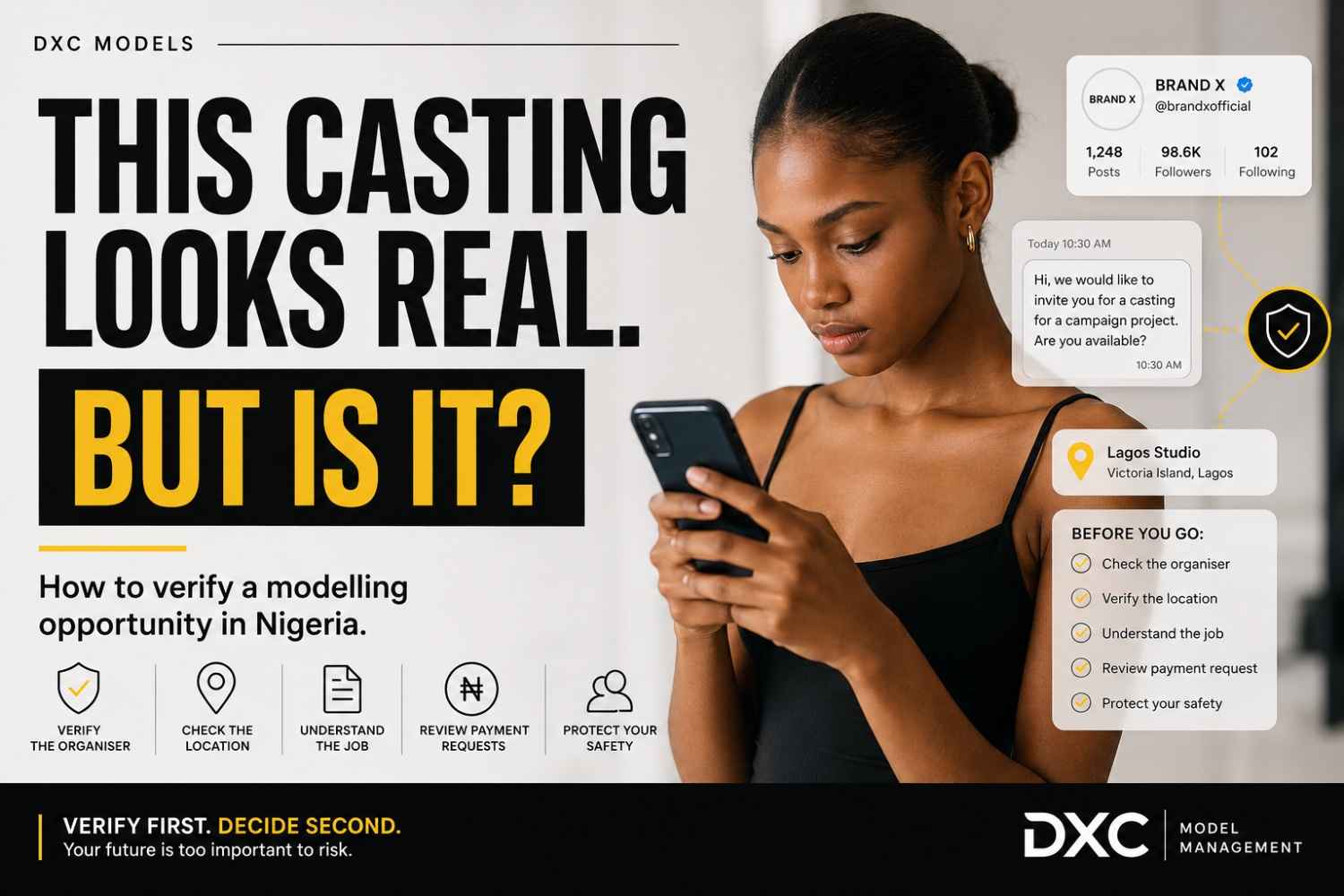
Getting a modelling opportunity can be exciting.
The flyer looks professional.
The Instagram account has photographs.
The person contacting you sounds confident.
The payment sounds good.
They know the name of a real fashion brand.
They even have an address.
Everything appears legitimate.
But here is the problem:
A casting can look real and still be fake.
Scammers do not always announce themselves with badly designed flyers and obviously suspicious messages. They can impersonate legitimate businesses, use stolen photographs, create convincing social-media profiles and present opportunities that initially look professional.
Earlier in 2026, a Lagos content creator alleged that she and a friend were lured to an apartment through what she believed was a paid modelling opportunity arranged through Instagram. The case is a serious reminder that verifying an opportunity should happen before you arrive at the location, not after something begins to feel wrong.
So if somebody contacts you about a modelling job today, how do you actually check whether it is genuine?
Here is a practical verification process.
1. Stop and Identify Exactly Who Contacted You
Before responding to the excitement of the opportunity, establish who is actually speaking to you.
Ask:
What is your full name?
What company or agency do you represent?
What is your position?
What is the official company website?
What is the official company email address?
Who is the client?
Then verify those answers independently.
Do not rely only on links the person sends you.
A scammer can create a social profile that looks similar to a legitimate agency or company. Consumer-protection guidance specifically warns that fraudulent recruiters can impersonate known companies and use convincing job communications to make an opportunity appear legitimate.
2. Search for the Company Yourself
If someone says:
“I work with XYZ Agency.”
don’t simply click the website link contained in their message.
Open Google yourself.
Search for the company.
Find its official website independently.
Then compare:
- website address
- email domain
- social-media handles
- phone numbers
- office information
- names of team members where available
Small differences matter.
For example, an impersonator may create a username or email address that differs from the legitimate organisation by only one letter.
If you are unsure, contact the company through the details you independently found on its official website and ask whether the person or casting is genuine.
3. Check Whether the Casting Exists Outside the DM
One of the strongest verification questions is:
Can I find evidence of this opportunity anywhere except inside the conversation with the person contacting me?
Check:
- the organisation’s official website
- its verified or established social accounts
- the client’s official pages
- the agency representing the casting
- other credible industry channels
Not every legitimate private casting will be publicly advertised.
So the absence of a public flyer does not automatically make an opportunity fraudulent.
But if someone claims:
“This is the official open casting for Brand X”
and Brand X, the named agency and all their official channels know nothing about it, that deserves investigation.
4. Verify the Location Before You Travel
Do not treat an address as proof that a casting is legitimate.
An address can simply be typed into a message.
Search the location.
Ask:
Is this an agency office?
A recognised studio?
A production space?
A hotel?
A private residence?
A short-let apartment?
Then ask why the casting is happening there.
A legitimate production can sometimes operate from temporary studios, rented locations or unconventional spaces.
The location alone therefore does not prove fraud.
But an unfamiliar private location combined with vague information, changing stories or an inability to identify the other people supposedly working on the project should make you more cautious.
If you arrive somewhere and the situation is substantially different from what you were told — different crew, different purpose, different activities or unexpected requests — you are allowed to leave.
5. Ask What Exactly You Are Being Cast For
“Modelling job” is not enough information.
You should be able to ask:
What brand is this for?
What product or campaign?
Is it photography or video?
What will I be expected to wear?
Will I be speaking?
Where will the images or video be used?
How long is the shoot?
What is the rate?
Who is producing the shoot?
Real projects can sometimes be confidential before launch.
But confidentiality is different from refusing to give a model enough information to understand what they are agreeing to.
You do not need every creative detail.
You do need enough information to make an informed decision.
6. Understand Any Payment Before Sending Money
This requires an important distinction.
Not every paid modelling-related service is automatically fraudulent.
Training, photography, portfolio development, classes and other clearly defined professional services can have legitimate costs.
The question is:
What exactly are you paying for?
There is a major difference between:
“This is a clearly priced photography service.”
and:
“Pay ₦25,000 now to secure the modelling job we have already selected you for.”
U.S. Federal Trade Commission guidance specifically identifies demands to pay in order to secure a casting spot or job as a common scam pattern.
Before paying anything, ask:
What am I buying?
What will I receive?
Is payment compulsory?
Is this payment for a service or supposedly for access to the job?
Can I receive the terms in writing?
If the explanation keeps changing, stop.
7. Verify the Rate Too
An unusually attractive payment can make people stop asking questions.
Imagine somebody messages an inexperienced model:
“We found your page and want to pay you ₦300,000 tomorrow.”
Could it be genuine?
Possibly.
But the bigger the unexpected opportunity, the more reason you have to verify it properly.
Model Alliance identifies unusually large offers to people with little or no modelling experience as one possible warning sign when combined with other suspicious behaviour.
Do not think:
“The money is too good for me to ask questions.”
Think:
“If this is a serious commercial job, the organiser should be able to answer serious commercial questions.”
8. Never Let Urgency Replace Verification
A real production may genuinely have a deadline.
Sometimes a model cancels.
Sometimes casting happens quickly.
Sometimes a client needs somebody the same day.
DXC itself works with urgent casting requests.
So:
urgency alone does not mean scam.
What matters is what happens when urgency is combined with pressure such as:
“Don’t contact the company.”
“Don’t tell anybody.”
“Transfer now or you’re out.”
“There is no time to ask questions.”
“Just come and we’ll explain everything there.”
Research on job scams has found time-pressure and urgency cues to be associated with scam compliance behaviour, which is one reason creating artificial pressure can be effective.
A deadline can be real.
Verification should still be possible.
9. Be Extremely Careful With Image Requests
Normal modelling applications often request photographs.
That may include:
- headshots
- profiles
- full-length images
- polaroids/digitals
- portfolio images
But someone calling themselves a scout does not automatically have the right to request intimate or inappropriate photographs.
Model Alliance specifically identifies requests for suggestive photographs as a major warning sign.
If you are unsure what proper modelling polaroids should look like, read our guide:
How to Take Modelling Polaroids at Home With Your Phone
Professional assessment does not require you to abandon personal boundaries.
10. Check the Person, Not Just the Company
This is very important.
You may successfully verify that:
the agency exists.
That does not automatically prove that:
the person messaging you actually works there.
Scammers can impersonate legitimate scouts, photographers, agencies and brands.
So if someone says they represent an organisation, verify that connection.
You can contact the organisation through its official channel and ask:
“Hello, I received a casting message from someone named ______ claiming to represent your organisation. Can you please confirm whether this person and opportunity are genuine?”
That one message can save you a great deal of trouble.
11. Search the Name of the Casting or Recruiter
Before attending, search:
person’s name + scam
company name + scam
casting name + complaint
company name + reviews
The FTC specifically recommends researching a casting call or casting director’s name alongside words such as “scam,” “review” or “complaint.”
One complaint does not automatically prove wrongdoing.
But multiple independent reports describing the same behaviour should not be ignored.
12. Ask Who Else Will Be Present
If it is a shoot, ask:
Who is the photographer?
Who is the makeup artist?
Who is the stylist?
Who is the producer?
Not every small production will have a huge crew.
But if you were told:
“There will be a photographer, makeup artist, stylist and brand representative”
and arrive to find one unknown person alone inside a private apartment, the situation you agreed to has changed.
You are allowed to reassess it.
You are allowed to leave.
13. Parents Should Verify Child-Modelling Opportunities Themselves
Parents should not outsource verification to the excitement of the child.
If somebody approaches your child about modelling, establish:
- who the organisation is
- who will work directly with the child
- where activities take place
- what images will be created
- where those images will be used
- what payment or fees apply
- who will supervise the child
- whether a parent or guardian can remain involved
FTC guidance specifically warns parents to investigate modelling offers carefully and understand promises and costs before paying for child-modelling opportunities.
A professional organisation should be able to communicate clearly with a parent or guardian.
THE DXC 60-SECOND CASTING CHECK
Before leaving home for an unfamiliar modelling opportunity, run through this:
1. WHO?
Do I know the real name and organisation of the person contacting me?
2. CAN I VERIFY THEM?
Have I checked the official website or contacted the company independently?
3. WHAT?
Do I understand what I am being cast or booked for?
4. WHERE?
Have I checked the location independently?
5. WHO ELSE?
Do I know who is expected to be present?
6. MONEY?
Do I understand the rate and exactly what any requested payment is for?
7. IMAGES?
Are the requested photographs appropriate for a normal modelling application?
8. DOES THE STORY MATCH?
Do the company, person, location, client and casting details all make sense together?
If several answers are:
“I don’t know,”
don’t ignore that because you are excited.
Verify first.
What If You Still Aren’t Sure?
If you cannot confidently verify an opportunity:
do not rush.
Contact the organisation directly.
Ask an experienced agency or industry professional.
Tell someone you trust where you are going.
For younger talent, involve a parent or guardian.
And if the organiser becomes angry simply because you are trying to confirm basic details, consider what that tells you.
Red Flags and Verification Are Two Different Things
Last week, we explained warning signs that can indicate a suspicious agency or modelling opportunity.
Today’s lesson is slightly different.
A red flag tells you:
“Something may be wrong.”
Verification asks:
“Can I independently prove who I am actually dealing with?”
Both matter.
If you haven’t read our earlier guide, start here:
Fake Modelling Agencies in Nigeria: 7 Red Flags Aspiring Models and Parents Should Know
The two guides should be used together.
DXC VIEW
A professional-looking casting flyer is not verification.
Verification means independently confirming the person, organisation, opportunity and location before you place your money, information or personal safety in their hands.
Legitimate Agencies and Brands Have a Role Too
Safety should not be entirely the model’s responsibility.
Professional agencies, brands and casting teams can make genuine opportunities easier to verify by maintaining:
- consistent official contact channels
- clear company websites
- recognisable email addresses
- accurate social-media handles
- transparent casting information
- accessible ways for talent to confirm suspicious approaches
When legitimate organisations make themselves easy to authenticate, impersonation becomes harder.
That strengthens the industry for everyone.
Before You Respond to Your Next Casting DM
Excitement is normal.
Ask questions anyway.
A genuine opportunity should be able to survive reasonable verification.
You are not being difficult.
You are being professional.
Verify first. Then decide.
For more modelling education, casting guidance and official DXC opportunities, visit dxcmodels.com.