MODEL DEVELOPMENT • FITTINGS • RUNWAY
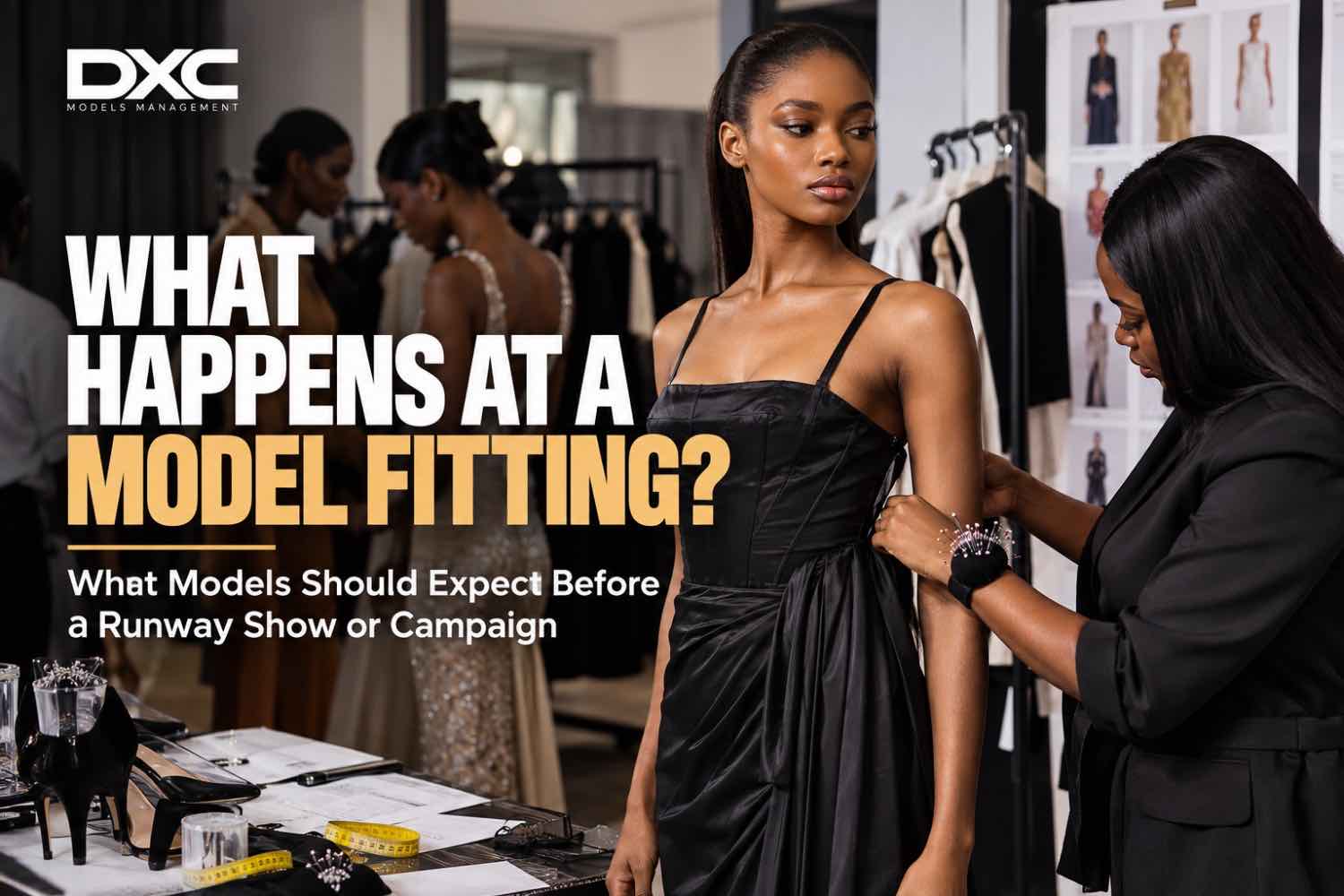
What Happens at a Model Fitting? What Models Should Expect Before a Runway Show or Campaign
You attended the casting.
Then the message comes:
“You have been called for a fitting.”
For a new model, that message can feel almost like getting the job.
Sometimes it means you are very close.
Sometimes you may already be provisionally booked.
But a fitting still has a job to do.
A fitting is where the clothes, the model and the creative idea finally meet in real life.
The designer, stylist or production team needs to see how the garment actually sits on your body, whether alterations are required, whether you can move properly in it and whether the overall look still works as intended.
If you are building a modelling career, understanding what happens at a model fitting will help you arrive prepared instead of confused.
What Is a Model Fitting?
A model fitting is a session where clothing, shoes, accessories or styling are tested on the model before the final fashion show, photoshoot, campaign or production.
During the fitting, the team may check:
- Whether the garment fits correctly
- Where adjustments are required
- How the clothing falls on the body
- Whether the model can walk or move comfortably
- Which outfit should be assigned to which model
- Whether shoes and accessories work with the look
- Whether the styling works as expected
- Whether the model’s current measurements match the information provided
For runway productions, fittings can also help determine the final order of looks and which model wears each garment.
01 Does Being Called for a Fitting Mean You Are Booked?
Not always.
This is one of the most important things new models need to understand.
Being invited to a fitting is generally a positive sign because the production team is investing time in testing you with the actual clothing.
But depending on the production, the final model lineup may still change.
A designer may discover that a particular garment works better on another model.
A look may be removed from the collection.
The show’s running order may change.
Measurements may not match what was originally submitted.
The client may adjust the casting direction.
So unless your agency or the production team has officially confirmed the booking, do not treat a fitting invitation as final confirmation by itself.
At the same time, do not arrive behaving as if you are still desperately auditioning.
You have been called because the team already sees potential fit.
Your job is to make the process easy.
02 Your Measurements May Be Checked Again
Do not be surprised if someone brings out a measuring tape.
The team may confirm measurements including:
- Chest or bust
- Waist
- Hips
- Height
- Shoulder width
- Inseam
- Shoe size
Fashion garments are often produced around specific measurements, so accuracy matters.
This is why models should never intentionally submit false measurements because they think a smaller waist or different size will improve their chances.
The garment eventually has to go on your actual body.
If your measurements have changed significantly since your casting or submission, tell your agency or the relevant contact rather than hoping nobody notices.
03 You May Try Several Outfits Before One Is Chosen
Do not assume that the first outfit you wear is automatically your runway look.
During a fitting, you may try multiple garments.
The designer may compare:
- Proportion
- Length
- Silhouette
- Movement
- Colour against your skin tone
- How the outfit photographs
- How the garment fits within the complete collection
You might start with one look and eventually be assigned another.
Sometimes the stylist is simply testing possibilities.
That is normal.
04 Expect Pins, Clips and Temporary Adjustments
A fitting is not always supposed to look perfect immediately.
That is why it is called a fitting.
A garment may be:
- Pinned at the waist
- Clipped at the back
- Shortened temporarily
- Adjusted around the shoulders
- Marked for tailoring
- Repositioned several times
The designer or tailor may need to see exactly where the garment needs alteration.
Stand naturally unless directed otherwise.
Constantly sucking in your stomach, changing your posture or shifting your body can make accurate fitting more difficult.
05 You May Be Asked to Walk
A garment can look perfect while you are standing still and become a completely different problem once you start moving.
For runway fittings, you may be asked to walk in the outfit.
The team may be checking:
- Whether the garment restricts your stride
- Whether the hem catches your shoes
- Whether a train moves correctly
- Whether a slit opens properly
- Whether straps stay in place
- Whether accessories interfere with movement
- Whether the overall look has the right runway effect
Walk normally first.
Then adjust if the runway director or designer gives you specific instructions.
06 What Should You Wear to a Model Fitting?
Unless the production gives you specific instructions, keep your arrival outfit simple.
You want clothing that allows the team to see your proportions and makes changing easier.
Good options may include:
- Fitted top or simple T-shirt
- Leggings, fitted trousers or simple jeans
- Simple underwear appropriate for changing into garments
- Clean, easy-to-remove shoes
- Heels if requested for runway
Avoid arriving in clothing that takes ten minutes to remove every time the team wants you to try another look.
For runway work, bringing a simple pair of heels you can confidently walk in can also be useful unless the production has specifically said footwear will be provided.
07 Keep Hair and Makeup Simple Unless Told Otherwise
A fitting is usually not the moment to arrive with styling that makes it difficult for the team to imagine the final look.
Unless instructed otherwise:
- Keep makeup light or minimal
- Keep your hair neat and manageable
- Avoid excessive body oil that could transfer onto garments
- Avoid anything that may stain clothing
Remember that some garments may be samples, one-off pieces or delicate designer clothing.
Treat them carefully.
08 What Should You Bring?
The production may give you a specific list.
If not, useful items can include:
- Your phone
- Charger or power bank
- Simple heels if relevant
- Basic flats or comfortable shoes
- Water
- Small personal grooming items
- Any wardrobe item specifically requested
Do not bring an entire suitcase unless somebody asked you to.
The fitting should be organised around the production requirements.
09 Be Ready to Change Clothes Several Times
This sounds obvious until a first-time model experiences a busy fitting.
You may change repeatedly.
Sometimes quickly.
There may be several models waiting and the designer may be working through an entire collection.
Be comfortable with the professional reality of wardrobe changes while still maintaining appropriate personal boundaries.
If proper changing facilities are available, use them.
If anything about the changing environment makes you uncomfortable, communicate professionally rather than feeling pressured to ignore your boundaries.
10 Do Not Treat the Clothes Casually
A garment may have taken days or weeks to make.
Some pieces are delicate.
Some are samples that cannot easily be replaced.
While wearing the garment:
- Do not eat carelessly over it
- Do not sit somewhere dirty without checking
- Do not pull aggressively at zips or fastenings
- Do not make alterations yourself
- Do not remove styling pieces without permission
If something feels too tight, tell the dresser.
Do not force it.
11 What If the Clothes Do Not Fit?
Do not panic.
That is partly what the fitting exists to discover.
The garment may be altered.
You may be assigned another look.
Another model may wear that particular garment.
Sometimes the production may decide that the fit cannot realistically be corrected.
That does not automatically mean you are a bad model.
Fashion production involves matching garments to bodies.
Not every garment will work on every model.
12 Do Not Change Your Body for a Last-Minute Fitting
If a garment is too small, the answer is not to starve yourself or drastically change your body overnight.
If your submitted measurements were accurate, let the production team solve the wardrobe problem professionally.
Models should maintain their health and provide current measurements honestly.
Trying to force rapid physical changes for one garment is neither a reliable nor professional solution.
13 Listen to the Designer, Stylist and Dressers
A fitting is collaborative.
You may receive instructions from several people.
For example:
“Try this one next.”
“Walk again.”
“Stand straight.”
“Lift your arms.”
“Turn around.”
“Try it with these shoes.”
Respond quickly and professionally.
You do not need to perform a full runway routine every time somebody asks you to take three steps.
Follow the direction being given.
14 Do Not Assume Silence Means Something Is Wrong
During fittings, designers and stylists may spend several minutes discussing the garment while you are standing there.
They may be speaking quietly.
They may be looking at the fabric.
They may be adjusting pins.
New models sometimes become nervous and assume:
“They don’t like me.”
Often, they are simply doing their job.
Do not personalise every production conversation.
15 A Fitting Can Take Longer Than Expected
A fitting may take twenty minutes.
It may also take considerably longer.
There may be:
- Many models
- Many garments
- Tailoring adjustments
- Late arrivals
- Creative changes
- Shoe problems
- Last-minute styling decisions
Do not schedule something extremely important ten minutes after the fitting is supposed to end unless you have confirmed the timing.
At the same time, productions should respect models’ time and communicate significant delays where possible.
16 Are Model Fittings Paid?
There is no single rule covering every modelling job.
Some fittings are included as part of the confirmed booking.
Some may attract a separate fitting fee.
Others may be part of the casting or selection process.
This depends on the client, agency, production, market and agreement.
If payment for the fitting matters to the booking, clarify it before attending rather than assuming.
For commercial jobs with significant time commitments, multiple fitting sessions or travel requirements, the agency should understand the full scope before confirming the model’s availability.
17 What If You Are Late?
Do not treat a fitting casually because it is not the actual show.
The designer may have several models scheduled one after another.
If you arrive thirty minutes late, you can disrupt:
- Garment assignment
- Tailoring
- Rehearsal planning
- Styling decisions
- The schedules of other models
Plan your journey properly.
If an unavoidable problem occurs, communicate early.
Disappearing and then arriving whenever you like is not professional.
18 Can You Still Be Removed After a Fitting?
It can happen.
Production decisions are sometimes made or changed after fittings.
Possible reasons include:
- A garment does not work on the model
- The number of runway looks is reduced
- The creative direction changes
- A designer reallocates looks
- Measurements differ substantially from those provided
- Availability changes
- Professional behaviour becomes an issue
But models should not attend every fitting expecting to be removed.
The purpose is usually to prepare the selected talent and garments for production.
Do your part professionally and allow the production team to make the decisions it needs to make.
19 What Happens After the Fitting?
Depending on the project, you may receive:
- Final booking confirmation
- Rehearsal information
- Show call time
- Hair and makeup instructions
- Location details
- A call sheet
- Wardrobe instructions
- Additional fitting dates
This is why models need to remain reachable after fitting day.
Do not switch off your phone and disappear for two days after a production has just assigned you a runway look.
20 The Fitting Is Part of Your Professional Reputation
Models sometimes think professionalism only matters when the camera is on or when they step onto the runway.
It starts much earlier.
People notice:
- Whether you arrive on time
- Whether you listen
- Whether you complain unnecessarily
- Whether you handle garments carefully
- Whether you take direction
- Whether you communicate properly
- Whether you make the production easier or harder
The person pinning a dress today may be recommending models for another designer next month.
The fashion industry remembers people who are good to work with.
A fitting is not just about whether a dress closes.
It is part of the production process.
It is where the designer confirms the garment, the stylist confirms the look and the model demonstrates that they can work professionally inside that process.
You do not need to arrive nervous.
You need to arrive prepared.
Know your measurements.
Be punctual.
Listen.
Handle the clothes properly.
And understand that being easy to work with is part of being a professional model.
Frequently Asked Questions About Model Fittings
What happens at a model fitting?
Models usually try on clothing while the designer, stylist or production team checks fit, movement, proportions, alterations, footwear and styling. Measurements may also be confirmed.
What should I wear to a model fitting?
Unless instructed otherwise, wear simple fitted clothing that shows your proportions and is easy to change out of. Runway models may also be asked to bring heels.
Does a fitting mean I got the modelling job?
A fitting is usually a positive sign, but it does not always guarantee final selection unless the booking has already been officially confirmed.
Can a model be dropped after a fitting?
Yes, production decisions can change. However, fittings are generally intended to prepare selected or strongly considered models for the final production.
How long does a model fitting take?
There is no fixed time. A simple fitting may be quick, while a major fashion production involving multiple garments and models may take much longer.
Should I wear makeup to a fitting?
Unless told otherwise, minimal makeup is usually more practical. The production may want to see your natural features and avoid makeup transferring onto garments.
What if the clothes do not fit me?
Tell the dresser or designer. The garment may be altered, another look may be assigned or the production may make another casting decision. Do not force yourself into a garment that clearly does not fit.
Are fashion model fittings paid?
It depends on the booking. Some fittings are included in the model’s job fee, some are paid separately and some form part of the selection process. Clarify the terms through the agency or production contact.
Should I change my measurements before a fitting?
No. Provide accurate current measurements and maintain your health. Do not attempt unsafe last-minute body changes to fit a particular garment.
Want to Become Better Prepared for Professional Modelling?
DXC Models develops aspiring and working models for the realities of castings, runway, commercial bookings and professional production environments.
Talent is important. Preparation, professionalism and understanding how the industry actually works matter too.