Brands & Advertising · DXC Industry Guide
Follower Count Is Not a Casting Brief: What Brands Should Look For Instead
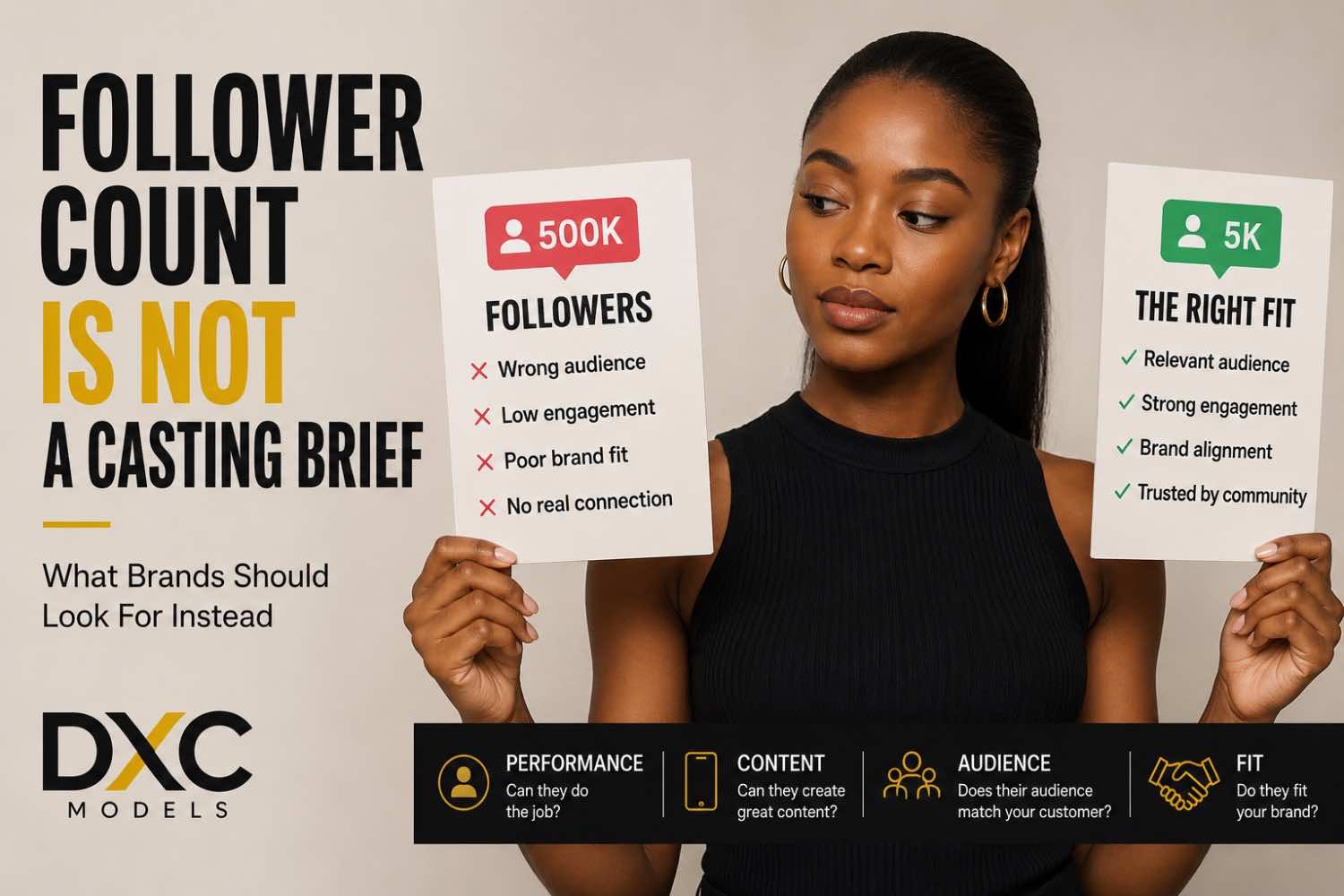
A person can have 500,000 followers and still be completely wrong for your campaign. Another person can have 5,000 followers and be exactly what the campaign needs.
DXC Models
The Industry Is Asking Better Questions
For years, one of the easiest ways to make a campaign feel digitally relevant was to attach a popular influencer to it.
Big audience. Big announcement. Big numbers.
But Nigerian marketers are increasingly questioning whether reach by itself actually produces meaningful influence.
A recent Nigerian consumer insight report from the National Institute of Marketing of Nigeria and Lagos Business School identified a shift away from celebrity driven influencer marketing towards smaller creators and community figures with more trusted relationships with their audiences.
Industry conversations are also moving towards measuring engagement quality, relevance, trust and actual campaign outcomes rather than simply celebrating follower numbers.
That should also change how brands think about casting.
First, Decide What You Are Actually Buying
Before asking:
“How many followers does this person have?”
ask:
“What exactly do we need this person to do?”
Because there are several very different things a campaign may be buying.
- Modelling ability
- Content production
- Acting or performance
- Audience access
- Credibility within a particular community
- Social distribution
- Product demonstration
- Brand association
Those things can exist in one person.
But they do not automatically come together.
01
If You Need a Model, Cast for Performance
Imagine a skincare campaign.
The talent needs to take direction, interact naturally with the product, maintain consistent positioning across takes, give different expressions and potentially move between photography and video.
A large social following does not tell you whether someone can do any of that.
The person with 800 followers may be significantly better at executing the visual brief than the person with 800,000.
Can this person make the campaign believable?
We explored this in our guide,
What Nigerian Brands Actually Look For When Casting Commercial Models in 2026
.
02
If You Need Content, Cast for Creation Ability
A content creator brings a different skill.
They may understand how to structure a TikTok, speak naturally to camera, create a hook, demonstrate a product or turn a campaign message into something that feels native to the platform.
Again, follower count does not automatically prove content ability.
Look at the actual work.
Can they tell a story?
Can they communicate the product clearly?
Does their content feel natural?
Can they interpret a brief without making every brand look exactly the same?
03
If You Need Reach, Then Audience Matters
There are campaigns where distribution genuinely matters.
Maybe you are launching a product and want immediate awareness within a specific community.
In that situation, the talent’s audience becomes part of what you are paying for.
But even then, the number at the top of the profile is only the beginning.
Brands should also examine:
- Who actually follows this person?
- Where is the audience located?
- Does the audience match the intended customer?
- How consistently do people engage?
- Do followers trust recommendations from this person?
- Does the creator normally speak about products in this category?
Campaign relevance over vanity metrics
04
Engagement Is Better Than Followers, But It Is Still Not the Whole Story
Marketers have understandably moved towards engagement rates as a better indicator than follower count.
That is an improvement.
But likes and comments still need context.
A comedy creator may generate enormous engagement while having very little natural connection to a luxury skincare campaign.
A fashion creator may have a smaller audience but significantly stronger relevance for a clothing brand.
The question is not simply:
“Who gets engagement?”
It is:
“Whose influence makes sense for this particular brand, audience and campaign?”
05
Community Can Matter More Than Celebrity
This is one of the more interesting developments in Nigerian marketing right now.
The recent NIMN and Lagos Business School consumer research identified growing value in micro and nano creators, particularly people with closer relationships to clearly defined communities. :contentReference[oaicite:0]{index=0}
The attraction is not simply that smaller creators cost less.
It is that influence often comes from familiarity and trust.
A creator who is genuinely respected within a specific beauty, fashion, parenting, fitness, technology or lifestyle community may offer a brand something a much larger general audience cannot.
06
Do Not Confuse Popularity With Brand Fit
Someone can be extremely popular and still be wrong for your brand.
Look at:
- Personal image
- Previous partnerships
- Audience demographics
- Tone of communication
- Public reputation
- Visual identity
- Values and cultural fit
A campaign should not feel like the brand simply rented whoever was trending that week.
The talent should make sense inside the brand’s world.
07
One Person Can Still Do Everything
There are genuinely valuable hybrid talents.
Someone may be an excellent model, produce strong platform native content and have an engaged audience.
That can be incredibly useful.
But those are three separate forms of value.
We explained the distinction in
Model vs Creator vs Influencer: What Does Your Brand Actually Need?
.
If you expect someone to model, create content and also publish that content to their audience, state all three requirements in the brief.
Do not book someone as a model and then casually add:
“Please make three TikToks and post them on your page too.”
Those are additional deliverables and should be discussed properly.
The Campaign Objective Should Come First
This is the simplest way to avoid bad casting.
Start with the objective.
If the goal is beautiful campaign imagery, prioritise modelling and performance.
If the goal is platform native branded content, prioritise creation ability.
If the goal is reaching a trusted audience, prioritise relevant influence and community.
If the campaign needs all three, look for hybrid talent and budget accordingly.
Do not start casting by asking who has the biggest following. Start by asking what the campaign needs this person to accomplish.
A Better Casting Brief
Instead of sending an agency:
“We need an influencer with at least 100K followers.”
a more useful brief could say:
We are launching a skincare product for Nigerian women aged 22 to 35. We need talent who can model the product naturally, speak comfortably to camera and produce two short social videos. Audience reach is useful but secondary to performance and content ability.
That brief immediately gives the agency something meaningful to cast against.
Follower Count Is Data. It Is Not Strategy.
Followers can absolutely matter.
Creators and influencers remain important parts of modern advertising, and current Nigerian marketing research continues to highlight the commercial value of trusted creator communities. :contentReference[oaicite:1]{index=1}
The mistake is turning one number into the entire talent strategy.
Before choosing anyone for a campaign, ask:
Can they perform?
Can they create?
Can they distribute?
Do people trust them?
Do they fit the consumer?
Do they fit the brand?
And most importantly:
What exactly are we hiring them to do?
DXC Models
Need Talent for a Campaign?
Tell DXC what your campaign needs. We can help identify talent based on the brief, audience, required skills and intended usage.