PORTFOLIOS • PHOTOGRAPHY • MODEL DEVELOPMENT
Model Test Shoots in Nigeria: TFP, Paid Tests & When You Should Work for Free
A photographer sends you a message:
“Hi, I’d like to collaborate with you for a test shoot.”
No payment.
You get pictures.
They get pictures.
Fine.
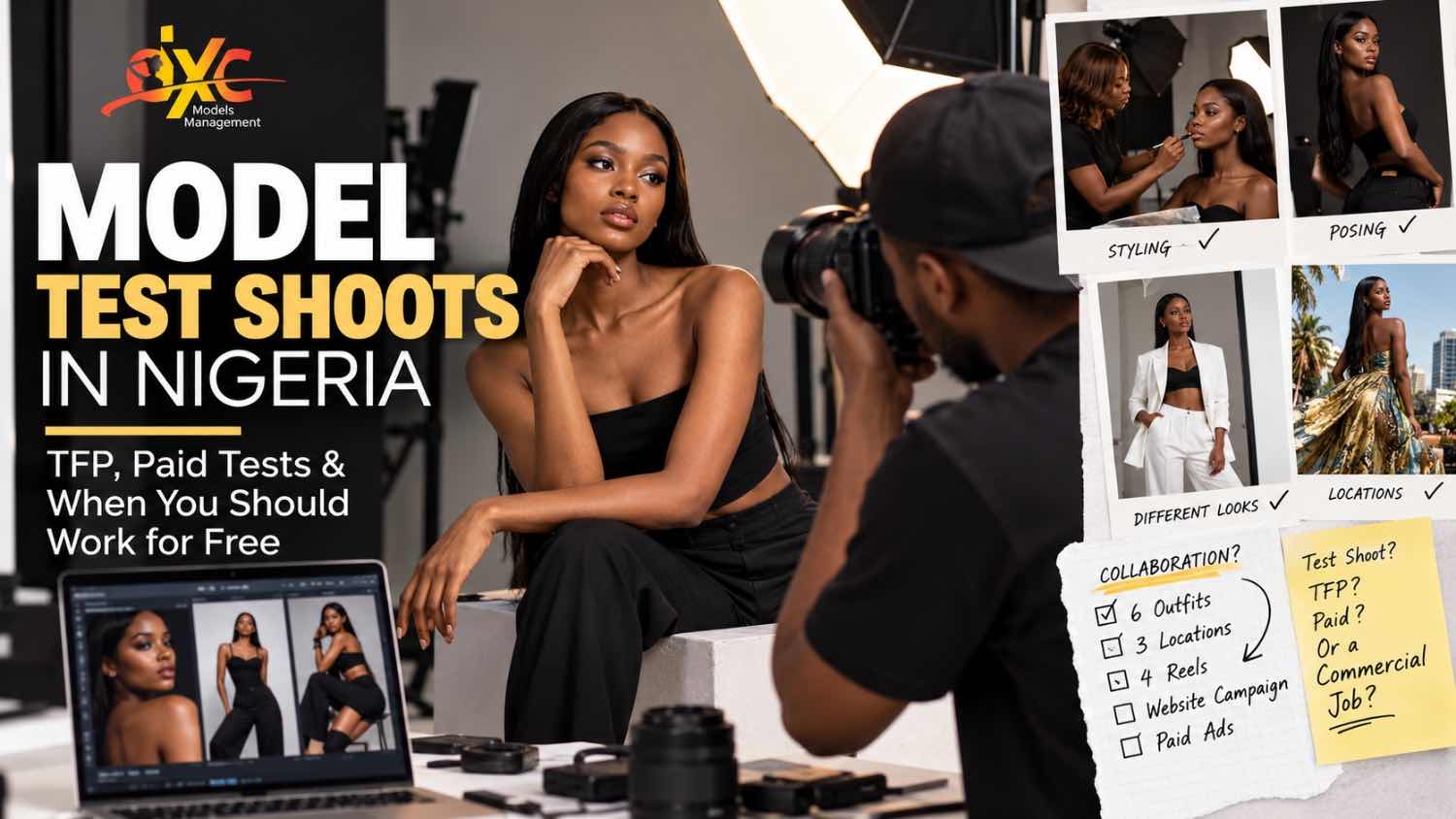
Then another person says they also want a “collaboration” but suddenly there is a clothing brand, six outfits, three locations, product videos and content that will be used to sell something.
That is where models need to start asking questions.
Because a model test shoot, a TFP collaboration, a paid portfolio session and a commercial modelling job are not automatically the same thing.
What Is a Model Test Shoot?
A test shoot is primarily created to develop or assess creative material rather than to advertise a client’s product.
For a model, it can help build experience in front of the camera and produce useful images for a portfolio.
For a photographer, it can be an opportunity to test lighting, styling, a concept or a new creative direction.
An agency may also arrange tests to understand how a developing model photographs and to build stronger material for their book.
The important part is the purpose.
A test shoot is about development and portfolio building. A commercial shoot is about producing content for somebody’s business.
What Does TFP Mean?
TFP traditionally means Time for Print or Trade for Print.
Today, nobody necessarily needs to leave the shoot carrying printed photographs.
The basic idea remains the same:
The model contributes their time.
The photographer contributes their photography and editing.
Sometimes makeup artists, stylists or designers also contribute their work.
Instead of everybody being paid a normal commercial fee, the creative material becomes part of the value exchanged.
The model gets useful pictures.
The photographer gets useful pictures.
Everybody should understand what they are receiving before the shoot happens.
Is Every Unpaid Shoot TFP?
No.
Calling something “TFP” does not automatically make it TFP.
Look at what the pictures are being created for.
If a photographer and model are deliberately creating portfolio material together, that can make sense as a collaboration.
If a fashion brand needs photographs for its website, Instagram adverts, campaign launch and product sales, the situation is different.
There is now a commercial beneficiary.
The business is receiving advertising material.
That does not mean every brand collaboration must always involve exactly the same type of payment structure.
But the model should understand what the company is receiving and what they are receiving in return.
The “Collaboration” That Is Actually a Full Client Job 😭
This is where things can become interesting.
Someone says:
“It’s just a collaboration.”
Then the brief arrives:
- Call time: 6:00 AM
- Six outfits
- Professional makeup
- Studio and outdoor location
- Product photographs
- Four Reels
- Website content
- Paid Instagram advertising
- Worldwide usage
At that point, the word “collaboration” is doing plenty work.
Models need to learn to look beyond the label and understand the actual project.
What Is a Paid Portfolio Shoot?
Sometimes the model is the client.
You may hire a photographer specifically because you need professional portfolio material.
In that case, paying for the photography does not automatically mean anything suspicious has happened.
You are purchasing a photography service.
This is different from a company hiring you to advertise its product and then charging you for the privilege of working on its campaign.
The question is always:
Who is hiring whom, and what is everybody receiving?
Test Shoot vs Polaroids
Do not confuse a model test with your polaroids or digitals.
Polaroids are deliberately simple.
They are supposed to show what you currently look like without elaborate styling, heavy makeup or dramatic editing.
A test shoot can involve professional lighting, styling, makeup, creative direction and actual posing.
One shows the agency what you look like.
The other can show what you can do with a creative team.
Do New Models Need Test Shoots?
Test shoots can be extremely useful for developing models.
They give you somewhere to make mistakes without the pressure of a major client waiting for deliverables.
You learn what your hands do when you are nervous.
You discover which angles work.
You learn how quickly you can change expression.
You start understanding lighting.
You learn how to interpret direction from somebody behind the camera.
And importantly, you discover that knowing three poses from Instagram is very different from modelling through an entire shoot.
When Is an Unpaid Test Shoot Worth Doing?
There has to be value for you too.
An unpaid collaboration can make sense when:
- The photographer’s work genuinely strengthens your portfolio
- The concept gives you something your current book does not have
- The creative team is strong
- You need experience in that type of shoot
- The images fit the direction you are developing toward
- The terms are clear before the shoot
- Everybody involved is contributing meaningful value
“Free pictures” alone is not automatically enough.
If you already have stronger images than what the collaboration is likely to produce, ask yourself why you are doing it.
When Should You Probably Say No?
You do not need to accept every photographer who offers you photographs.
Be cautious when:
- The concept has no relevance to your portfolio
- The person’s work is significantly below your current standard
- They refuse to explain how the images will be used
- The shoot suddenly becomes a commercial campaign after you agree
- You are expected to carry major costs while everybody else benefits
- The location or arrangement feels unsafe
- You are pressured into nudity or styling you did not agree to
- They cannot explain when or whether you will receive images
How Many Pictures Should You Receive?
There is no universal number.
This is exactly why you should discuss it before the shoot.
Do not assume:
“We shot 500 pictures, therefore I am receiving 500 edited pictures.”
That is rarely how professional photography works.
Agree on what the model can reasonably expect.
For example:
Will you receive selected edited images?
How many?
Who chooses them?
Approximately when will they be delivered?
Can you post them?
Does the photographer require credit?
Clear expectations prevent plenty unnecessary WhatsApp fights later.
Ask Who Can Use the Images
This is one of the most important questions.
You agree to a creative test with a photographer.
Three months later, you discover the image being used to advertise somebody’s product.
That is no longer the purpose you originally understood.
Before the shoot, clarify whether the images are intended for:
- Model portfolio
- Photographer portfolio
- Social media
- Editorial submission
- Website portfolio
- Commercial advertising
Commercial usage should not simply appear later because somebody likes the picture.
Terms and permissions matter.
What If a Brand Provides Clothes for the Test?
That alone does not automatically make the shoot commercial.
Designers sometimes lend clothing to photographers and stylists for editorial or portfolio projects.
But again, look at the purpose.
Was the clothing simply used creatively?
Or was the model specifically hired to produce marketing material for that brand?
Those are different situations.
Should Models Pay for Test Shoots?
Sometimes, yes.
Sometimes, no.
A model may deliberately pay an experienced photographer to create specific portfolio material.
An agency may recommend professional testing because the model needs stronger images.
A photographer may also invite a model to collaborate at no cost because the photographer wants the images too.
All of those arrangements can exist.
The problem begins when people speak as though there is only one legitimate structure.
Understand the service.
Understand the cost.
Understand what you receive.
Then make the decision.
A Test Shoot Is Not a Guaranteed Job
Building a beautiful portfolio does not mean clients will automatically start booking you the following week.
A test is development.
It can improve your material.
It can improve your camera confidence.
It can reveal your strengths.
But paid work still depends on market fit, client demand, representation, availability and the individual brief.
How DXC Looks at Test Shoots
For us, the question is not simply:
“Are the pictures beautiful?”
The better question is whether the shoot gives the model something useful.
Does it reveal another side of the model?
Does it strengthen a weak area of the portfolio?
Does it support the category we are positioning the model for?
Does it show range?
Or is it simply another collection of attractive photographs that looks exactly like everything already in the book?
A model does not need twenty random shoots.
They need useful material.
BEFORE YOU AGREE TO A “COLLAB”, ASK:
Who is organising the shoot?
What is the purpose?
Is there a commercial client?
Who is paying whom?
What am I expected to provide?
What images will I receive?
When will I receive them?
How can the images be used?
Who covers transport, makeup or styling costs?
Is this actually useful for my portfolio?
Frequently Asked Questions
What is a test shoot in modelling?
A model test shoot is generally a photoshoot created for model development, camera assessment or portfolio building rather than for a specific commercial advertising campaign.
What does TFP mean?
TFP generally means Time for Print or Trade for Print. The model and photographer collaborate without their normal commercial fees because both receive useful images from the shoot.
Do models get paid for test shoots?
Not necessarily. Some tests are unpaid collaborations, while in other situations a model or agency may pay a photographer to produce specific portfolio material.
Is TFP the same as working for free?
Money may not change hands, but a proper TFP arrangement should still involve a clear value exchange. The model receives useful imagery while the photographer or creative team also receives material for their work.
Can a brand shoot be called TFP?
A label alone does not determine what the project is. If a company is creating advertising or sales material using the model, the model should understand the commercial purpose, usage and compensation arrangement before agreeing.
Do I need test shoots before applying to an agency?
Not always. Many agencies can initially assess new talent using clean current photographs or polaroids. Test shoots become useful when developing stronger professional portfolio material.
What is the difference between a test shoot and a portfolio shoot?
The terms can overlap. A test may be arranged collaboratively or by an agency to assess and develop a model, while a portfolio shoot can also be a photography service deliberately purchased by the model to create professional images.
Building Your Modelling Portfolio?
Before spending money on random shoots, understand what your portfolio actually needs.
Send DXC your current photographs and modelling information on WhatsApp and our team can guide you on the appropriate next step.
Important: Test shoots, portfolio development, training or agency representation do not guarantee paid modelling bookings.