African Fashion · Industry Insight
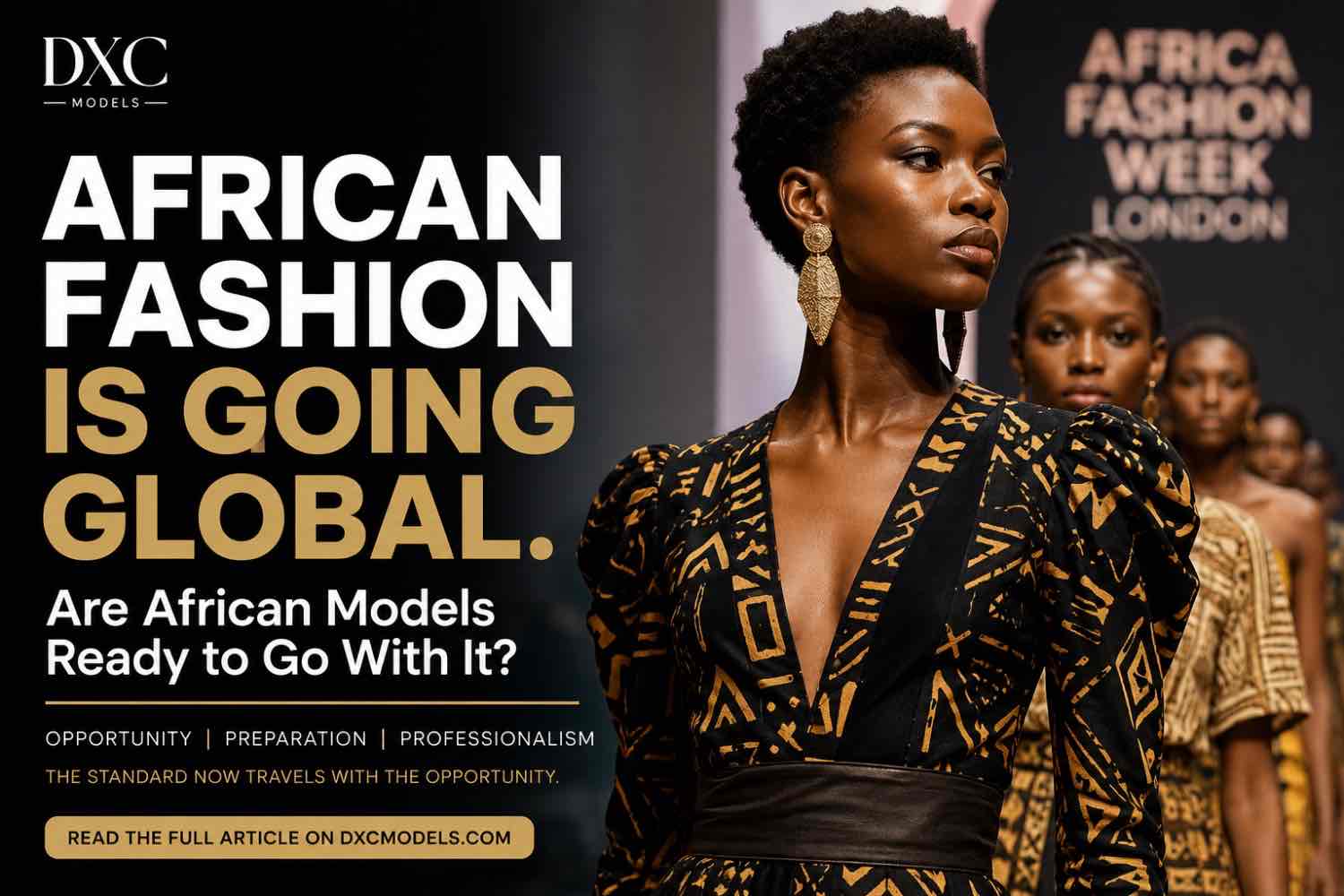
African Fashion Is Going Global. Are African Models Ready to Go With It?
African fashion is increasingly appearing on international runways, exhibitions, creative programmes and global industry platforms. That visibility creates opportunity for African models too. But opportunity alone does not make talent internationally ready.
DXC Models
African Fashion Had Another International Moment This Weekend
Africa Fashion Week London held its 2026 live shows in Central London on 22 and 23 August, bringing African and African inspired designers, creatives, buyers, media and industry professionals together.
The official programme also included creative industry discussions, an AI in Design seminar and designer development sessions in the days leading up to the runway shows.
According to Africa Fashion Week London, the platform has showcased more than 3,000 designers and creatives since it was founded in 2011.
View the official Africa Fashion Week London 2026 programme
.
Nigerian brands were also visible within the 2026 designer and exhibitor line up, alongside designers from several other African countries. That matters because African fashion is not only being discussed as culture. It is increasingly being presented as a commercial and creative industry capable of travelling across markets.
See the official AFWL 2026 designer line up
.
But Where Do African Models Fit Into That Growth?
When African designers enter international spaces, models are part of the visual language used to present those clothes.
Campaigns need faces.
Runways need bodies.
Beauty brands need talent.
Advertising needs people who can communicate stories.
So the growth of African fashion should naturally create more conversations about African modelling talent.
But there is an important difference between being discovered and being prepared.
If an international opportunity appeared tomorrow, would the model only be excited, or would they actually be ready to work at the level expected?
01
Your Walk Cannot Be the Only Thing You Develop
Runway remains one of the most visible parts of modelling, especially around fashion week.
But a model hoping to build a broader career needs more than a strong walk.
International opportunities can involve:
- Editorial photography
- Commercial campaigns
- Beauty
- E commerce
- Showroom modelling
- Video
- Fit modelling
- Fashion presentations
A model whose development begins and ends with runway may be limiting the number of opportunities they can realistically take.
02
Your Polaroids Need to Represent What You Actually Look Like
When talent is being considered across borders, clean and current images become even more important.
An agency or client may initially see you through a screen.
They need to understand your current face, proportions, hair and overall appearance without heavy styling hiding the information they need.
This is why strong polaroids remain such an important modelling tool.
If you are still unsure how to create them, read our guide:
How to Take Modelling Polaroids at Home With Your Phone
.
03
You Need to Understand Measurements and Fit
Knowing your measurements is not administrative information you should guess when someone asks.
It can determine whether garments prepared for a show, fitting or campaign will actually work on you.
Models should know their current measurements and update them when their body changes significantly.
The more professional the opportunity becomes, the less acceptable inaccurate information becomes.
04
Professionalism Has to Travel With You
International readiness is not only about appearance.
Can you follow instructions?
Can you communicate properly?
Can you arrive on time?
Can you handle long fittings or production days?
Can you work respectfully with people from different cultures?
Can you stay composed when plans change?
Your professionalism becomes part of your reputation.
Professional readiness
05
Models Need Commercial Skills Too
Fashion visibility can attract opportunities beyond runway.
Brands may need models who can interact with products, move naturally, deliver expressions, work on video and follow a commercial brief.
We recently explored this in:
Why Commercial Models Need More Than Poses in 2026
.
The wider your professional ability, the more situations you can realistically be considered for.
06
Social Media Should Support Your Professional Image
A model does not need to become an influencer simply because the fashion industry is becoming more digital.
But when someone searches your name or opens your profile, what do they see?
An international scout, agency or client may encounter your social media before ever meeting you physically.
Your account does not have to look perfect.
But it should not make it difficult to understand who you are professionally.
Read:
Do Models Need Social Media in 2026?
.
07
Learn How the Business Side Works
International opportunity can sound exciting enough that models forget to ask practical questions.
Who is representing you?
Who is paying for travel?
What costs can be deducted?
What is the commission?
How long are you expected to stay?
What usage rights are attached to a campaign?
Who owns the images?
What happens if AI or digital likeness rights appear in the agreement?
The more valuable an opportunity becomes, the more important it becomes to understand what you are agreeing to.
08
Not Every International Opportunity Is Automatically a Good Opportunity
The words “international” and “global” can make young models stop asking questions.
They should not.
A legitimate international opportunity should still be verified.
You should understand who is organising it, what is expected, what it costs, who is responsible for travel and accommodation, and what contractual relationship is being created.
DXC has previously discussed this when covering opportunities such as
Future Face Global 2026
.
The Competition Is African Too
Another important reality is that Nigerian talent is not only competing with other Nigerian models.
Africa’s modelling ecosystem continues to produce talent from South Africa, Kenya, Ghana, Senegal, Côte d’Ivoire, Uganda, Rwanda, Nigeria and many other markets.
Africa’s Next Super Model is currently accepting registrations for its 2026 edition, another reminder that scouting and model development increasingly operate across borders rather than within one city or country.
View the official Africa’s Next Super Model 2026 registration page
.
For an aspiring Nigerian model, the lesson is not to become intimidated.
The lesson is to understand the standard you are preparing for.
African models should not prepare only to be noticed in Africa. The goal should be to develop talent that can enter a professional environment anywhere and still understand what is expected.
What Does Global Readiness Actually Look Like?
Current, accurate polaroids
Correct measurements
Strong movement and runway fundamentals
Commercial camera confidence
Professional communication
Understanding of contracts and usage
A clean professional digital presence
Ability to take direction
Reliability
A willingness to keep developing
African Fashion Can Travel. African Talent Must Be Ready to Travel With It.
It is encouraging to see African designers, textiles, creative businesses and fashion platforms occupying more international spaces.
But visibility should create a higher standard, not simply more excitement.
If African models want to benefit from a more globally visible African fashion industry, development needs to become more serious too.
The goal is not simply to look international.
The goal is to be professionally ready when the opportunity arrives.
DXC Models
Build for More Than the Next Casting
DXC Models develops talent with the skills, knowledge and professional awareness needed to build sustainable modelling careers.