DXC MODELS | AI, CASTING & MODEL RIGHTS
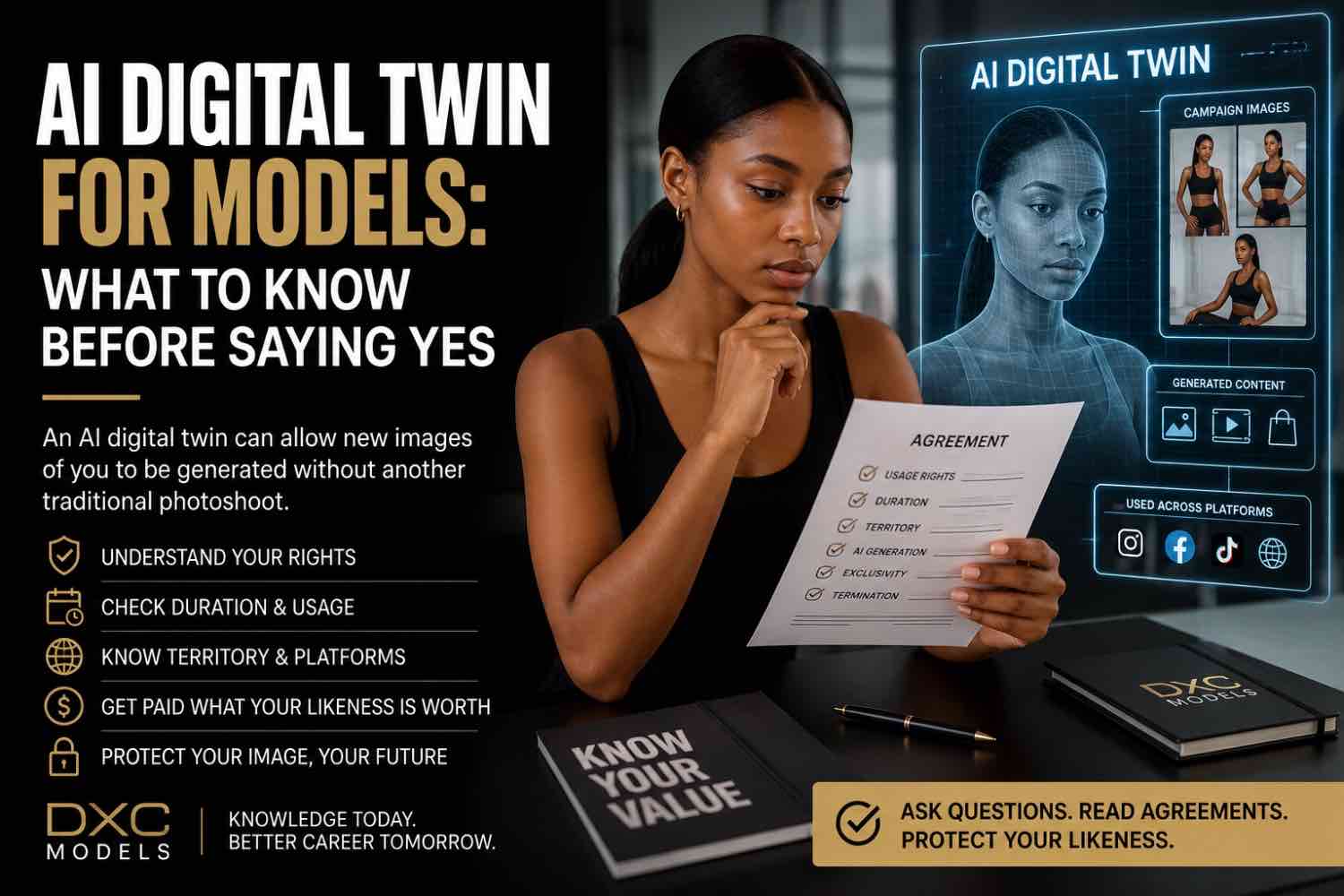
AI Digital Twin for Models: What to Know Before Saying Yes
Would you allow a brand to create a digital version of you that could appear in campaign images without you returning for another traditional photoshoot?
That question is becoming increasingly relevant for models.
A current international casting is recruiting men and women worldwide for what it describes as an AI Digital Twin project for an international sportswear brand.
The online casting is paid, lists compensation of €100 to €200, and asks applicants to imagine their likeness being used to create sportswear campaigns without the need for traditional photoshoots.
That does not automatically make the opportunity good or bad.
But it does change the conversation.
An AI modelling job may look like one booking, but the asset being licensed could potentially create many more images after the model has left the set.
For models, agencies and brands, that means the important question is no longer only:
“How much does the shoot pay?”
It is also:
“What exactly are you paying for the right to do with my likeness?”
What Is an AI Digital Twin for Models?
An AI digital twin is a digital representation of a real person that can potentially be used to create new visual material resembling that person.
Depending on the technology and agreement, the system may be trained or created using photographs, video, scans, body data, facial information, motion or other material supplied by the model.
Once created, the digital version may be capable of appearing in images or other media that the real model never physically posed for.
This is different from ordinary retouching.
If a photographer removes a blemish or adjusts the colour of a photograph, the original performance still came from the model.
With a sufficiently capable digital replica, entirely new material may potentially be generated.
The model might never have worn that particular outfit.
They might never have stood in that location.
They might never have made that particular pose.
Yet the final image could still look like them.
Why Models Should Pay Attention Now
AI generated advertising is moving from experimentation into real commercial workflows.
Models may increasingly encounter briefs involving digital replicas, synthetic imagery, virtual fitting, AI generated campaign extensions or licensing of image data.
For Nigerian models, the opportunity may even come from outside Nigeria because some of these projects can be produced remotely.
That creates access to new kinds of work.
It also creates new questions around contracts and compensation.
DXC Note: We are not telling models to reject AI work. We are saying that models should understand what they are agreeing to before licensing something as valuable as their identity.
1. Are You Being Paid for a Shoot or for Your Likeness?
This is the first distinction models need to understand.
A traditional modelling fee often compensates the model for performing during a shoot, while the contract separately determines how the resulting photographs can be used.
An AI digital twin may involve something broader.
The model may be supplying data that allows additional images to be created later.
So a fee that initially sounds reasonable should not be judged only by the number of hours spent creating the digital twin.
The model should also understand the commercial value of what the client can produce afterwards.
For example:
- Can the brand create one final campaign image?
- Can it create 100 variations?
- Can the digital twin appear in future collections?
- Can it be used on websites, billboards and social media?
- Can it continue generating material after the original campaign ends?
Those are very different transactions.
2. What Exactly Can the Brand Generate?
Before agreeing, ask for a reasonably clear description of the intended use.
“AI usage” is too broad by itself.
A model should understand whether the digital twin can be used to generate:
- Still photographs
- Video
- Animated content
- Social media advertising
- E-commerce images
- Virtual try-on content
- Campaign extensions
- Future advertising
The more uses the client receives, the more important the agreement becomes.
3. How Long Can Your Digital Twin Be Used?
Duration matters.
Three months is not the same as three years.
And three years is very different from permanent use.
Models should be especially careful with language such as:
Perpetual.
Irrevocable.
Worldwide.
All media.
Existing and future technologies.
These phrases are not automatically unacceptable, but models need to understand how much control they are giving away.
A limited campaign should ideally have clearly understood limits.
4. Where Can the AI Version of You Appear?
This is known as territory.
A campaign may be:
- Nigeria only
- West Africa
- Africa
- Europe
- Worldwide
A global licence can carry greater commercial value because the model’s likeness may be used across many markets.
Models should know the territory before agreeing to a fee.
5. Can Your Face or Body Be Changed?
This is one of the more complicated questions.
If a digital twin can generate new material, what level of alteration is permitted?
Could the technology:
- Change your body shape?
- Change your skin tone?
- Change your hair?
- Make you appear older or younger?
- Place your face on a different body?
- Create suggestive or controversial material?
- Make you appear to endorse something you never agreed to?
A model’s likeness is connected to their reputation.
That is why restrictions around manipulation can matter just as much as payment.
6. Can Your Digital Twin Be Used for Another Product?
Imagine agreeing to model sportswear.
Six months later, your digital twin appears advertising another product that was never discussed during the original booking.
Would the original agreement allow that?
Models should ask whether permission applies to:
One campaign.
One product category.
One brand.
Or anything the company chooses to create later.
The difference matters.
7. Can the Digital Twin Be Given to Another Company?
Models should also understand whether the client can transfer, sublicense or share the digital replica with:
- Advertising agencies
- Production companies
- Technology providers
- Other brands
- Affiliated companies
- Third-party platforms
Some sharing may be necessary to produce the campaign.
But the model should know who may gain access and for what purpose.
8. What Happens When the Agreement Ends?
This may become one of the biggest questions in AI modelling contracts.
If a licence expires, what happens to the digital twin?
Is it deleted?
Archived?
Disabled?
Can existing campaign material remain online?
Can the underlying model or dataset continue being used?
Can new images still be generated?
An agreement should ideally make the end of the relationship understandable, not only the beginning.
9. Does the Model Approve the Final AI Images?
With traditional modelling, the model normally knows what happened during the shoot.
AI can create material afterwards.
That raises another question:
Will the model see or approve what is generated?
Approval rights will not be appropriate or available for every commercial job.
But where a person’s likeness can be placed into materially different situations, models should at least understand the approval process before signing.
10. Should AI Usage Affect What a Model Charges?
Potentially, yes.
There is no single universal price for an AI digital twin.
The value depends on the scope of the rights.
A narrowly defined one-campaign licence is different from a worldwide, multi-year agreement allowing extensive generation of new material.
Models and agencies should therefore look beyond the production-day fee.
Consider:
- Duration
- Territory
- Number of campaigns
- Media
- Exclusivity
- Ability to generate new material
- Transfer rights
- Future uses
The broader the commercial rights, the more carefully compensation should be considered.
11. Can the Agreement Affect Future Modelling Jobs?
Imagine your digital twin is licensed to one sportswear company.
Could that stop you from working physically with a competing sportswear company?
This is where exclusivity becomes important.
A model should ask:
Which competitors are covered?
Which product category?
Which countries?
For how long?
Does exclusivity apply only to the AI campaign or to the model personally as well?
An inexpensive booking can become much more expensive to the model if it prevents them from accepting better work later.
12. What Happens to the Data Used to Create You?
The final campaign image is not necessarily the only valuable asset.
The photographs, scans, recordings or other data used to create the digital twin may also matter.
Ask what happens to the source material.
How long is it stored?
Who can access it?
Can it be reused?
Can it be used to improve another AI system?
Can it be combined with other datasets?
The model should understand whether they are licensing campaign usage or contributing data for something broader.
Before You Agree to an AI Digital Twin Job, Ask These Questions
1. What exactly are you creating from my likeness?
2. Which campaign or product will it be used for?
3. How long can it be used?
4. Which countries and platforms are covered?
5. Can new images or videos be generated later?
6. Can my appearance be materially altered?
7. Can the digital twin be transferred or sublicensed?
8. Is there any exclusivity?
9. What happens to my digital replica and source data when the licence ends?
10. Is the compensation for the shoot, the usage rights, or both?
AI Work Is Not Automatically a Red Flag
This distinction is important.
A legitimate brand openly explaining that it wants to create an AI digital twin is very different from someone secretly taking a model’s photographs and using them to train or generate commercial material without permission.
AI itself is not the red flag.
Lack of transparency is.
Models should know what technology is being used, what rights are requested and what they are being paid for.
The DXC View
AI will create opportunities for models, but opportunity without understanding can quickly become exploitation.
The goal should not be to make models afraid of technology.
The goal should be to make models knowledgeable enough to participate in the new industry without casually giving away control of their identity.
A model’s face, body, movement and likeness are part of their commercial value.
If technology makes that likeness more reusable, then models need to become more informed about how it is licensed.
We have already covered some of the questions models should ask before agreeing to AI image usage in our guide:
Models should also learn how to verify opportunities before submitting personal information or images:
Final Thought
The question is no longer simply whether AI will enter modelling.
It already has.
The more useful question is whether models will enter this new part of the industry understanding what their likeness is worth and what they are agreeing to.
Do not only ask, “How much does the job pay?” Ask, “What does this payment give you permission to do with me?”
Building a Modelling Career?
DXC Models helps aspiring and developing models understand both the creative and professional sides of the modelling industry.