CASTINGS • APPLICATIONS • MODEL BASICS
Model Measurements in Nigeria: How to Measure Yourself Correctly for Castings
A casting asks for your measurements and you confidently reply:
“I’m a size 8.”
Unfortunately, that is not what they asked you.
If you are applying to an agency or submitting for a modelling job, knowing your current model measurements is one of the most basic pieces of information you should have available.
And no, guessing is not close enough.
What Measurements Do Models Usually Need?
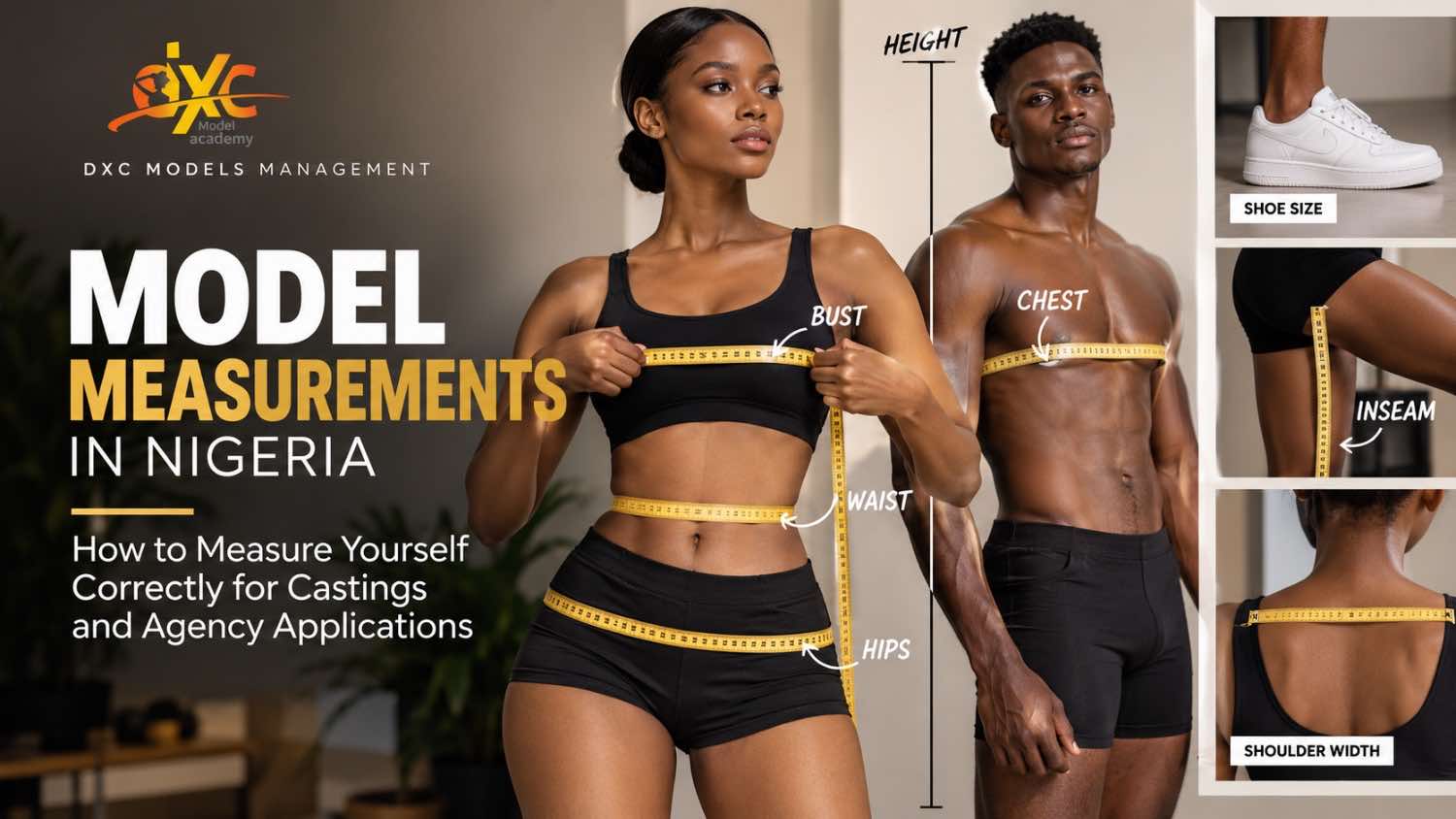
The exact information depends on the type of modelling and the casting, but models may be asked for:
- Height
- Bust or chest
- Waist
- Hips
- Dress or clothing size
- Shoe size
- Inseam
- Shoulder width in some cases
You may not need every single measurement for every job.
But if you are actively modelling, you should know the basics without having to start searching for a measuring tape every time somebody sends you a brief.
Why Do Model Measurements Matter?
Because clients are not asking out of curiosity.
Measurements can help an agency or client understand whether you may fit the requirements of a particular job.
For fashion work, garments may already exist in specific sample sizes.
For commercial campaigns, measurements may help wardrobe teams prepare clothing before you arrive.
For runway, designers may need models whose proportions work with the collection being shown.
For fittings, accurate measurements can save everybody time.
Your measurements are working information. They are not something to exaggerate because you think one number sounds more “model-like.”
Before You Start Measuring
Use a flexible measuring tape, the type normally used by tailors.
Do not use a metal construction tape.
Wear fitted clothing or underwear so bulky fabric does not distort the measurements.
Stand naturally.
Do not suck in your stomach.
Do not tighten the tape until it digs into your body.
And ideally, ask someone to help you with measurements that are difficult to take accurately by yourself.
How to Measure Your Height
Remove your shoes.
Stand with your back against a flat wall.
Keep your feet flat on the floor and stand upright without stretching yourself unnaturally.
Look straight ahead.
Place a flat object, such as a book, horizontally on top of your head and mark where it meets the wall.
Measure from the floor to that point.
Record the height accurately.
If you are 5’7″, writing 5’9″ on a casting form will not magically make you two inches taller when you arrive.
How to Measure Your Bust
For female models, place the measuring tape around the fullest part of the bust.
Keep the tape level around your back.
It should sit comfortably against the body without squeezing.
Stand normally and breathe normally.
Do not deliberately push your chest out or compress the bust to produce a smaller number.
How to Measure Your Chest
For male models, chest measurement is generally taken around the fullest part of the chest, with the tape running evenly underneath the arms and across the back.
Keep your arms relaxed.
Do not inflate your chest dramatically before the measurement is taken.
How to Measure Your Waist
Your waist measurement is not automatically wherever your trousers sit.
Find your natural waistline, normally around the narrowest area of your torso between the ribs and hips.
Wrap the tape around that point.
Keep it level.
Do not suck in your stomach.
And please do not pull the tape so tightly that you have to stop breathing just to achieve the number you want.
How to Measure Your Hips
Stand with your feet fairly close together.
Wrap the measuring tape around the fullest part of your hips and buttocks.
Check that the tape remains level all the way around your body.
This is where people sometimes accidentally take a smaller measurement by placing the tape too high.
You are looking for the fullest point.
What Does 34-26-38 Mean?
When you see three measurements written together like:
34-26-38
they usually refer to:
Bust – Waist – Hips
So in this example:
Bust: 34 inches
Waist: 26 inches
Hips: 38 inches
Do not assume every person working in modelling automatically uses exactly the same format. If a form labels each field separately, follow the labels.
How to Measure Your Inseam
Inseam is the distance from the upper inside leg or crotch area down to the ankle or desired trouser length point.
This can be especially useful for fashion, trouser fittings and some commercial wardrobe requirements.
It is one of those measurements that is easier to take accurately with assistance.
What About Shoe Size?
Know your actual shoe size.
For runway and fashion work, this can matter because shoes may already have been sourced before you arrive.
If you normally wear different sizes depending on the shoe, give your most consistent standard size and clarify where necessary.
Also pay attention to the sizing system being requested.
UK, EU and US shoe sizes are not the same.
Is Clothing Size the Same as Your Measurements?
No.
This causes plenty confusion.
Saying you are a UK size 8 gives useful information, but it does not replace your bust, waist and hip measurements.
Clothing sizes can also vary between brands.
A size 10 from one company may fit differently from a size 10 somewhere else.
Actual body measurements are more precise.
Should Models Measure in Inches or Centimetres?
Both are used.
In Nigeria, you will regularly encounter inches for bust, waist and hips, while international applications may request centimetres.
Height may appear in feet and inches or centimetres.
The safest approach is to know how your measurements translate into both systems or record both somewhere you can easily access.
But when completing a casting form, always use the unit requested.
How Often Should You Update Your Measurements?
Whenever your body changes noticeably.
Do not keep submitting measurements you took two years ago simply because you prefer those numbers.
Models’ bodies change.
Weight changes.
Training changes body composition.
People grow.
Measurements shift.
Your agency and clients need information that reflects how you look now.
Why Lying About Your Measurements Is a Bad Idea
Because eventually somebody is going to meet you.
Or fit clothes on you.
Or measure you again.
If a designer is preparing a garment around the measurements supplied and your actual body is significantly different, you have created a problem for production.
This is not about shaming anybody’s body.
It is about accuracy.
If your waist is 30 inches, the professional answer is 30 inches.
Not 27 because you think 27 sounds more acceptable for a model.
What If Your Measurements Do Not Meet Runway Standards?
Then you may not fit that particular runway brief.
That does not automatically mean you cannot model.
Commercial modelling, beauty, lifestyle, curve, plus-size, fitness, parts modelling and other markets can work with very different body profiles.
This is why DXC keeps explaining that one casting requirement should not be treated as the universal definition of a model.
The goal is to understand where your actual profile can work.
Measurements Can Change From One Casting to Another
A designer may request very specific measurements because garments have already been produced.
A commercial campaign may be much more flexible.
Another client may only need your clothing and shoe size.
A beauty campaign might care very little about your hip measurement at all.
The brief determines what matters.
So do not turn one casting requirement into a permanent rule for the entire modelling industry.
The DXC Measurement Check
Before sending your next model application or casting submission, check:
Is my height accurate?
Are my bust or chest measurements current?
Do I know my waist?
Do I know my hips?
Do I know my shoe size?
Am I using the unit requested?
Have my measurements changed recently?
If you have to guess half of these answers, measure yourself again.
Do Agencies Measure Models Themselves?
Yes, agencies may confirm or update measurements during assessments, development sessions or before submitting models for certain work.
But that does not mean you should know nothing about your own body profile.
If you are serious about modelling, your measurements should be basic professional information you can provide when required.
Frequently Asked Questions
What measurements do I need to become a model?
Common model measurements include height, bust or chest, waist, hips, shoe size and sometimes inseam, clothing size or other measurements depending on the job.
How do models measure their waist?
Measure around the natural waistline, usually the narrowest part of the torso between the ribs and hips. Keep the tape level and comfortably fitted without sucking in the stomach.
How do models measure hips?
Wrap the measuring tape around the fullest part of the hips and buttocks while standing naturally. Make sure the tape remains level around the body.
Do I need model measurements for commercial modelling?
They may still be requested, particularly for wardrobe and client submissions, although commercial jobs can have much broader physical requirements than traditional runway modelling.
Can my measurements stop me from modelling?
They can make you unsuitable for a particular brief, especially where garments or specific proportions are required. They do not automatically determine whether you can work in every other modelling category.
Should I lie about my height or measurements to qualify for a casting?
No. Measurements can easily be verified during an assessment or fitting. Accurate information helps agencies and clients place models appropriately.
Not Sure Where You Fit in Modelling?
Send DXC your age, location, height, current measurements and clear recent photographs on WhatsApp.
Our team can guide you on the appropriate next step based on your actual profile.
Important: Meeting particular measurements does not guarantee representation or modelling jobs. Client requirements vary according to each individual brief.