DXC MODELS | MODEL CATEGORIES & CAREER DEVELOPMENT
Types of Modeling: 15 Model Categories Explained in 2026
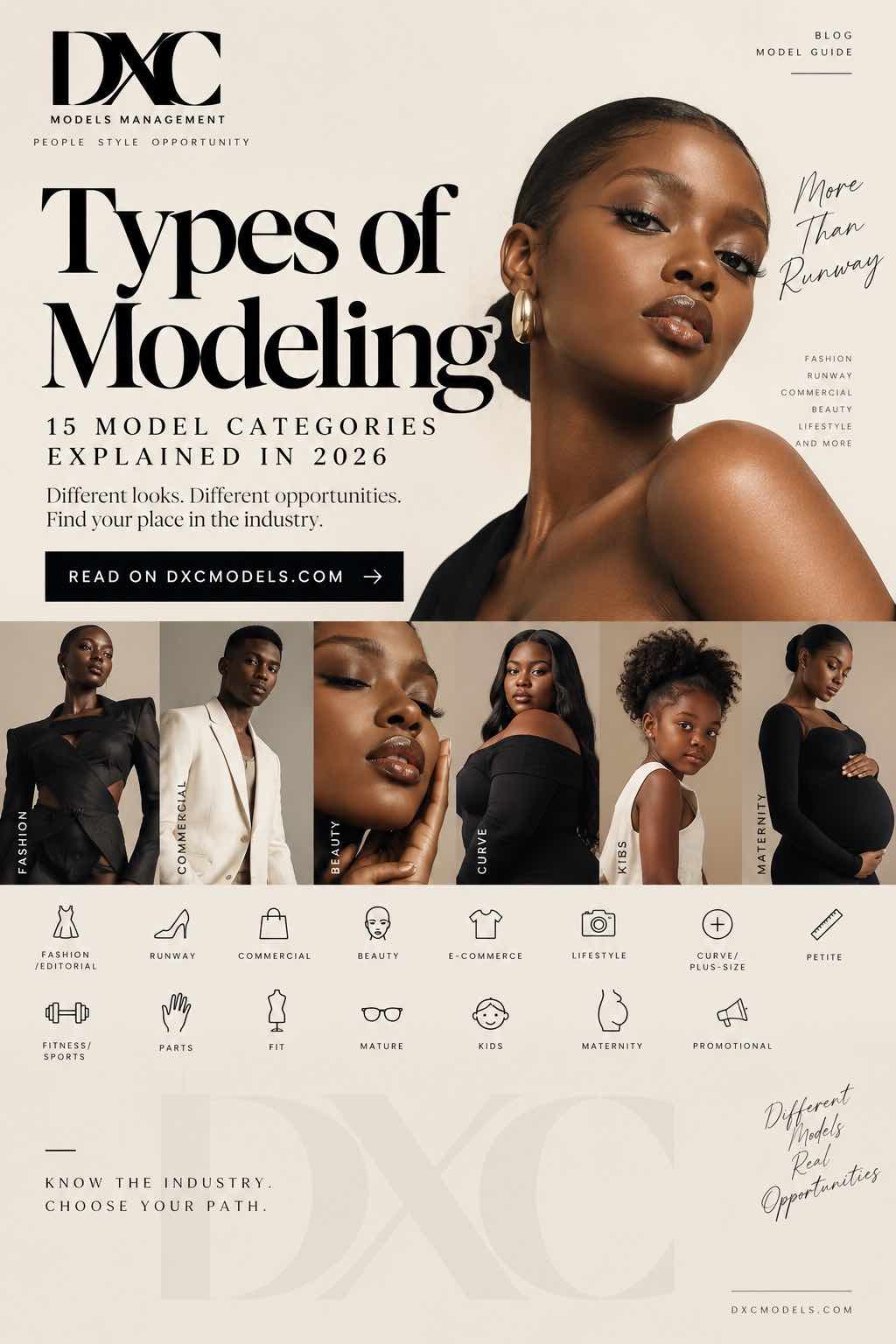
What are the different types of modeling? The modelling industry includes several categories, including fashion, runway, commercial, beauty, e-commerce, lifestyle, curve, petite, fitness, parts, fit, mature, kids, maternity and promotional modelling. Each category has different clients, skills and casting requirements.
One of the biggest mistakes beginners make is thinking there is only one way to look like a model.
There isn’t.
The model selected to walk a designer’s runway may be completely different from the person chosen for a bank advertisement.
The model used for a skincare close-up may not fit the same brief as someone modelling sportswear.
A children’s clothing company obviously needs different talent from a luxury menswear designer.
You do not need to fit every type of modeling. You need to understand which parts of the industry are most realistic for you.
Many professional models also work across more than one category.
Someone might do commercial, beauty and e-commerce work.
Another model may combine runway and editorial.
A curve model may also work in beauty, commercial advertising and lifestyle campaigns.
So think of these categories as different markets within modelling, not permanent boxes that every model must remain inside.
What Are the Main Types of Modeling?
The 15 common model categories we will explain are:
- Fashion and editorial modelling
- Runway modelling
- Commercial modelling
- Beauty modelling
- E-commerce modelling
- Lifestyle modelling
- Curve and plus-size modelling
- Petite modelling
- Fitness and sports modelling
- Parts modelling
- Fit modelling
- Mature modelling
- Kids modelling
- Maternity modelling
- Promotional modelling
1. Fashion and Editorial Modeling
Fashion and editorial modelling focuses strongly on fashion, styling, visual storytelling and creative image-making.
Models may appear in:
- Fashion magazines
- Designer editorials
- Creative fashion shoots
- Lookbooks
- Fashion campaigns
- Conceptual photography
Clients may care about:
- Distinctive appearance
- Strong posing ability
- Body awareness
- Ability to communicate mood
- Understanding creative direction
- Versatility in front of the camera
Editorial modelling is often more experimental than mainstream commercial advertising.
The objective may be to communicate an artistic idea rather than simply make a product look relatable.
Who hires fashion and editorial models?
Fashion designers, magazines, photographers, stylists, creative directors and fashion publications.
Does height matter?
It can, particularly where fashion samples or traditional high-fashion standards are involved, but editorial photography itself can be more flexible depending on the concept.
2. Runway Modeling
Runway modelling involves presenting clothing and accessories during a live fashion show.
The model’s job is to help the audience understand how the designer’s clothes look and move on the body.
Runway models need:
- Strong posture
- Balance
- Controlled walking
- Clean turns
- Timing
- Garment awareness
- Ability to take direction quickly
Height and measurements are often more important in runway casting because designers may already have fixed sample garments.
However, every fashion show has its own brief.
DXC Note: There is no single height requirement that applies to every runway show. Always read the actual casting requirements.
For a complete breakdown, read What Is Runway Modeling? A Beginner’s Guide.
3. Commercial Modeling
Commercial modelling is one of the broadest areas of the industry.
Commercial models help brands advertise products, services and everyday experiences.
You may see commercial models in campaigns for:
- Banks
- Telecommunications companies
- Food brands
- Beverage companies
- Fintech businesses
- Healthcare companies
- Household products
- Hotels
- Technology companies
Commercial casting can include a much wider range of ages, appearances and body types than traditional runway modelling.
The important question is often:
Does this person look believable for the role?
A commercial model may need strong:
- Facial expression
- Acting ability
- Natural movement
- Personality
- Ability to take direction
This is why commercial models need more than poses.
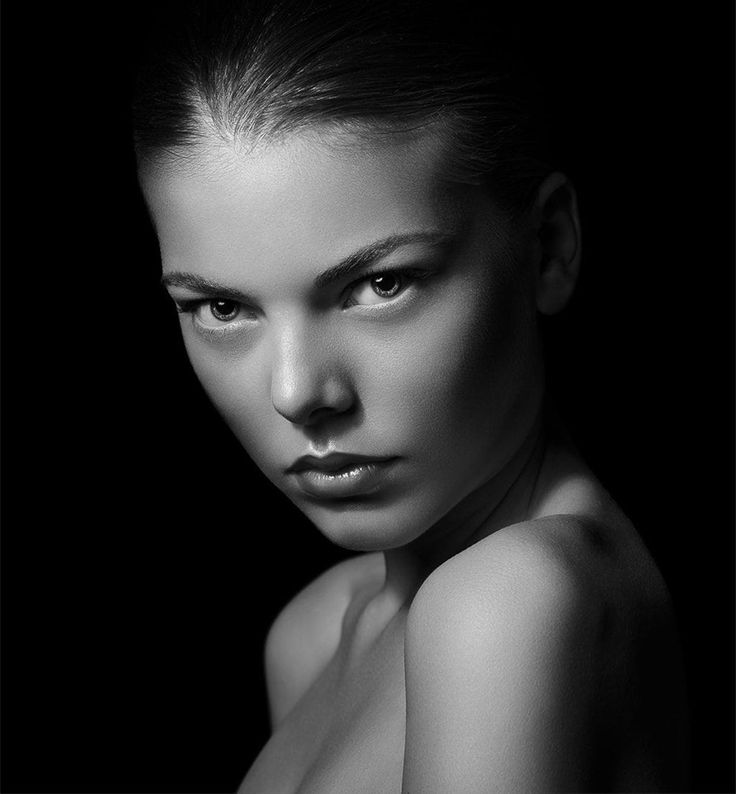
4. Beauty Modeling
Beauty modelling focuses heavily on the face, skin, hair or other close-up features.
Beauty models may work for:
- Skincare brands
- Makeup companies
- Hair brands
- Jewellery companies
- Beauty publications
- Cosmetic campaigns
The camera may be extremely close.
That means small movements matter.
Beauty models often need:
- Strong facial control
- Eye expression
- Good profile
- Comfort with close framing
- Controlled hand placement
- Ability to remain still when required
Height may be much less important than it would be for traditional runway work.
5. E-Commerce Modeling
E-commerce models help online businesses show products clearly enough for customers to make buying decisions.
A retailer may need models for:
- Website product pages
- Online catalogues
- Social commerce
- Product videos
- New collection drops
The model may need to show:
- Front of the garment
- Side view
- Back view
- Fit
- Movement
- Important product details
E-commerce modelling is often less about dramatic posing and more about consistency.
A model who can photograph twenty outfits efficiently while keeping the product clear can be extremely valuable.
This is also one of the areas where brands may book the same model repeatedly.
6. Lifestyle Modeling
Lifestyle modelling is designed to make products or services feel natural, relatable and connected to everyday life.
You might be asked to look like:
- A student
- A young professional
- A parent
- A hotel guest
- A couple
- A group of friends
- A traveller
- A restaurant customer
The final image should often feel like a real moment rather than an obvious pose.
That makes natural expression and interaction particularly important.
Lifestyle modelling frequently overlaps with commercial modelling.
7. Curve and Plus-Size Modeling
Curve modelling represents customers and fashion markets outside traditional straight-size sample ranges.
There is no single universal clothing size that defines every curve model across every market.
Different agencies, designers and clients use different requirements.
Curve models may work in:
- Fashion
- E-commerce
- Beauty
- Commercial advertising
- Lifestyle campaigns
- Bridal campaigns
- Runway
The professional requirements still apply.
A curve model needs to understand posing, movement, expression and how to present products effectively.
Curve modelling is a category, not an excuse for lower professional standards.
8. Petite Modeling
Petite modelling generally refers to models who are shorter than the traditional height range often associated with high-fashion runway work.
That does not mean shorter models cannot work professionally.
Petite models may find opportunities in:
- Commercial advertising
- Beauty
- E-commerce
- Lifestyle
- Parts modelling
- Petite fashion brands
The important thing is understanding where height actually matters and where it does not.
Not being tall enough for one runway casting does not mean you are too short for the entire modelling industry.
9. Fitness and Sports Modeling
Fitness and sports models represent active products, services and lifestyles.
Clients may include:
- Sportswear companies
- Fitness brands
- Gyms
- Wellness companies
- Sports equipment brands
- Advertising agencies
Some briefs require genuine physical ability.
If the campaign needs someone playing tennis, running, swimming or lifting weights, the production may prefer a model who can actually perform the activity convincingly.
Skills can therefore become part of your commercial value.
Do not claim a sport you cannot actually perform.
10. Parts Modeling
Parts models are hired specifically for individual body parts.
For example:
- Hands
- Feet
- Legs
- Hair
- Teeth
- Lips
- Eyes
A jewellery company may need a hand model.
A shoe company may focus on feet.
A toothpaste campaign may need a strong smile.
A hair brand may need healthy hair.
Parts models require precision because the camera may be focused entirely on a small area.
11. Fit Modeling
Fit modelling is very different from posing for a campaign.
A fit model works with designers and clothing manufacturers while garments are being developed.
The model acts as a consistent human reference for how clothing fits and feels.
The designer may check:
- Garment length
- Ease of movement
- Waist placement
- Sleeve length
- Comfort
- Proportions
Measurements are extremely important because the model needs to remain within the size specification the company is developing around.
A fit model does not necessarily need to appear publicly in the final campaign.
12. Mature Modeling
Mature modelling involves older adult talent representing products, services and lifestyles relevant to different age groups.
There is no single age at which somebody suddenly becomes a mature model.
It depends on the client’s intended audience and playing age.
Mature models may appear in:
- Healthcare advertising
- Financial campaigns
- Travel
- Fashion
- Beauty
- Family advertising
- Lifestyle campaigns
Commercial brands need people representing many stages of life.
Modelling is not automatically finished because someone is no longer 21.
13. Kids Modeling
Kids modelling involves children appearing in age-appropriate fashion and commercial campaigns.
Children may be booked for:
- Clothing
- Food advertising
- Family campaigns
- Education brands
- Toys
- Healthcare
- Television commercials
- Lifestyle advertising
For children, personality and ability to cooperate on set can be just as important as appearance.
Parents and guardians also play an important role.
Children’s modelling should be age-appropriate, properly supervised and balanced with the child’s wellbeing, education and normal life.
14. Maternity Modeling
Maternity models are pregnant models hired for campaigns where pregnancy is relevant to the product or story.
Clients may include:
- Maternity fashion brands
- Healthcare companies
- Baby brands
- Family lifestyle campaigns
- Parenting products
- Hospitals and health services
The pregnancy itself is part of the casting requirement.
Productions should also consider the model’s comfort, safety and working conditions appropriately.
15. Promotional Modeling
Promotional models combine presentation with direct interaction at live campaigns and events.
They may work at:
- Product launches
- Exhibitions
- Mall activations
- Trade shows
- Brand events
- Sampling campaigns
- Experiential marketing activities
The role may involve:
- Welcoming consumers
- Demonstrating products
- Answering basic questions
- Distributing samples
- Taking photographs
- Encouraging participation
Good communication and personality can therefore matter just as much as appearance.
Is Influencer Modeling a Type of Modeling?
This is where the terminology often becomes confusing.
A model, content creator and influencer can sometimes be the same person.
But they provide different types of value.
A model is primarily hired for their ability to perform visually for a campaign.
A creator is hired to produce content.
An influencer is valued partly because of access to an audience.
A person may do all three, but follower count does not automatically create modelling ability.
We explain this distinction in Model vs Creator vs Influencer.
Which Type of Modeling Is Best for Beginners?
There is no single best category for every beginner.
Your strongest category depends on:
- Your current appearance
- Your height
- Your measurements
- Your age or playing age
- Your movement
- Your facial expressions
- Your personality
- Your skills
- Your location
- The market around you
A beginner who is not suited to traditional runway work may be excellent commercially.
Someone with strong facial features may naturally perform well in beauty.
A highly athletic person may fit sports campaigns.
A child with an expressive personality may suit commercial kids work.
The objective is not to force yourself into the category you think sounds most prestigious.
It is to find where you are most commercially useful.
Do You Have to Choose Only One Type of Modeling?
No.
Many models work across several categories.
For example:
A commercial model may also work in beauty and lifestyle campaigns.
A runway model may also shoot fashion editorials.
A curve model may work in e-commerce, commercial and bridal campaigns.
A fitness model may appear in mainstream commercial advertising too.
Versatility can be valuable.
But versatility does not mean pretending you fit every casting.
What Type of Modeling Does Not Require Height?
Height tends to matter most in traditional runway and some fashion casting.
Categories where height may be much less restrictive can include:
- Commercial modelling
- Beauty modelling
- Lifestyle modelling
- Parts modelling
- Some e-commerce work
- Promotional modelling
- Some fitness campaigns
The individual client’s brief still decides.
Can You Model If You Are Not Skinny?
Yes.
The modelling industry serves many different customers and products.
Traditional high-fashion sample sizing is only one part of the market.
Curve fashion, commercial advertising, lifestyle, beauty, e-commerce, fitness, maternity and other categories can require different body types.
The better question is not:
“Do I have the one correct model body?”
It is:
“Which market is looking for someone like me?”
Can Short Models Get Modeling Jobs?
Yes.
Being shorter than traditional runway requirements does not remove somebody from commercial, beauty, lifestyle, e-commerce, parts or many other types of work.
Again, the specific brief determines whether height is relevant.
Which Types of Modeling Pay the Most?
There is no category that automatically guarantees the highest income.
A model’s earnings can depend on:
- Client
- Campaign budget
- Usage
- Territory
- Duration
- Exclusivity
- Experience
- Agency representation
- Number of shoot days
- Market
A commercial advertising campaign with wide usage may sometimes pay more than a fashion editorial.
A recurring e-commerce client can provide more consistent work than occasional runway bookings.
Do not choose a category based only on what you assume sounds expensive.
How Do You Know Which Type of Modeling Fits You?
Start with an honest professional assessment.
1. Know your real height and current measurements.
2. Take clean current polaroids.
3. Look at your natural strengths.
4. Understand what clients in each category actually require.
5. Develop the skills relevant to the categories you want.
6. Apply for castings you genuinely fit.
7. Pay attention to the type of work clients respond positively to.
You do not have to decide your entire career before your first casting.
Your strongest market can become clearer as you develop.
What Do You Need Before Applying for Model Jobs?
Regardless of category, most beginners benefit from having:
- Current polaroids
- Accurate measurements
- Clear full-length photograph
- Clean close-up
- Current location
- Short introduction video
- Walk video where relevant
- Professional contact information
Our guide to building a digital casting profile for models explains what to prepare.
Who Actually Hires These Different Types of Models?
Different categories lead to different clients.
Fashion designers may hire runway and editorial models.
Beauty companies may hire beauty models.
Online retailers may need e-commerce models.
Banks and telecom companies may need commercial talent.
Sports brands may need fitness models.
Children’s brands may need kids models.
Event campaigns may require promotional models.
This is why knowing your category helps you understand where your opportunities may actually come from.
Read Companies Looking for Models in Nigeria: Where Model Jobs Actually Come From.
What If You Don’t Fit Runway Requirements?
This deserves its own answer because many beginners incorrectly believe runway is the definition of modelling.
It isn’t.
If a runway casting requires 5’9″ and you are 5’5″, arguing with the brief will not make the sample garment change size.
But that particular rejection does not mean your modelling career is finished.
You may fit:
- Commercial work
- Beauty
- E-commerce
- Lifestyle
- Parts modelling
- Promotional campaigns
Understand your market instead of measuring your entire potential against one category.
Not tall enough for runway? Runway is one category. It is not the whole modelling industry.
Frequently Asked Questions About Types of Modeling
What are the main types of modeling?
Common types of modeling include fashion, editorial, runway, commercial, beauty, e-commerce, lifestyle, curve, petite, fitness, parts, fit, mature, kids, maternity and promotional modelling.
Which type of modeling is easiest to get into?
No professional modelling category is automatically easy. Commercial and lifestyle casting may accommodate a wider range of appearances than traditional high-fashion runway, but models still need to fit the individual brief and perform professionally.
What type of modeling is best for short models?
Shorter models may find opportunities in commercial, beauty, lifestyle, e-commerce, parts and promotional modelling, depending on the client’s requirements.
Can one model do different types of modeling?
Yes. Many professional models work across several categories. A model may combine commercial, beauty, lifestyle and e-commerce work, for example.
Do all models have to be tall?
No. Height is particularly relevant to traditional runway and some fashion jobs, but many commercial, beauty, lifestyle and other modelling opportunities do not use the same height requirements.
Do models need professional photos to start?
Not always. Many agencies and castings initially need clean current polaroids that clearly show what the model looks like. Read our guide on how to take modelling polaroids at home.
The DXC View
Too many aspiring models judge themselves using only one corner of the industry.
They hear runway.
They hear 5’9″.
They look at themselves.
And immediately conclude:
“Maybe I cannot model.”
That is the wrong conclusion.
The better question is:
“Which modelling market am I actually suited to?”
Understanding your category does not limit your career.
It helps you stop wasting energy chasing briefs that were never designed for you and start developing toward opportunities where you can genuinely compete.
Ready to Start Modeling in Nigeria?
If you are still at the beginning, understand the industry before chasing every casting you see.
Know your measurements.
Take proper polaroids.
Understand your likely categories.
Develop the right skills.
Then apply strategically.
Read our complete guide on how to become a model in Nigeria.
Find Your Place in the Industry
DXC Models works with aspiring and developing talent in Lagos through model development, professional guidance and suitable industry opportunities.