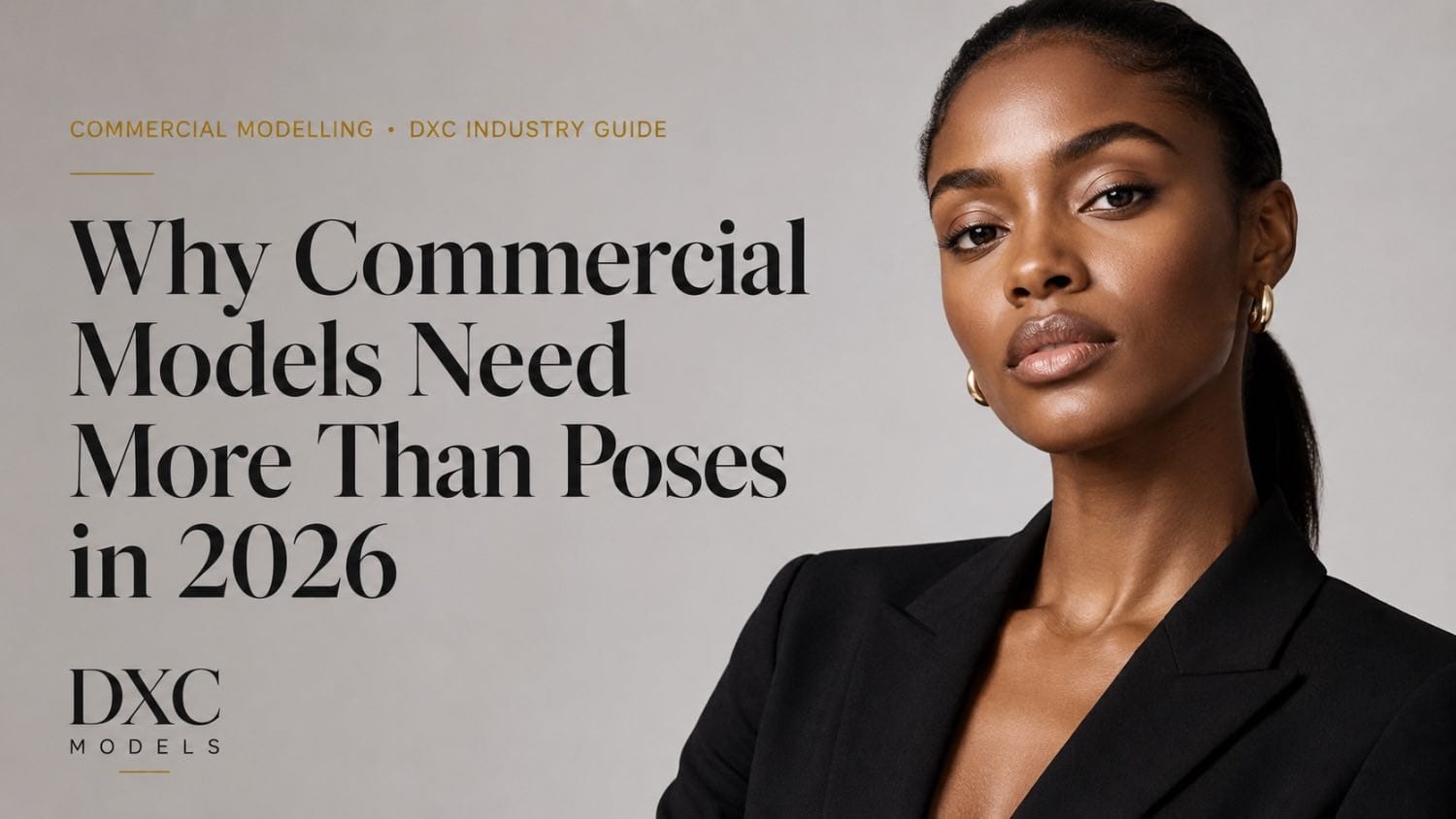
Commercial Modelling · DXC Industry Guide
Why Commercial Models Need More Than Poses in 2026
A model can know ten poses, turn beautifully, find the light and give a strong expression — and still struggle on a commercial set. Because commercial modelling is not simply about creating a beautiful photograph. It is about helping a brand communicate something.
DXC Models
Commercial Modelling Is Performance
Imagine a skincare campaign. The photographer may ask you to pick up the product, look at it, apply it naturally, turn towards the camera, smile and repeat the same action while maintaining continuity.
Then the client asks for a 15-second vertical video.
Suddenly, the model has to move naturally, understand timing, remember the product position and perhaps deliver a short line to camera.
That is commercial modelling. The pose is only one part of it.
01
You Need to Take Direction Quickly
On a professional set, instructions can change constantly: less smile, turn slightly, repeat the action more slowly, look at the product first, give more energy, hold that position, make it feel less posed.
A commercially useful model listens, adjusts and repeats without needing ten explanations.
Production time costs money. A model who understands direction quickly can sometimes be more valuable than someone who photographs beautifully but struggles to adapt.
02
You Need to Know How to Move
Some models become very comfortable creating still poses. Then the camera switches to video and everything changes.
Movement exposes things still photography can hide. How naturally do you walk? What do your hands do between poses? Can you sit without looking staged? Can you pick up a product without making the action feel rehearsed?
Commercial models should practise transitions, not only finished poses.
Record yourself moving between positions instead of only taking photographs. Watch the moments between the poses. That is often where your real camera confidence becomes visible.
03
Your Face Needs Range
Commercial campaigns often require emotion. Not dramatic acting, but believable emotion.
- A bank advert may need reassurance.
- A beverage campaign may need excitement.
- A family campaign may require warmth.
- A beauty campaign may require confidence or softness.
- A fashion campaign may require attitude.
If every photograph produces exactly the same expression, your range becomes limited.
04
You Need to Interact With Products Naturally
If you are advertising a phone, the phone is not simply a prop you can forget about.
If you are modelling jewellery, the jewellery needs to remain visible. If you are holding a drink, your hand should not cover the logo. If you are applying skincare, the movement needs to feel natural while still allowing the product and your face to remain camera-ready.
Commercial models need product awareness.
Commercial Modelling Principle
05
Video Confidence Is Becoming More Important
Campaigns no longer live only on billboards and magazine pages.
Brands increasingly need content for Instagram Reels, TikTok, digital advertising, websites, product demonstrations and other forms of short-form video.
That does not mean every model needs to become an influencer.
We explained that distinction in
Do Models Need Social Media in 2026? What Nigerian Brands Are Actually Looking For
.
But a model who is comfortable on video gives a client another level of versatility.
- Look into a lens naturally.
- Move without freezing.
- Repeat actions consistently.
- Deliver a simple line to camera.
- Maintain energy between takes.
- Remain aware of framing and the product.
06
Speaking Can Be a Commercial Skill
Some campaigns require only one sentence. Others may involve a testimonial-style line, a reaction, a product introduction or content designed to feel natural on social media.
A model who has never practised speaking to camera can suddenly become stiff the moment dialogue is introduced.
Start simply. Record yourself speaking naturally to the lens.
The goal is not to sound like a television presenter. The goal is to look and sound believable.
07
Commercial Models Need Personality
Commercial advertising often needs the audience to connect with the person inside the campaign.
That does not mean becoming loud or performing constantly. It means allowing enough personality to come through that the image or video feels human.
A model simply holding a drink is one thing. A person who appears to genuinely enjoy that drink can create a completely different advertisement.
08
Learn Continuity
Imagine a director films you picking up a bottle with your right hand while your elbow rests on the table.
They move the camera and ask you to repeat the action.
If you suddenly use your left hand and move the bottle somewhere else, the footage may not cut together properly.
Commercial shoots often require models to repeat the same action several times from different angles.
Consistency makes the production and editing process easier.
09
Understand the Brief Before You Perform
Do not automatically give “model face” simply because a camera appears.
Understand what the campaign is trying to communicate.
- Who is the audience?
- What is the product or service?
- What emotion should the campaign create?
- Should you feel aspirational or relatable?
- Energetic or calm?
- Luxurious or everyday?
Understanding the campaign objective changes how you perform.
10
Professionalism Is Still a Commercial Skill
A model can have excellent movement and still lose opportunities because of poor professionalism.
Commercial productions need talent who arrive on time, communicate properly, follow wardrobe instructions, respect call times, listen and remain patient during long setups.
Photographers remember models who are easy to work with. Agencies remember them. Clients remember them.
Can Models Actually Practise These Skills?
Yes. You do not need a professional studio every day.
Choose a simple product at home. Record yourself walking into frame, picking it up, looking at it, using it, smiling, turning towards the camera and delivering one simple sentence.
Then watch the video back.
Do you look natural? Are your movements stiff? Are you rushing? Do your hands look uncomfortable? Are you aware of the product? Does your expression match what you are doing?
That five-minute exercise can teach you things another fifty posed selfies may not.
The Model-Creator Crossover
This does not mean every commercial model should become a content creator.
A model performs the visual brief. A creator produces content. An influencer brings an audience and distribution.
Sometimes one person can do all three.
But brands and agencies should define those expectations properly before the booking.
For brands trying to understand the difference, read
Model vs Creator vs Influencer: What Does Your Brand Actually Need?
.
Brands Should Cast for Ability, Not Just Appearance
If your campaign requires product interaction, video, dialogue, movement, family chemistry, comedy or natural lifestyle performance, tell the agency from the beginning.
A strong casting brief helps the agency send talent with the appropriate skill set rather than simply sending attractive faces.
This is also why commercial casting should not always use the same criteria as runway casting.
The future commercial model is not simply someone who knows where to place their hands. The strongest talent increasingly understands movement, expression, direction, product interaction, video and professionalism.
Posing Gets You the Photograph. Performance Gets You the Campaign.
A strong pose still matters.
But commercial modelling begins when the model can move beyond the pose.
Learn to listen. Learn to move. Learn to communicate. Learn to interact with products. Learn to become comfortable on video.
Most importantly, learn to understand what the brand is trying to make the audience feel.
Because commercial modelling is not simply about being seen.
It is about making the message believable.
Build More Than a Pose
Explore model development, industry education and official talent opportunities through DXC Models.