MODELING CAREERS • AGE • NIGERIA
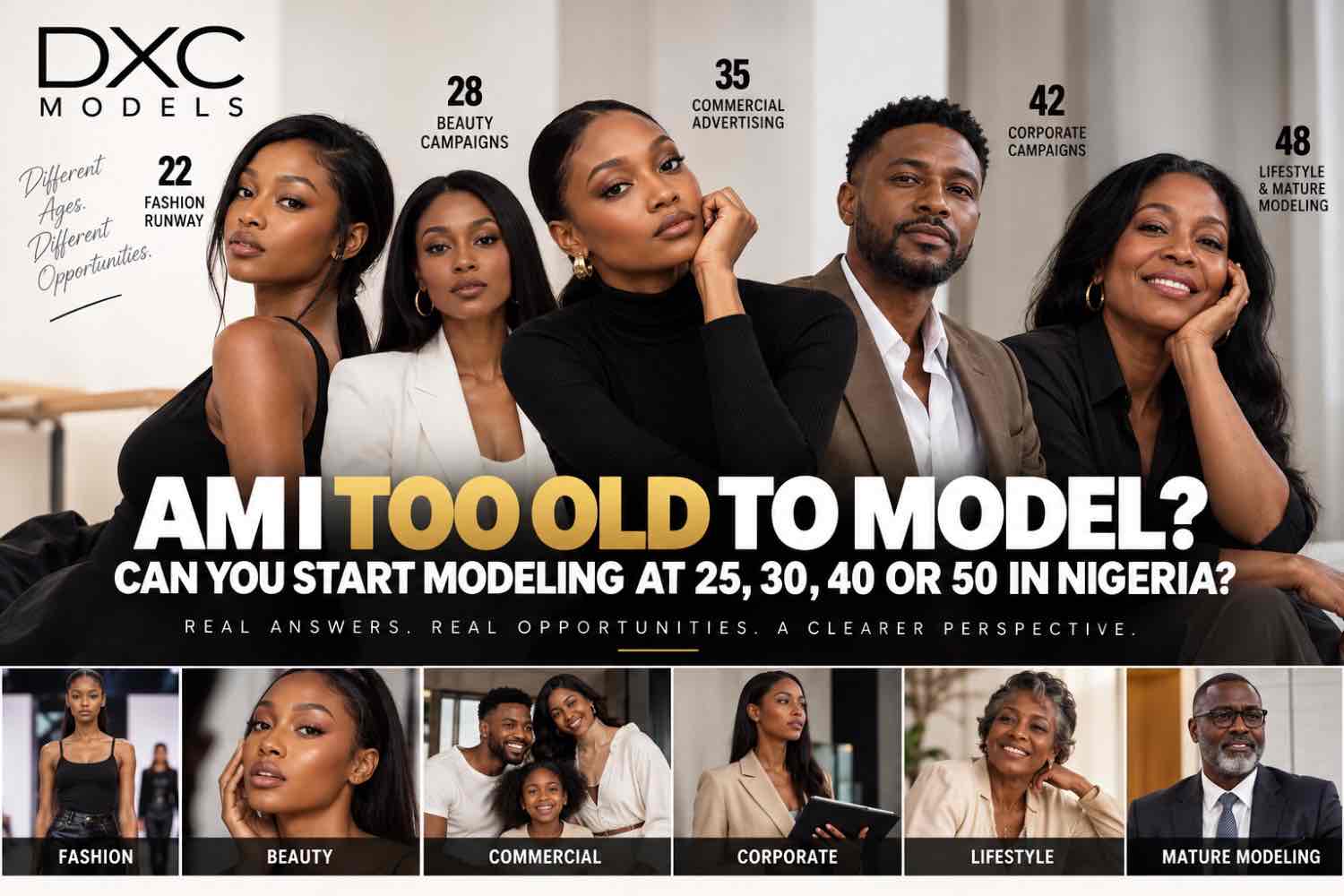
Am I Too Old to Model? Can You Start Modeling at 25, 30, 40 or 50 in Nigeria?
If you have ever searched “am I too old to model?” because you are 25, 30, 35, 40 or even older, the answer is not simply yes or no.
The more useful question is: what kind of modelling are you trying to do?
Someone trying to enter international high-fashion runway at 35 is dealing with a very different market from someone being considered for a Nigerian bank campaign, healthcare advert, beauty commercial, family shoot or lifestyle campaign.
That difference matters because modelling is not one job.
And age does not affect every part of the business in the same way.
So, Are You Too Old to Model?
Not automatically.
But we are also not going to tell you that age means absolutely nothing.
It does.
Some parts of fashion still develop models very young, particularly where an agency is trying to build a long international runway and editorial career around a new face.
Other parts of the modelling business need adults of practically every age because the people buying the products being advertised are not all 19 years old.
At 30, you may not be competing for the same jobs as an 18-year-old model. That does not mean there are no modelling jobs for a 30-year-old.
Something Interesting Just Happened During Fashion Month
Vogue’s Spring 2027 breakout-model list included nine models ranging from 18 to 44 years old.
One of them, Katrina Robinson, is 44 and appeared this season for Proenza Schouler, Diotima, Heirlome and Lacoste. The same list included 26-year-old Esther Kim and 19-year-old Lagos model Nimota Daudu.
That does not mean every 44-year-old can suddenly walk into a major fashion house tomorrow.
It does show something more useful: even at the highest levels of fashion, there is not one single age that describes everyone currently getting attention.
And outside high fashion, the range becomes much wider.
Starting at 25 Is Not Late
We hear this one more often than you might expect.
Someone is 24, 25 or 26 and already feels as though they missed the modelling train because they keep seeing 17, 18 and 19-year-old new faces online.
For many forms of modelling, 25 is not remotely the end.
Commercial, beauty, e-commerce, lifestyle, advertising and certain fashion opportunities can all use models in their mid and late twenties.
What may change is how an agency positions and develops you.
If your only goal is to become a teenage-style international runway new face, then yes, starting younger can matter.
But if your goal is simply to work professionally as a model, there are more possibilities than that one path.
What About Starting Modeling at 30?
Thirty is where people often start eliminating themselves before anybody in the industry has even assessed them.
They think:
“Models are young.”
Then they stop there.
But look around at the advertising Nigerians see every day.
Banks advertise to adults.
Insurance companies advertise to adults.
Healthcare brands need adults.
Property companies need people who can believably look like homeowners, executives, couples and parents.
Telecoms, food companies, supermarkets, airlines, hotels, fintech brands and consumer-goods companies regularly build campaigns around everyday people at different stages of life.
A brand casting a 32-year-old mother is not necessarily searching for somebody who can convincingly pass for 19.
They may actually want someone who looks 32.
Can You Model at 40 or 50?
Yes, there are modelling markets that use people in their 40s, 50s and beyond.
Again, the category becomes important.
A mature model may be suitable for lifestyle campaigns, healthcare advertising, financial services, corporate campaigns, hospitality, family advertising, beauty, fashion aimed at older consumers and other commercial projects.
Imagine a television commercial built around three generations of a Nigerian family.
Someone has to play the parents.
Someone has to play the grandparents.
Those are casting roles too.
The idea that every professional model must look 20 comes largely from people treating runway fashion as though it represents the entire modelling business.
It does not.
Fashion Modeling and Commercial Modeling Are Different Markets
This is probably the most important thing to understand if you are entering modelling later.
Fashion modelling can be very specific about things like height, measurements, proportions, age, look and current creative direction.
Commercial modelling is often driven by a different question:
Can the audience believe this person?
A detergent brand casting a family may need a believable mother.
A private hospital campaign may need someone who looks like a working professional in their forties.
A pension company probably does not need every person in its advertising to look like a university student.
That is why understanding the different types of modelling is far more useful than simply asking whether you are “too old.”
But Does Starting Later Make Some Things Harder?
Yes.
And there is no reason for us to pretend otherwise.
If you are 35 and your only target is the traditional international high-fashion development route normally built around much younger new faces, your options may be narrower.
Some agencies also have particular age brackets for the kind of talent they currently want to develop.
Individual castings can specify exact age ranges too.
If a brief asks for models aged 18 to 23, being 34 does not become irrelevant because someone on TikTok told you “age is just a number.”
You are simply not the person that particular client is casting.
That is different from saying there is no modelling market for you.
The Mistake Is Trying to Compete in the Wrong Category
Imagine two aspiring models.
One is 19, 5’10”, lean and interested in international runway.
The other is 38, polished, expressive on camera and looks believable as a senior professional or mother.
Trying to judge both people using the same criteria makes no sense.
They may not even be competing for the same clients.
The 38-year-old does not need to become a worse version of the 19-year-old.
She needs to understand where her own look can work.
What Brands May Look for in Older Models
The qualities can vary enormously depending on the campaign, but commercial clients frequently care about things such as:
- Natural expressions
- Confidence in front of the camera
- Ability to take direction
- Believability
- Personality
- Professional behaviour
- Clear speech where dialogue is involved
- Good grooming
- Availability and reliability
You may have spent 15 years working in an office and think that makes you less suitable for modelling.
For the right campaign, being able to naturally carry yourself like an experienced professional may be exactly why you work.
You Do Not Have to Pretend to Be Younger
Please do not remove five years from your age because you think an agency will like you more.
And do not submit photographs that are eight years old because you prefer how you looked then.
Casting works much better when everybody knows who they are actually considering.
If a client needs a model who looks 40, looking 40 is not a disadvantage.
It is the brief.
What Pictures Do You Need if You Are Starting Later?
You do not need to start with an expensive portfolio.
The same basic principle DXC gives many new models applies here: begin with clear, current pictures that allow someone to properly assess you.
That usually means:
- A clear headshot
- A full-length picture
- A side or profile view where requested
- Natural lighting
- Simple clothing
- No heavy filters
- Your current appearance
You can learn more in our guide on how to take modelling polaroids at home.
Do You Need Training?
Not every mature model needs runway training.
That depends on the category you are pursuing.
Someone interested in fashion shows may need runway development.
Someone pursuing commercial work may benefit more from camera confidence, expressions, movement, posing, casting preparation and learning how to take direction naturally.
This is why development should have a purpose.
Training should solve something.
It should not simply be a box everyone is forced through regardless of what type of modelling they want to do.
Should You Apply to an Agency at 30 or 40?
You can, but research what that agency actually represents.
Some agencies are heavily fashion-focused.
Others work across commercial talent, lifestyle, families, creators, curve models or more diverse age groups.
Do not assume rejection from one agency means “the modelling industry has rejected you.”
It may simply mean you do not fit that agency’s current board or market.
The same principle applies at any age.
What If You Have No Experience?
Being older does not magically mean you should already know how modelling works.
If this is your first time, you are still a beginner.
Learn how castings work.
Learn your measurements.
Learn how to submit yourself properly.
Learn the difference between fashion, commercial and lifestyle work.
Learn how model rates and image usage work before accepting jobs.
DXC’s guide to becoming a model in Nigeria is a good starting point for the wider process.
Can Social Media Help Older Aspiring Models?
Yes, but you do not need to suddenly behave like a 19-year-old influencer.
A useful social profile can simply show that you photograph well, understand presentation, have personality and look like the person you claim to be.
Depending on the kind of modelling you want, lifestyle photographs, clean portraits, movement and short videos can help people understand your presence.
But follower count is not a substitute for being suitable for a casting brief.
What About Height?
Age and height are two separate questions.
Traditional runway opportunities can have fairly narrow height expectations regardless of whether you are 19 or 29.
Commercial work can be much more flexible because the casting is often based on the character or consumer being represented.
We break that down separately in How Tall Do You Have to Be to Model in Nigeria?
The Question DXC Would Ask You Instead
Rather than:
“Am I too old?”
we would rather know:
How old are you, what do you look like, what kind of modelling interests you, what market suits you and what do you currently need to develop?
That gives us something useful to work with.
Age alone does not tell the whole story.
REALISTIC EXPECTATION:
Starting modelling at 30, 40 or 50 does not mean you will have the same career path as someone scouted at 16 for international fashion development.
It also does not mean there is no professional modelling market available to you.
The goal is to identify the category in which your age, appearance and skills make sense rather than trying to force yourself into somebody else’s lane.
Frequently Asked Questions
Is 25 too old to start modeling?
No. Twenty-five can still work across many modelling categories, including commercial, beauty, lifestyle, e-commerce and some fashion work. Your suitability will depend on the specific market and brief.
Can I start modeling at 30?
Yes. Thirty does not automatically disqualify you from professional modelling. Commercial and lifestyle clients in particular may require models in their thirties and older.
Can a 40-year-old become a model?
Yes. Campaigns may need adults in their forties for lifestyle, corporate, healthcare, family, financial, fashion, hospitality and other advertising roles. Opportunities will depend on your look and the client’s brief.
Can I model at 50?
There are modelling and advertising opportunities for people in their fifties and beyond, particularly where brands need mature consumers, parents, grandparents, professionals or age-specific lifestyle talent.
Do modeling agencies accept older models?
Some do and some focus on narrower markets. Research the type of talent an agency represents before applying. An agency declining your application does not necessarily mean you are too old to work as a model.
Is there an age limit for commercial modeling?
There is no single age limit covering every commercial modelling job. Individual briefs may specify an age or age range based on the character or target customer a brand wants to represent.
Do I need experience to start modeling after 30?
No. You can still start as a beginner. What matters is learning the professional basics, building the right material and developing the skills required for the kind of work you want to pursue.
Think You Started Too Late?
Do not rule yourself out before you have even been assessed.
DXC Models works with aspiring and developing talent in Lagos across different modelling categories. The first step is understanding where you realistically fit and what you need to develop.
Note: Modelling opportunities are always subject to individual casting requirements. Age, height, measurements, appearance, location and experience requirements can vary from one client or category to another. No assessment, training or agency representation guarantees bookings.